
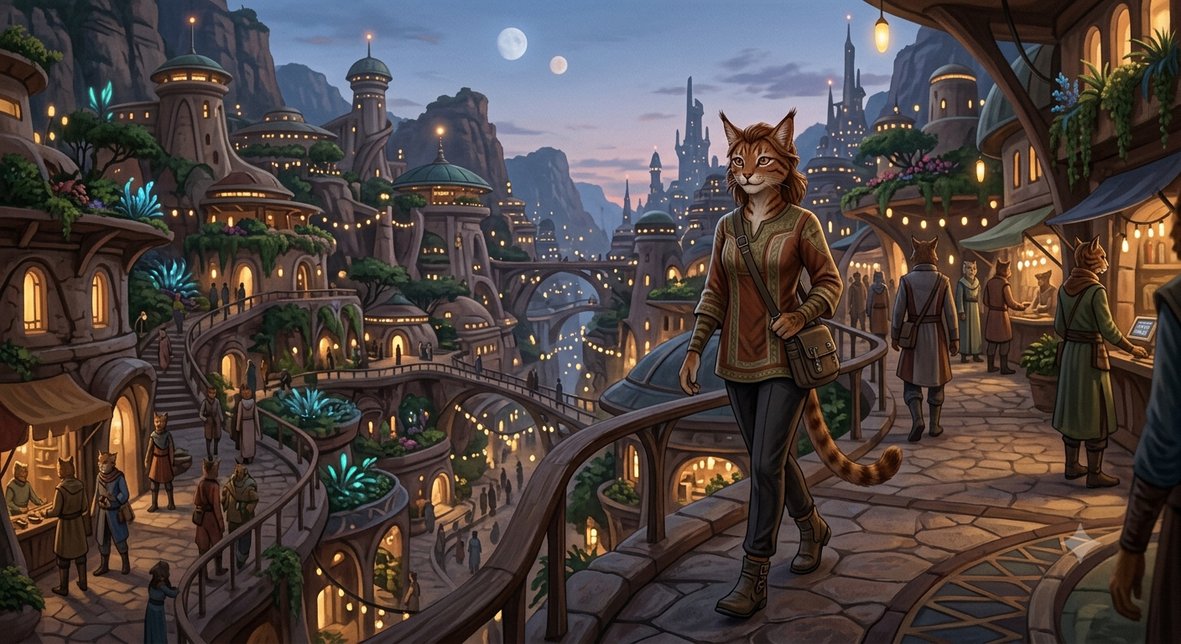
 The Caitians are not simply another Federation member species; they are a people whose political identity was forged in exile, sharpened by trauma, and ultimately redirected into a fierce, almost spiritual commitment to protecting other displaced cultures. Their championing of the El-Aurian diaspora in 2293 is not charity — it is memory.
The Caitian Flight from Kzin
The repression that preceded the exodus
For decades before the Federation ever encountered the Borg, the Caitians lived under the shadow of the Kzinti Imperium and its “Enhanced Kzinti” shock-breeds — engineered warriors bred for obedience, aggression, and racial supremacy.
The Kzinti viewed Caitians as:
politically unreliable
genetically “lesser”
economically exploitable
culturally contaminating
This produced a system of repression that Caitian historians later called the Quiet Subjugation:
forced labour quotas in Kzinti-controlled sectors
racialised surveillance of Caitian communities
restrictions on interstellar travel
cultural erasure campaigns, banning Caitian literature and ritual music
Enhanced Kzinti patrols used to intimidate Caitian settlements
The Enhanced Kzinti were the most feared: towering, gene-augmented enforcers whose presence alone could silence a district. Their existence is a key topic in Kzinti physiology and Kzinti society.
The refugee wave
By the mid-23rd century, tens of thousands of Caitians fled:
across disputed borders
through Orion-controlled smuggling routes
into Federation space via clandestine transports
They arrived as:
stateless persons
survivors of racial persecution
witnesses to Kzinti genetic militarisation
carriers of a cultural memory built on fear and endurance
This refugee identity became the core of Caitian political consciousness.
How Caitian trauma shaped their politicsCaitians developed a national ethos around three principles:
No people should face extinction alone.
Diasporas deserve protection equal to nations.
Refugees are not burdens — they are warnings.
This ethos made Caitians the Federation’s most vocal advocates for:
asylum rights
anti-trafficking laws
diaspora representation in the Federation Council
monitoring Orion Syndicate exploitation networks
Their experience with Kzinti oppression made them experts in identifying patterns of manipulation, coercion, and predation — especially from groups like the Orion Syndicate, whose tactics they had seen firsthand.
 2293: The El-Aurian Catastrophe
When the El-Aurians fled the Borg, the Caitians recognised the pattern instantly:
- sudden mass displacement
- cultural annihilation
- trauma carried across generations
- predatory criminal networks exploiting the chaos
- governments hesitant to intervene
The destruction of the Lakul and the tragedy of the Nexus were not abstract events to Caitians — they were echoes of their own history.
Why Caitians championed the El-Aurian protectorate
Caitian leaders argued that the El-Aurians were:
- a diaspora without a homeworld
- a culture defined by listening, memory, and trauma
- a people whose gifts (perception, empathy, intuition) made them vulnerable to exploitation
- at risk of being scattered, assimilated, or lost entirely
They pushed for a Federation Protectorate Charter, insisting that:
- El-Aurians needed legal protection
- their diaspora required cultural preservation
- their trauma demanded specialised support
- their abilities made them targets for intelligence agencies
This last point was crucial: Caitians knew how the Orion Syndicate manipulated refugees — and they knew the Tal Shiar would covet El-Aurians as interrogators, analysts, and empathic operatives. Their experience with Kzinti oppression made them uniquely sensitive to how intelligence services weaponise vulnerable populations.
Caitian advocacy in the Federation Council
Caitian delegates delivered speeches that became foundational texts in Federation refugee law. One famous line, often quoted, was:
“We were prey once. We will not allow others to be hunted.”
They argued that the El-Aurians were not merely survivors of the Borg — they were survivors of cosmic trauma, and their cultural gifts made them essential to the Federation’s moral fabric.
Their advocacy resulted in:
- the El-Aurian Cultural Preservation Mandate
- the Diaspora Protection Protocols of 2294
- the establishment of Caitian–El-Aurian joint refugee councils
- the creation of Federation trauma-response units staffed by both species
The Caitian–El-Aurian bond
Caitians saw in the El-Aurians:
- the same haunted eyes
- the same quiet grief
- the same fear of being forgotten
- the same determination to rebuild
El-Aurians, in turn, found Caitians to be:
- gentle but fierce
- empathetic but politically sharp
- survivors who understood the cost of silence
- allies who refused to let their story be erased
This bond became one of the most powerful interspecies alliances in Federation history.
The Caitians designed Cait to embody:
- the landscape of old Kzin
- the architecture of pre-Imperial Kzinti cities
- the ecology of their ancestral savannah world
- the cultural dignity they were denied
But crucially, Cait is not a replica — it is a restoration. A vision of Kzin without oppression, without racial supremacy, without Enhanced Kzinti patrols, without erasure.
This concept is central to Caitian diaspora politics.
Landscape: From African Savannah to Pampas
Old Kzin
Kzin was an old world, ecologically similar to the African savannah:
- tall grasses
- scattered acacia-like trees
- warm winds
- predator-prey ecosystems
- open horizons ideal for Caitian hunting traditions
It was a world of movement, sound, and scent — perfect for Caitian sensory culture.
Cait
Caitian planners chose a biome resembling the pampas of Argentina and South America:
- rolling grasslands
- wide plains
- long sightlines
- fertile soil
- gentle seasonal shifts
This environment preserved the feeling of Kzin while avoiding the harsher, more dangerous elements of their ancestral world.
Architecture: Recreating the “Old Glory” of Kzin
Caitian architects rebuilt the lost cities of Kzin — but in a way that reclaimed them from Kzinti domination.
1. Pre-Imperial Kzinti Architecture Reimagined
They reconstructed:
- sandstone towers with curved buttresses
- wide plazas designed for communal gatherings
- tall, narrow windows for wind-song acoustics
- domed civic halls inspired by ancient Kzinti meeting places
But they removed:
- Kzinti war iconography
- racial supremacy symbols
- imperial banners
- intimidation architecture used by Enhanced Kzinti patrols
2. Caitian Cultural Integration
They added:
- communal scent gardens
- elevated walkways for feline movement
- sun-platforms for meditation
- memory-court chambers built into civic centres
These structures became part of Caitian memory courts.
3. Diaspora Reconstruction Zones
Entire districts were built as architectural memory projects, where Caitians could walk through:
- replicas of ancestral villages
- reconstructions of pre-occupation temples
- restored hunting grounds
- museums of Kzinti oppression and Caitian resistance
These zones serve as both cultural education and trauma healing.

Political Purpose: Cait as a Statement
Cait is a political message to the galaxy:
“This is what Kzin could have been — and what we will never allow to be erased.”
Caitians use the world as:
- a diaspora capital
- a refugee sanctuary
- a protectorate model for El-Aurians
- a memory-world for trauma preservation
- a cultural rebirth free from Kzinti hierarchy
This ties directly into the Protectorate Bloc and their advocacy for the El-Aurians.
Ecological Engineering: Rebuilding Ancestral Life
Caitian ecologists recreated:
- ancestral prey species (non-sentient analogues)
- grassland migration patterns
- wind-song corridors
- scent-marker trees
- nocturnal soundscapes resembling old Kzin nights
These ecological reconstructions help maintain Caitian sensory culture and support memory-court rituals.
Social Reconstruction: A World Without Predators
Cait is designed to be the opposite of Kzin’s oppressive society:
- no racial hierarchy
- no genetic militarisation
- no Enhanced Kzinti enforcers
- no surveillance
- no cultural erasure
Instead, Cait is built on:
- communal governance
- diaspora solidarity
- trauma-informed law
- protectorate ethics
- interspecies refuge
This is the philosophical core of Caitian legal philosophy.

Why Cait Matters
Cait is not nostalgia — it is political reclamation.
It is:
- a rebuke to Kzinti oppression
- a sanctuary for Caitian identity
- a model for how worlds can be rebuilt after trauma
- a symbol of diaspora sovereignty
- a foundation for protectorate politics
- a living memory of what was lost and what was saved
Cait is the Caitians’ answer to history: “We rebuild what you tried to destroy — and we make it better.”
Core Principle: Architecture as Restored Ancestry
Caitian architectural philosophy begins with the belief that built space must preserve memory. Every structure is designed to evoke:
- the savannah openness of old Kzin
- the rolling pampas of Cait
- the pre-Imperial Kzinti aesthetic before racial hierarchy
- the Caitian diaspora’s reclaimed dignity
This philosophy is inseparable from Caitian diaspora politics, which treat architecture as a civic tool for cultural survival.
The Three Foundations of Caitian Architecture
1. Landscape Integration (“The World is the First Building”)
Caitian architects design structures that merge with the pampas:
- low, sweeping forms that follow grassland contours
- wide terraces that mimic savannah horizons
- wind-channel corridors that recreate Kzin’s ancient soundscapes
- scent-gardens that anchor memory through olfactory cues
This reflects the Caitian belief that landscape is identity, a principle tied to Caitian ecological reconstruction.
2. Memory Reconstruction (“We Build What Was Stolen”)
Caitian cities intentionally recreate the lost glory of pre-Imperial Kzin:
- sandstone towers with curved buttresses
- domed communal halls inspired by ancient Kzinti meeting places
- plazas designed for ritual gatherings and storytelling
- elevated walkways for feline movement and vantage
But they remove all elements associated with oppression:
- no imperial iconography
- no intimidation architecture
- no hierarchical spatial design
- no Enhanced Kzinti militaristic motifs
This architectural cleansing is central to Caitian collective trauma mandates.
3. Diaspora Functionality (“Buildings Must Heal”)
Caitian architecture is designed to support diaspora life:
- memory-court chambers integrated into civic centres
- trauma-healing spaces with controlled sound and scent
- communal rooftops for sun-meditation
- multi-species refuge zones for protectorate populations
These spaces directly support Caitian memory courts and Protectorate Bloc activities.

Architectural Motifs and Symbolism
Wind-Song Channels
Narrow slits in buildings that create harmonic tones when wind passes through.
Symbolism: the voices of ancestors carried across the plains.
Scent-Stone Niches
Small alcoves holding aromatic minerals or plants.
Symbolism: memory preserved through scent, a core Caitian sensory tradition.
Sun-Platforms
Raised terraces for communal basking and meditation.
Symbolism: reclaiming the open skies of old Kzin.
Grassline Architecture
Buildings whose roofs blend into the pampas grass.
Symbolism: diaspora unity with the land.
These motifs reinforce Caitian legal philosophy, where memory and justice intertwine.
Reconstructed Kzin Cities on Cait
Entire districts are designed as corrected replicas of ancestral Kzin cities:
- pre-Imperial civic halls
- ancient market plazas
- restored hunting-path boulevards
- communal towers without Kzinti dominance symbols
These reconstructions serve as:
- cultural education centres
- diaspora identity anchors
- trauma-healing environments
- political statements of reclamation
Architectural Ethics: “No Structure Without Memory”
Caitian architects follow strict ethical rules:
- every building must reference ancestral Kzin
- every civic structure must include a memory-ritual space
- no design may evoke Kzinti oppression
- diaspora communities must be able to navigate buildings intuitively
- architecture must protect vulnerable species (especially El-Aurians)
This ethic is why El-Aurians describe Caitian cities as: “Places where memory breathes.”
Their experience can be explored through El-Aurian experience of Cait.
Political Purpose: Architecture as Defiance
Caitian architecture is a political message:
- We remember.
- We rebuild.
- We refuse erasure.
- We create what Kzin could have been.
Every building is a rebuke to the Kzinti Imperium and a celebration of Caitian survival.
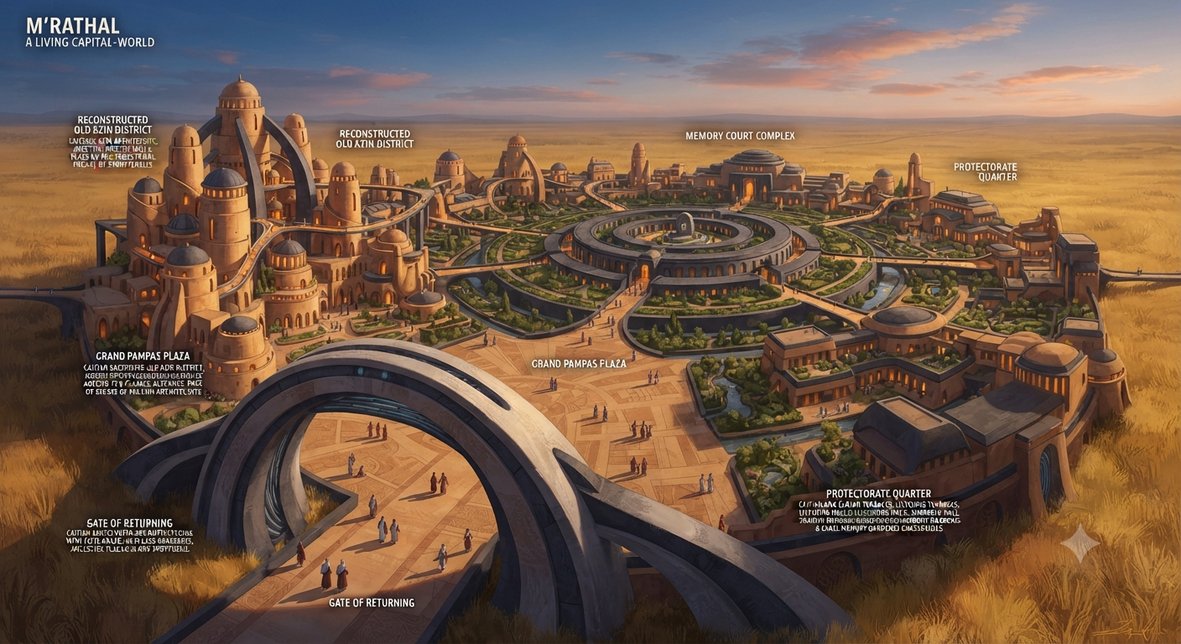
The Caitian capital city — M’Rathal in most diaspora traditions — is designed as a living memory-world, a place where architecture, landscape, and civic ritual merge into a single cultural organism. A tour of M’Rathal is not just sightseeing; it is walking through Caitian history, trauma, reclamation, and pride.
Below is a full, immersive tour written for your worldbuilding style, with Guided Links woven naturally throughout.
Arrival: The Plains Before the City
Your shuttle descends over the golden pampas, rolling grasslands that echo the ancestral savannahs of old Kzin. The horizon stretches endlessly, broken only by low clusters of sandstone structures that seem to grow out of the earth rather than sit upon it.
This landscape is the foundation of Caitian architectural philosophy — the world itself is the first building.
The air is warm, carrying scents of wildgrass and sun-baked stone. Caitians say the land “greets you before the people do.”
The Gate of Returning
The city’s entrance is a vast, curved arch of moon-basalt, textured on one side and smooth on the other — a deliberate echo of the weighing stone.
As you pass beneath it, a soft harmonic tone resonates from wind-song channels carved into the arch. This sound is meant to evoke ancestral Kzin winds, a sensory invocation of memory.
Caitians bow slightly as they enter, acknowledging the land and the past.
The Grand Pampas Plaza
The plaza is enormous — a sweeping expanse of sandstone tiles arranged in patterns resembling savannah migration routes. Caitians walk barefoot here to feel the warmth of the stone, a ritual of grounding.
Around the plaza rise:
- low, curved civic halls
- elevated walkways for feline movement
- scent-gardens filled with aromatic grasses
- sun-platform terraces where Caitians bask and meditate
This is the heart of Caitian diaspora politics — a space designed for communal identity.
The Reconstructed Old Kzin District
To the west lies the most striking part of M’Rathal: the Old Kzin Reconstruction Zone, a district built as a corrected memory of ancestral Kzin cities.
Here you walk through:
- sandstone towers with curved buttresses
- domed meeting halls inspired by pre-Imperial Kzinti architecture
- plazas designed for storytelling and ritual gatherings
- narrow wind-channels that produce haunting, melodic tones
But there is no imperial iconography.
No war banners.
No hierarchical intimidation architecture.
This district is a political statement: “We rebuild what was stolen — without the symbols of our oppressors.”
The Memory Court Complex
At the center of the city stands the Hall of Remembering, the largest memory-court complex in the Federation.
The building is circular, with three concentric rings:
1. The Outer Ring — gardens of scent-stones and ancestral plants
2. The Middle Ring — chambers for testimony, lined with textured basalt
3. The Inner Ring — the Court of Harm Weighing, where the great weighing stone rests on a dais of moon-basalt
Inside, you witness:
- the Opening Silence
- the Invocation of Lineage
- the Circle of Voices
- rulings sung into the wind-channels
This is the ceremonial heart of Caitian memory courts and memory court rituals.
The Protectorate Quarter
To the south lies the Protectorate Quarter, built after 2293 to house El-Aurian refugees.
This district blends Caitian and El-Aurian aesthetics:
- harmonised wind-song and resonance chambers
- shared memory-gardens
- listening halls where El-Aurians and Caitians exchange testimony
- communal terraces overlooking the pampas
El-Aurians describe this district as:
“A place where memory listens back.” It is the living embodiment of the Protectorate Bloc.
The Sky-Paths
Above the city, elevated walkways weave between towers like flowing ribbons. These sky-paths allow Caitians to move with feline grace, observing the city from vantage points that mimic ancestral hunting perches.
From here you see:
- the pampas stretching to the horizon
- reconstructed Kzin towers glowing in the sun
- scent-gardens forming geometric patterns
- memory-court domes shimmering with mineral veins
The city feels alive — a breathing organism of stone, wind, and memory.
The Nightfall Ritual
As dusk settles, the city shifts.
Wind-channels deepen their tones.
Scent-gardens release nocturnal fragrances.
Sky-paths glow with soft amber light.
Caitians gather in plazas for the Nightfall Remembering, a communal ritual where:
- stories of old Kzin are told
- diaspora histories are sung
- El-Aurians share listening-testimony
- the city itself becomes a memory-court
This nightly ritual is the soul of M’Rathal.

Why the Capital Matters
M’Rathal is:
- a reclaimed ancestral world
- a rebuke to Kzinti oppression
- a sanctuary for diaspora identity
- a protectorate model for vulnerable species
- a living archive of trauma and triumph
- a city where architecture is politics
It is the Caitians’ greatest act of cultural defiance and their most beautiful expression of survival.
A reconstructed Kzin city on Cait is not a replica — it is a corrected memory, a cultural act of reclamation, and a political statement carved into stone. Walking through it feels like stepping into an alternate history where Kzin evolved without imperial brutality, racial hierarchy, or Enhanced Kzinti domination. This tour takes you through one of the most important districts in M’Rathal: T’Razhira, the Caitian re-imagining of an ancestral Kzinti metropolis.
Entering T’Razhira: The Gate of First Dawn
The entrance arch is a sweeping crescent of moon-basalt, textured on one side and smooth on the other — a deliberate echo of the weighing stone.
Wind-song channels carved into the arch produce a low harmonic tone, reminiscent of ancient Kzin dawn winds.
Caitians pause here, touching the textured side with their right hand. It is a ritual of acknowledgment: “We remember what was taken.”
The Savannah-Stones Boulevard
You step onto a wide boulevard paved with sandstone tiles arranged in flowing patterns that mimic the migration routes of ancestral Kzin wildlife. The boulevard curves gently, following the natural contours of the pampas.
Along its edges rise:
- low, curved buildings blending into the grassline
- tall, narrow windows designed to catch wind and create soft tonal resonance
- scent-gardens filled with acacia-analog plants
- elevated walkways for feline movement
This boulevard embodies Caitian architectural philosophy — landscape first, structure second.
The Plaza of Unbroken Horizons
The plaza is enormous, open, and sun-drenched — a deliberate recreation of the wide communal spaces of pre-Imperial Kzin.
But here, the plaza is free of:
- imperial iconography
- war banners
- hierarchical intimidation architecture
Instead, you see:
- communal sun-platforms
- storytelling circles
- scent-stone alcoves
- wind-harp towers producing soft, melodic tones
Caitians gather here at dusk for the Circle of Voices, a ritual tied to memory court traditions.
The Hall of Ancestral Stone
This towering structure is the centerpiece of T’Razhira — a reconstruction of an ancient Kzinti civic hall, but purified of all symbols of domination.
Inside, you find:
- curved buttresses rising like the ribs of a great beast
- a domed ceiling painted with savannah constellations
- a central dais where Caitians perform lineage invocations
- alcoves containing scent-stones representing ancestral villages
The hall is used for diaspora ceremonies, protectorate gatherings, and joint Caitian–El-Aurian memory rituals.
It is the architectural embodiment of Caitian diaspora politics.
The Sky-Paths of T’Razhira
Above the district, elevated walkways weave between towers like flowing ribbons. These sky-paths allow Caitians to move with feline grace, observing the city from vantage points that mimic ancestral hunting perches.
From here you see:
- sandstone towers glowing gold in the sun
- plazas arranged in geometric patterns inspired by savannah ecology
- scent-gardens forming green constellations
- wind-harp towers singing softly in the breeze
The sky-paths are a celebration of Caitian movement — a reclamation of freedom denied under Kzinti rule.
The Market of Gentle Voices
This market recreates the bustling trade centers of ancient Kzin, but with Caitian cultural ethics:
- no intimidation architecture
- no hierarchical vendor tiers
- no dominance-based spatial design
Instead, stalls are arranged in circular patterns, symbolising equality.
Vendors offer:
- moon-basalt carvings
- pampas-grass textiles
- scent-infused ritual cloth
- El-Aurian resonance instruments
This market is a living example of inter-diaspora alliances.
 The Garden of Returning Winds
A vast ecological reconstruction zone, designed to evoke the savannahs of old Kzin:
- tall grasses swaying in warm breezes
- acacia-analog trees casting long shadows
- artificial migration paths for non-sentient herbivores
- nocturnal soundscapes engineered to mimic ancestral nights
Caitians walk these paths at sunset, letting the wind carry ancestral memory across their fur.
This garden is central to Caitian ecological reconstruction.
The House of Cleansed Stone
This building is a museum of reclamation — a place where Caitians display:
- pre-Imperial Kzinti artifacts
- reconstructed ancestral tools
- erased cultural symbols restored from oral tradition
- art depicting the Caitian exile and return
The final chamber contains a massive weighing stone carved from moon-basalt, symbolising the burden of history and the triumph of survival.
It is deeply tied to Caitian legal philosophy.
Nightfall in T’Razhira
As dusk settles:
- wind-channels deepen their tones
- scent-gardens release nocturnal fragrances
- sky-paths glow with amber light
- plazas fill with Caitians performing the Nightfall Remembering
El-Aurians often join, sharing listening-testimony that harmonises with the wind-harps.
The city becomes a living memory court — a place where architecture, landscape, and ritual merge into one.
Why T’Razhira Matters
This reconstructed Kzin city is:
- a rebuke to Kzinti oppression
- a reclamation of ancestral dignity
- a sanctuary for diaspora identity
- a model of protectorate ethics
- a living archive of trauma and triumph
- a vision of what Kzin could have been
It is the Caitians’ greatest architectural act of defiance: “We rebuild the world you tried to erase — and we make it better.”
Caitian ecological reconstruction is one of the most ambitious cultural-environmental projects in the Federation — a deliberate attempt to rebuild the ancestral ecology of old Kzin on a new world, but without the violence, hierarchy, and predation that defined Kzinti rule. It is ecology as memory, ecology as healing, ecology as political defiance.
Core Principle: “The Land Remembers Us”
Caitians believe their identity is inseparable from the savannah world they lost. Ecological reconstruction is therefore not terraforming — it is diaspora restoration, a way to rebuild:
- ancestral landscapes
- sensory environments
- migration patterns
- nocturnal soundscapes
- cultural hunting grounds
This philosophy is inseparable from Caitian architectural philosophy and Caitian diaspora politics.
Step 1: Recreating the Ancestral Biome
Old Kzin resembled the African savannah — tall grasses, acacia-like trees, warm winds, open horizons. Cait’s pampas biome was chosen because it offered:
- similar grassland expanses
- long sightlines for feline sensory culture
- fertile soil for ancestral plant analogues
- gentle seasonal cycles ideal for migration patterns
Caitian ecologists engineered the pampas to feel like Kzin, even if the species are different.
Step 2: Rebuilding Ancestral Flora
Caitian botanists recreated Kzin’s plant ecology using genetic analogues:
- Acacia-analog trees with wide canopies for shade and scent-marking
- Tall savannah grasses engineered to sway like ancestral Kzin plains
- Scent-marker shrubs used in Caitian ritual navigation
- Wind-whisper reeds that produce harmonic tones in the breeze
These plants anchor Caitian sensory culture — especially scent and sound.
Step 3: Reintroducing Non-Sentient Fauna
Caitians refused to recreate any predatory species associated with Kzinti dominance. Instead, they introduced gentle herbivores and migratory animals:
- plains-grazer analogues
- long-horned browsing beasts
- nocturnal chirpers that recreate ancestral soundscapes
- burrowing mammals that aerate the soil
These species support Caitian hunting traditions symbolically, not violently.
This ecological ethic ties directly to Caitian anti-predation activism.
Step 4: Engineering Soundscapes
Caitians have acute auditory senses, and old Kzin’s soundscape was central to their identity. Ecologists recreated:
- dawn wind-harmonics using engineered grass corridors
- nocturnal insect choruses tuned to ancestral frequencies
- low plains-rumble produced by underground resonance chambers
- wind-harp towers integrated into city architecture
These soundscapes support memory court rituals, where sound is part of testimony.
Step 5: Scent Ecology
Caitian culture is deeply olfactory. Ecologists rebuilt scent-based environmental cues:
- scent-stone gardens
- aromatic grasses
- memory-shrubs used in lineage rituals
- wind-carried plant oils that evoke ancestral Kzin evenings
These scents are used in Caitian memory courts to anchor testimony.
Step 6: Migration Path Reconstruction
Old Kzin’s wildlife migrations shaped Caitian movement traditions. On Cait, ecologists created:
- artificial migration corridors
- seasonal grazing cycles
- safe observation perches
- elevated sky-paths that mimic ancestral hunting vantage points
These corridors are central to Caitian meditation and diaspora identity.
Step 7: Nightfall Ecology
Cait’s nights are engineered to resemble ancestral Kzin:
- deep amber twilight
- long shadows cast by acacia-analog trees
- nocturnal soundscapes tuned to ancestral frequencies
- scent-release cycles triggered at dusk
This supports the Nightfall Remembering ritual, explored in Nightfall Remembering.
Step 8: Ecological Memory Zones
Entire regions of Cait are designated as memory-ecologies, where:
- ancestral flora is concentrated
- soundscapes are carefully tuned
- scent-markers guide movement
- reconstructed Kzin villages blend into the land
These zones serve as trauma-healing environments and cultural education centres.
Step 9: Protectorate Ecology for El-Aurians
After 2293, Caitians expanded ecological reconstruction to support El-Aurians:
- resonance-friendly plant species
- quiet zones for listening rituals
- shared memory-gardens
- harmonised wind-song corridors
El-Aurians describe Cait’s ecology as: “A world that remembers with us.”
This ties directly to the Protectorate Bloc.
Why Ecological Reconstruction Matters
Cait’s ecology is:
- a rebuke to Kzinti oppression
- a sanctuary for Caitian identity
- a living archive of ancestral memory
- a trauma-healing environment
- a protectorate model for vulnerable species
- a world rebuilt through dignity, not domination
It is the Caitians’ greatest environmental act of defiance: “We rebuild the land you tried to erase — and we make it better.”
Sources:
The Slaver Weapon by Larry Niven - Star Trek: The Animated Series.
The Man-Kzin Wars by Larry Niven.
The Ringworld Engineers by Larry Niven.
Ringworld by Larry Niven.
The Great Moghuls by Bamber Gascoigne.
Lives of the Indian Princes by Charles Allen & Sharada Dwivedi.
Partition by Barney White-Spumer.
Cat Sense by John Bradshaw.
Feline Behaviour and Welfare by Andrew F. Fraser.
Himmler's Crusade by Christopher Hale.
Why I'm No Longer Talking to White People About Race by Reni Eddo-Lodge.
Me and White Supremacy by Layla F Saad.
How to be an Anti-Racist by Ibram X. Kendi.
Staying Power: The History of Black People in Britain by Peter Fryer.
Biracial Britain by Remi Adekoya.
Natives: Race and Class in the ruins of Empire by Akala.
In Black and White by Alexandra Wilson.
Black British Problems by Marceline Powell.
Black and British: A Forgotten History by David Olusoga.
The Science of Hate by Matthew Williams.
Irish Freedom by Richard English.
The Troubles by Tim Pat Coogan.
Making Sense of The Troubles by David McKittrick and David McVea.
Silencing the Past by Michel-Rolph Trouillot.
Israel and Palestine: The Complete History by Ian Carroll.
Chimera by Stephen Gallagher.
The Nightmare Man by David Wiltshire.
The Holocaust by Laurence Rees.
Tribes by David Lammy.
A Cultural History of Tibet by David Snellgrove and Hugh Richardson.
China's Forgotten People: Xinjiang, Terror and the Chinese State by Nick Holdstock.
The Tree that Bleeds: A Uighur Town on the Edge by Nick Holdstock.
 Caitian Nation.
Cait. This is a recreation of Kzin of thousands of years ago, before the dark times, before the Kzinti. Palaces, gardens, monuments and museums all recreated on a world as close to Kzin in climate and geography as possible. Relics saved in the exodus helped to recreate the old ways. Old traditions and language reappeared as the Caitians reclaimed their future with the entire United Federation of Planets between them and their mortal enemies.
From M’ress biography: The Caitians and the war-like Kzinti share common roots in the deep past -- as do Vulcans and Romulans. As with the Vulcans and Romulans, the two groups went their separate ways to develop as two entirely different civilizations. The Caitians are fierce warriors when so called upon, but pride themselves on their accomplishments in arts and philosophy rather than on the martial arts. Their family units are extremely close. M'Ress's other three litter mates also serve in Starfleet in various capacities. The long line of her ancestors is well known on Cait, and her parents are honoured citizens.
From Memory Beta: The Caitian language consists of multiple soft tones, spoken with a deep, purring resonance; this style of communication makes it difficult for many Caitians to adapt to phonetic languages. Caitians have excellent hearing, with a frequency range far beyond that heard by normal humanoids. Many Caitians who enter Starfleet train in communications and linguistics as a result of this
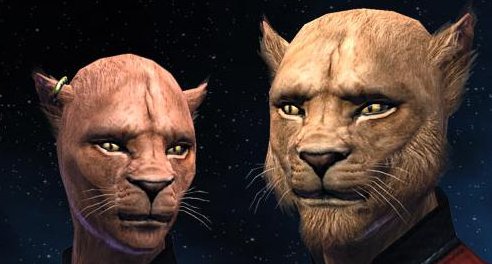
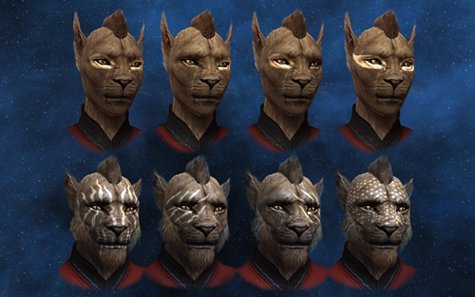
Female Caitians have thinner faces and one or more earrings. These symbolise family lineage (rather like the Bajoran religious earring designs) and the importance of the female in continuing the pride/family line. Male Caitians can often be seen with goatees or manes depicting their gender.
Caitians are “small and sinewy; the females are as delicately dainty as the Siamese or Abyssinian cats of old Earth” and as for their culture they “pride themselves on their accomplishments in arts and philosophy”. Clan/pack/family ties are strong in Caitian society – as in Kzinti cultures as well. The long line of ancestors is well known on Cait. Caitians have a variation of markings on the fur and face that can identify different prides.
Recent developments within Caitian society concern the issue of the Kzintis and whether a dialogue could be opened to talk to them. With a Caitian as President of the Federation, the Caitian people have never had a louder voice in the Federation Council to make their needs and wants known. President Sh’ghee has already had a four-year term in office.
Prior to the election of Sh’ghee as President in the early months of 2308, a number of attacks took place both in Caitian space and on Cait itself. Investigations by the Federation Police Service blamed Caitian separatists who have an agenda to reunify the Caitian nation with their known cousins in the Beta Quadrant. This once-shunned political viewpoint had gained strength over the decades as disaffection with endless conflicts made people turn towards blood over politics.
Federation Security investigated allegations that Kzinti were involved in the attacks, which would be a contravention of the Treaty of Sirius, but the evidence was non-conclusive.
Art-lovers were congregating on Cait in 2310 for an auction of a rare painting by M’grrouw, the famous Caitian artist. The painting, Dawn over the Abyssinian Plains, fetched a record price. The new owners, whose identity is a closely-guarded secret, have pledged to display the art in the National Museum of Art in the Caitian Capital city.
One of the themes of the Interim Years is about the Caitian/Kzinti nation and the journey ALL of these feline relations will take in finding their destiny. For the Kzinti there is the opportunity to ally with the Klingons in order to be freed from the Treaty of Sirius. Their genetic knowledge has enhanced them beyond Caitian abilities. The Caitians escaped from the experiments their Kzinti cousins were conducting 800 years ago. The Korlivilar are an offshoot from the Caitian baseline, perhaps with some ISC tinkering. They have to contend with being blamed in part for the failure of the Pacification War and to find themselves a place in the future of the ISC.
KRADs novel Singular Destiny speaks of the Caitians having left and returned to the Federation at least once before. This may be some political development with the Caitians deciding to rejoin their genetic brothers. With the Kzinti affiliated to the Klingon Empire, it may be the case that the Caitians want to reunify.
 Cait
Cait
The Caitian system consists of two planets and an asteroid belt. Cait, the second planet in the system, has two moons Rea and Sura. The asteroid belt lies further out from unformed planets and is a rich source of minerals; the Federation dilithium crystals for this region come from the orbital mining facilities here. Cait has M-class gravity and atmosphere and a rich ecosystem of plains and jungles.
The rich biosphere on Cait has provided medical advancements and is in itself a wonder of the Alpha Quadrant. Biochemistry at the University of Cait is arguably at the leading edge of the Federation. Starfleet Medical has a large facility on Cait to investigate possible medicinal uses of the flora on the planet.
Cait has a starbase facility and orbital fleet yard which specialises in TacFleet assets. The new Federation fighter craft and fleet carrier technology eminates from the yards of Cait. With the new pivot by Starfleet towards the Alpha Quadrant, Cait has now been placed onto the frontline of exploration.
Admiral Irina Khmelnova, the Starfleet Commander, has ordered the allocation of the principal elements of the Starfleet to Cait for pioneering missions into the Alpha Quadrant. Captain Demora Sulu has taken the Enterprise-B to Cait before heading spinward.
Caitian diaspora politics
Best understood as a survival-driven ideology that transformed into one of the Federation’s most sophisticated, morally forceful political traditions. It is not a single movement — it is a continuum of trauma, memory, cultural reconstruction, and interstellar activism shaped by their flight from Kzin and the Enhanced Kzinti.
Core Identity: A Nation Formed in Exile
Caitian diaspora politics begins with one foundational truth: the Caitian people became a political community because they were displaced.
Their exile produced three defining principles:
- Diaspora Sovereignty — a belief that a people’s political legitimacy comes from shared memory, not territorial control.
- Collective Trauma Mandates — laws requiring the preservation of historical suffering as a civic duty.
- Anti-Predation Doctrine — a commitment to preventing any species from being hunted, exploited, or erased.
These principles shaped every Caitian political institution in the Federation.
The Three Pillars of Caitian Diaspora Politics
1. Memory as Governance
Caitians treat memory as a political resource. Their councils maintain:
- archives of Kzinti repression
- oral histories of flight and survival
- trauma registries documenting generational impact
- cultural memory courts that adjudicate disputes involving historical harm
This is not symbolic — it is constitutional. Caitian law requires leaders to demonstrate literacy in diaspora history before holding office.
2. Diaspora Solidarity Networks
Caitians believe diasporas must protect one another across species lines. Their solidarity networks include:
- refugee-to-refugee aid corridors
- cultural preservation exchanges
- trauma-response teams trained for Borg and Orion Syndicate survivors
- political blocs in the Federation Council advocating for displaced peoples
This is why they became the fiercest champions of the El-Aurian Protectorate after the Lakul and Nexus tragedies.
3. Anti-Exploitation Activism
Having survived Kzinti racial hierarchy and Enhanced Kzinti intimidation, Caitians developed a political instinct for identifying predatory systems.
They monitor:
- Orion Syndicate refugee trafficking
- Tal Shiar psychological exploitation
- Klingon House-based indenture practices in border regions
Their activism is not passive — Caitians often lead Federation investigative committees.

The Diaspora Council: A Government Without Borders
The Caitian Diaspora Council is the heart of their politics. It operates like a government, but its constituency is spread across dozens of worlds.
The Council oversees:
- diaspora citizenship
- cultural transmission programs
- trauma-healing institutions
- interstellar refugee diplomacy
- protectorate advocacy
It is the Council that pushed for the El-Aurian Protectorate Charter of 2294, arguing that the El-Aurians were a “memory people” whose survival was essential to the moral health of the Federation.
The El-Aurian Turning Point (2293–2294)
The destruction of the Lakul and the loss of El-Aurians to the Nexus triggered a political awakening in Caitian society.
They recognised:
- the same pattern of annihilation they had faced under Kzinti rule
- the same vulnerability to exploitation
- the same cultural fragility
- the same danger of being scattered beyond recovery
Caitians argued that the El-Aurians were not merely refugees — they were a diaspora in existential peril.
Their advocacy led to:
- the El-Aurian Protectorate
- Federation trauma-response units
- Caitian–El-Aurian cultural memory exchanges
- joint diaspora councils
- legal protections for “memory-sensitive species”
Caitian Political Factions
Diaspora politics produced several ideological factions:
- The Memory Guardians — archivists who treat history as sacred.
- The Border Vigil — activists who monitor predatory powers.
- The Diaspora Integrationists — advocates for blending Caitian culture with Federation norms.
- The Protectorate Bloc — the faction that championed the El-Aurians.
These factions debate fiercely but share one unifying belief: never again.
Why Caitian Diaspora Politics Matters
It reshaped Federation law by introducing:
- trauma-informed governance
- diaspora-based citizenship
- cultural preservation mandates
- anti-exploitation monitoring
- protectorate frameworks for endangered species
Caitians turned their suffering into a political philosophy that protects others.
What Caitian Memory Courts Are
Memory courts are formal civic bodies that adjudicate disputes involving:
- historical trauma
- cultural misrepresentation
- diaspora identity conflicts
- intergenerational harm
- political decisions that may echo past oppression
They operate on the principle that memory is a constitutional resource, not a private matter. Every ruling is designed to protect the diaspora from forgetting the conditions that once endangered them.
Why Caitians Created Memory Courts
Their origin lies in three historical pressures:
- Kzinti repression, which weaponised erasure and forced silence
- Enhanced Kzinti intimidation, which taught Caitians that trauma must be documented to be resisted
- Diaspora fragmentation, which made shared memory essential for unity across worlds
Caitians concluded that trauma must be institutionalised to prevent future predation.
This became the foundation of the Collective Trauma Mandates.
Structure of a Memory Court
Memory courts are composed of three roles:
1. The Archivist-Judges
Experts in:
- oral histories
- trauma psychology
- diaspora law
- cultural preservation
They interpret memory as evidence.
2. The Witness-Custodians
Individuals trained to present:
- ancestral accounts
- community histories
- personal trauma narratives
Their testimony is considered a civic duty.
3. The Harm-Assessors
Specialists who evaluate:
- cultural damage
- intergenerational impact
- political consequences
- risk of repeating historical patterns
Their assessments guide rulings.
What Cases Memory Courts Hear
Memory courts do not handle criminal law. They handle cultural and political harm, such as:
- misuse of Caitian historical trauma
- political rhetoric echoing Kzinti racial hierarchies
- Federation policies that inadvertently endanger diaspora cohesion
- disputes over cultural ownership or ritual authenticity
- conflicts between Caitian communities on different worlds
- cases involving refugees whose trauma intersects with Caitian experience
They also hear cases from other diasporas, especially El-Aurians.
How Rulings Work
Memory court rulings are not punitive — they are corrective. Outcomes may include:
- mandatory historical education
- public remembrance rituals
- reparative cultural work
- trauma-healing obligations
- political policy revisions
- diaspora solidarity directives
The goal is always restoration, not punishment.
The El-Aurian Integration
After the Lakul tragedy and the Nexus disaster, Caitian memory courts became central to the El-Aurian protectorate effort.
They ruled that:
- El-Aurian trauma must be recognised as a protected cultural memory
- El-Aurians should have access to Caitian trauma-response institutions
- Caitian and El-Aurian histories should be preserved jointly
- the Federation must treat Borg-induced diaspora trauma as a political emergency
This ruling became the backbone of the Protectorate Bloc.
Political Power of Memory Courts
Memory courts influence:
- Federation refugee law
- protectorate charters
- cultural preservation mandates
- anti-exploitation activism
- diaspora diplomacy
Their rulings often shape Federation Council debates, especially on issues involving:
- the Borg
- the Orion Syndicate
- Tal Shiar psychological operations
- Kzinti border tensions
Why Memory Courts Matter
They ensure that Caitian politics remains:
- trauma-literate
- historically grounded
- diaspora-focused
- protective of vulnerable species
- resistant to predatory powers
They are the institutional embodiment of the Caitian vow: “We remember so others may survive.”
The Purpose of Memory Court Rituals
Memory court rituals exist to transform personal pain into civic responsibility. They ensure that:
- trauma is preserved accurately
- historical harm is contextualised
- diaspora identity remains unified
- political decisions never repeat past oppression
They are the ceremonial embodiment of Collective Trauma Mandates and the philosophical engine of Caitian diaspora sovereignty.
The Ritual Sequence
Caitian memory court proceedings follow a strict ritual order. Each stage is designed to evoke emotional clarity, cultural continuity, and political accountability.
1. The Opening Silence (“The First Remembering”)
A full minute of silence is observed.
Purpose:
- honour ancestors lost to Kzinti repression
- centre the court in shared memory
- remind participants that trauma is communal
This silence is considered sacred; breaking it is a cultural offence.
2. The Invocation of Lineage
The Archivist-Judges recite the lineage of the case:
- the ancestral line of the claimant
- the historical context of the harm
- the diaspora branch affected
This ritual ensures that every case is framed within the broader Caitian exile narrative.
3. The Presentation of Memory (“Testimony of the Heart”)
Witness-Custodians present the memory in one of three forms:
- Oral testimony
- Ancestral recordings
- Cultural artifacts (music, scent-stones, ritual cloth)
Caitians believe memory is multisensory; therefore, testimony often includes:
- rhythmic vocalisations
- scent markers
- tactile objects
This ritual is deeply emotional and often requires trained trauma mediators.
4. The Harm Weighing
Harm-Assessors perform a ritualised evaluation:
- cultural damage
- intergenerational impact
- political consequences
- risk of repeating historical patterns
They use a ceremonial object called the weighing stone, symbolising the burden of memory.
5. The Communal Response (“The Circle of Voices”)
Participants form a circle and speak one sentence each:
- affirming the memory
- acknowledging the harm
- committing to restoration
This ritual ensures that memory is not isolated — it becomes a shared civic truth.
6. The Ruling of Restoration
Memory court rulings are corrective, not punitive. Ritual outcomes may include:
- public remembrance ceremonies
- reparative cultural work
- trauma-healing obligations
- policy revisions
- diaspora solidarity directives
The ruling is sung, not spoken — a tradition meant to embed the decision in cultural memory.
7. The Closing Gesture (“The Last Remembering”)
Participants place their hands over their hearts and bow slightly. This gesture symbolises:
- humility before history
- unity of the diaspora
- commitment to future vigilance
It is the ritual that binds the court’s decision to Caitian identity.
Special Rituals for El-Aurian Cases
After 2293, memory courts developed joint rituals for El-Aurian testimony:
- dual-species circles of voices
- shared trauma-weighing ceremonies
- combined ancestral recordings
- harmonised vocal invocations
These rituals became foundational to the Protectorate Bloc and the political alliance between Caitians and El-Aurians.
Why These Rituals Matter
Memory court rituals:
- preserve Caitian cultural identity
- prevent historical erasure
- transform trauma into governance
- unify diaspora communities across worlds
- shape Federation refugee and protectorate law
They are the ceremonial backbone of Caitian political philosophy: Memory is protection. Memory is justice. Memory is survival.
The Legal Status of Memory Courts in the Federation
Memory courts are formally classified as cultural-juridical bodies under Federation Charter Article 17, which protects:
- diaspora governance
- cultural preservation systems
- trauma-based legal traditions
This classification gives Caitian memory courts limited extraterritorial authority, similar to Vulcan ritual courts or Bajoran spiritual tribunals — but with a unique focus on historical harm.
What Federation Law Recognises
Federation law acknowledges three core powers of Caitian memory courts:
1. Authority Over Cultural Harm
Memory courts can issue binding rulings on:
- cultural misrepresentation
- diaspora fragmentation
- historical erasure
- trauma exploitation
Federation member worlds must comply with corrective directives issued by the courts, provided they do not conflict with planetary sovereignty.
2. Protectorate Influence
Memory court rulings directly inform:
- protectorate charters
- refugee rights legislation
- trauma-response protocols
This became crucial during the El-Aurian Protectorate debates, where Caitian rulings shaped Federation policy.
3. Inter-diaspora Jurisdiction
Memory courts may hear cases involving:
- El-Aurians
- Klingon exiles
- Ch'ramaki refugees
- Borg-survivor diasporas
Their rulings are advisory but highly influential in Federation Council deliberations.
How Memory Court Rulings Affect Federation Policy
Memory court decisions often trigger:
- amendments to refugee law
- cultural preservation mandates
- trauma-sensitive diplomatic protocols
- restrictions on predatory intelligence practices
- oversight of Orion Syndicate exploitation networks
Their rulings are treated as ethical precedents, shaping how the Federation interprets harm, trauma, and diaspora rights.
The “Trauma Precedent Doctrine”
In 2294, following the Lakul tragedy, the Federation Council adopted the Trauma Precedent Doctrine, heavily inspired by Caitian jurisprudence.
It states:
“Historical trauma may constitute legal harm even without contemporary injury.”
This doctrine allows:
- reparative rulings
- cultural restitution
- trauma-informed policy reviews
- protectorate status for endangered cultures
It is one of the most significant legal shifts in Federation history.
Memory Courts and the El-Aurian Protectorate
Memory courts played a decisive role in the creation of the El-Aurian Protectorate after the Borg exodus and the Nexus disaster.
Their rulings argued that:
- El-Aurian trauma was cosmological, not merely historical
- Borg-induced diaspora collapse required emergency protection
- El-Aurians were at risk of cultural extinction
- their abilities made them targets for predatory powers
These rulings became the backbone of the Protectorate Charter.
Memory Courts as a Federation Ethical Compass
Over time, memory courts evolved into a moral institution within Federation politics. Council members often consult Caitian rulings when debating:
- refugee crises
- Borg-survivor rights
- Klingon diaspora protections
- cultural restitution for worlds damaged by the Tabula Rasa Campaign
- trauma-informed diplomacy with the Cardassian Union
Memory courts are not merely legal bodies — they are ethical engines.
Why the Federation Values Memory Courts
They provide:
- a trauma-literate framework
- a diaspora-centric perspective
- a safeguard against historical repetition
- a mechanism for cultural justice
- a model for interspecies solidarity
Memory courts help the Federation avoid becoming complacent, reminding it that survival is political, and memory is law.
Identity and Purpose of the Weighing Stone
The weighing stone is the ceremonial heart of Caitian memory courts. It represents:
- the burden of historical trauma
- the weight of diaspora survival
- the responsibility of truth-telling
- the danger of forgetting
It is used during the Harm Weighing stage of a memory court ritual, where Harm-Assessors determine the cultural, intergenerational, and political impact of a memory.
Physical Description
The weighing stone is typically:
- palm-sized
- smooth on one side, textured on the other
- carved from Caitian moon-basalt
- embedded with faint, shimmering mineral veins
- warm to the touch when held during testimony
The smooth side represents clarity of memory. The textured side represents the scars of history.
Caitians believe the stone “remembers” through touch — not metaphysically, but symbolically, as a tactile reminder of the weight of truth.
Ritual Use in Memory Courts
During the Harm Weighing ritual:
1. The Harm-Assessor holds the stone in both hands.
2. They listen to the testimony — oral, musical, or artifact-based.
3. They turn the stone slowly, alternating between smooth and textured sides.
4. They speak a formal evaluation of harm, guided by the stone’s symbolism.
5. The stone is placed on a central dais, marking the transition to communal response.
This ritual ensures that harm is not evaluated intellectually alone — it is felt, acknowledged, and embodied.
Symbolic Layers
The weighing stone carries several layers of meaning:
- Diaspora Burden — the weight of exile from Kzin.
- Collective Trauma — the shared suffering of Caitian communities.
- Cultural Continuity — the stone is passed down through generations.
- Judicial Responsibility — rulings must honour memory, not convenience.
- Anti-Predation Vigilance — a reminder of the Enhanced Kzinti oppression.
Variants Across the Diaspora
Different Caitian diaspora branches have unique versions:
1. The Border Vigil Stones
Used by Caitians living near Kzinti space. Heavier, darker, symbolising constant vigilance.
2. The Protectorate Stones
Used in cases involving El-Aurians. Inlaid with silver flecks representing El-Aurian “listening.”
3. The Council Stones
Used by the Diaspora Council itself. Larger, often requiring two hands to lift — symbolising the weight of leadership.
The Weighing Stone in Federation Law
Federation jurisprudence recognises the weighing stone as a cultural-legal instrument under Article 17 protections. Its use is cited in:
- trauma-precedent rulings
- protectorate charters
- diaspora harm evaluations
- cultural restitution cases
The stone’s symbolism helped shape the Trauma Precedent Doctrine, which states that historical trauma can constitute legal harm.
The El-Aurian Connection
After the Lakul tragedy and the Nexus disaster, El-Aurians were invited to touch the weighing stone during joint testimony rituals.
El-Aurians described the stone as: “A memory that listens.”
This phrase became part of the Protectorate Charter.
Why the Weighing Stone Matters
It is the object that ensures Caitian justice remains:
- trauma-literate
- historically grounded
- culturally protective
- diaspora-focused
- ethically vigilant
The weighing stone is not merely a ritual item — it is the physical embodiment of Caitian political philosophy:
Memory has weight. Justice must carry it.
Core Principle: “Never Again Prey”
Caitian anti-predation activism is built on a single foundational ethos:
No people, no culture, no diaspora shall be hunted — literally or politically.
This ethos shapes:
- refugee protection
- intelligence oversight
- anti-trafficking operations
- diaspora solidarity networks
- protectorate politics
It is inseparable from Caitian diaspora politics and the memory of Kzinti oppression.
Why Caitians Became Anti-Predation Activists
Three historical forces forged this activism:
1. Kzinti Racial Hierarchy
Caitians lived under a system where they were classified as:
- “lesser”
- exploitable
- culturally contaminating
This taught them to recognise predatory social structures instantly.
2. Enhanced Kzinti Intimidation
Gene-augmented enforcers patrolled Caitian districts, using:
- fear
- surveillance
- physical dominance
Caitians learned to identify predation not just in violence, but in power imbalance.
3. Diaspora Trauma
Exile scattered Caitians across the stars. They saw how diasporas become targets for:
- traffickers
- intelligence agencies
- criminal syndicates
- opportunistic governments
This trauma became the foundation of Collective Trauma Mandates.
The Three Pillars of Anti-Predation Activism
1. Structural Vigilance
Caitians monitor systems that enable predation:
- Orion Syndicate trafficking routes
- Tal Shiar psychological exploitation
- Ferengi displacement-market speculation
- Klingon House indenture practices
- border militarisation near Kzinti space
Their vigilance is proactive — they intervene before predation escalates.
2. Diaspora Protection
Caitians specialise in defending vulnerable diasporas:
- El-Aurians
- Klingon exiles
- Romulan refugees
- Borg-survivor communities
They provide:
- safe corridors
- trauma-response teams
- cultural preservation support
- political advocacy in the Federation Council
This is central to the Protectorate Bloc.
3. Memory-Court Enforcement
Caitian memory courts treat predation as historical harm, even if no crime has occurred yet.
They issue:
- corrective rulings
- cultural restitution directives
- anti-exploitation mandates
- diaspora protection orders
This judicial activism is rooted in memory court rituals and the symbolism of the weighing stone.
Anti-Predation Tactics and Methods
1. Pattern Recognition Teams
Caitians train specialists to identify predatory patterns:
- coercive diplomacy
- exploitative trade deals
- intelligence manipulation
- cultural erasure campaigns
- refugee targeting
These teams often work with Federation Security and Starfleet Intelligence.
2. Trauma-Informed Diplomacy
Caitian diplomats use trauma literacy to detect predation in negotiations:
- tone analysis
- power-imbalance mapping
- cultural vulnerability assessment
- diaspora risk modelling
This approach reshaped Federation diplomatic protocols.
3. Protectorate Intervention Units
These units respond to crises involving:
- displaced populations
- cultural extinction threats
- Borg-survivor trauma
- criminal exploitation networks
They were instrumental in supporting the El-Aurians after the Lakul and Nexus tragedies.
4. Public Memory Campaigns
Caitians use cultural memory to educate the Federation:
- holodocumentaries
- scent-garden memorials
- wind-song installations
- diaspora storytelling circles
These campaigns remind citizens that predation begins with forgetting.
Anti-Predation Activism and the El-Aurians
Caitians recognised El-Aurians as a memory-sensitive diaspora uniquely vulnerable to exploitation:
- their listening abilities
- their trauma from the Borg
- their cultural fragility
- their scattered population
Caitians argued that El-Aurians were at risk of being:
- trafficked
- manipulated
- weaponised
- erased
Their activism led directly to the El-Aurian Protectorate, explored in El-Aurian protectorate politics.
Anti-Predation Architecture
Even Caitian architecture is designed to resist predation:
- no hierarchical spatial design
- no intimidation structures
- communal vantage points
- scent-based navigation for safety
- wind-song corridors that reveal movement
This is part of Caitian architectural philosophy.
Anti-Predation Ecology
Caitian ecological reconstruction avoids predatory species entirely. Their engineered savannahs support:
- gentle herbivores
- safe migration paths
- non-violent hunting traditions
- trauma-healing environments
This is central to Caitian ecological reconstruction.
Why Anti-Predation Activism Matters
It is:
- a rebuke to Kzinti oppression
- a safeguard for vulnerable diasporas
- a moral compass for the Federation
- a trauma-informed political philosophy
- a model for protectorate ethics
- a cultural vow: never again prey
Caitians turned their suffering into a political force that protects others.
Caitian anti-predation intelligence methods are one of the most refined, trauma-informed security systems in the Federation. They were built by a people who survived being prey, who lived under Kzinti racial hierarchy, who endured Enhanced Kzinti intimidation, and who vowed that no species — not Caitians, not El-Aurians, not anyone — would ever be hunted again.

Core Ethos: “Predation Begins Before the First Strike”
Caitian intelligence doctrine is built on the belief that predation starts long before violence — in patterns, incentives, power imbalances, and cultural vulnerabilities. Their intelligence methods focus on detecting predation at its earliest conceptual stage.
This ethos is inseparable from Caitian anti-predation activism.
The Four Pillars of Caitian Anti-Predation Intelligence
1. Pattern-Scent Analysis
Caitians use a multisensory approach to intelligence. Their analysts are trained to detect “predatory patterns” in:
- diplomatic language
- trade agreements
- troop movements
- refugee flows
- cultural erasure campaigns
They call this pattern-scenting — not literal smell, but a metaphor for intuitive, trauma-informed pattern recognition.
This method is central to anti-predation diplomacy.
2. Diaspora Vulnerability Mapping
Caitians maintain detailed maps of diaspora populations across the Federation, identifying:
- cultural fragility
- political marginalisation
- economic exploitation risk
- intelligence-targeting likelihood
- trafficking corridors
These maps allow Caitians to intervene before predation escalates.
This ties directly to Protectorate intervention units.
3. Predation Signature Detection
Caitian analysts classify predatory behaviour into “signatures,” including:
- Coercive Silence — attempts to suppress cultural expression
- Shadow Ownership — economic control without legal authority
- Memory Extraction — exploiting trauma for manipulation
- Diaspora Fragmentation — scattering populations to weaken identity
- Soft Surveillance — monitoring vulnerable groups without cause
These signatures are used in memory courts to justify early intervention.
4. Trauma-Informed Intelligence Review
Every intelligence report is reviewed by trauma specialists trained in:
- generational harm
- cultural memory
- diaspora psychology
- coercion dynamics
This ensures Caitian intelligence never misinterprets trauma as instability or weakness — a mistake other powers often make.
This method supports Caitian collective trauma mandates.
Operational Methods
1. The Listening Triads
Teams of three specialists:
- a pattern-scent analyst
- a trauma-literate diplomat
- a cultural historian
They analyse predatory behaviour from multiple angles simultaneously.
2. The Border Vigil Observatories
Stations near Kzinti space monitor:
- Enhanced Kzinti deployments
- genetic militarisation signals
- predatory rhetoric in Kzinti broadcasts
- shifts in racial hierarchy doctrine
These observatories are run by the Border Vigil faction.
3. The Diaspora Early-Warning Grid
A network of Caitian and El-Aurian observers stationed across the Federation. They report:
- trafficking rumours
- coercive diplomacy
- cultural erasure attempts
- predatory intelligence activity
This grid was crucial during the El-Aurian crisis after the Lakul and Nexus tragedies.
4. Memory-Court Intelligence Hearings
When predation is suspected, memory courts hold hearings where:
- witnesses present ancestral parallels
- harm-assessors evaluate risk
- archivist-judges compare patterns to historical oppression
- the weighing stone is used to determine severity
These hearings often lead to Federation Council action.
5. Protectorate Strike-Teams (Non-violent)
These teams intervene in predatory situations using:
- evacuation
- diplomatic pressure
- cultural reinforcement
- exposure of predatory behaviour
- trauma-response support
They never use violence; their power is political, cultural, and moral.
Intelligence Targets
Caitian anti-predation intelligence focuses on groups known for exploiting vulnerable populations:
- Orion Syndicate trafficking networks
- Tal Shiar psychological manipulation
- Klingon House indenture practices
- Kzinti genetic militarisation programs
Their methods are defensive, protective, and trauma-informed — never aggressive.
The El-Aurian Integration
El-Aurians became essential partners in Caitian intelligence after 2293. Their listening abilities allow them to detect:
- coercive intent
- emotional predation
- manipulative rhetoric
- hidden trauma exploitation
Caitians describe El-Aurians as “predation empaths,” and their partnership is central to El-Aurian protectorate politics.
Why Caitian Intelligence Methods Matter
They provide the Federation with:
- early detection of exploitation
- trauma-literate analysis
- diaspora-centered protection
- non-violent intervention strategies
- ethical intelligence frameworks
Caitians turned their suffering into a system that protects others from becoming prey.
Kzin, the origins of the Caitians and their diaspora.
Kzin: like a mixture of old India and Tibet; an ancient world whos civilisation has existed for thousands of years. Temples, museums and palaces dot the planet, as well as vast cities that reflect the wealth and status of this old civilisation. What you see on the surface, however, doesn;t reflect the actual, violent, divisive history of this world. The statues, monuments and public spaces very much reflect the dominant species of this planet: Kzinti. It doesn't, however, make any mention of the second species also born here: Caitians.
The plains that gave birth to the Kzinti species, were the one and the same that created the Caitians. Thousands of years ago, Kzinti and Caitians were the same species, dominating these plains just as the big cats once ruled the African plains on Earth. Unlike on Earth, the Kzinti/Caitians are the ones who evolved intelligence, to become the dominant species on the planet. All other species on Kzin fell before them as prey. For thousands of years, these subspecies lived together harmoniously, looking identical to the Caitian species of modern times, with a few variations. Change came in their equivalent of the 20th Century technological development. Medical science and genetic became known to them. Suddenly the different subspecies became classified in science as seperate. What had occasionally been seen as behavioural differences became racial diversity. In the case of the Kzinti, justification to place themselves as the superior race, and Caitians the lesser species.
It started as social and racial slurs in the streets. Caitians were treated as the source of weakness, disease and fake news poured petrol onto the fire. Race riots broke out; Caitians were demonstrocised as criminals or worse. In addition, Kzinti medical science was seeking to 'purify' the Kzinti genome; they sought the mythical progenitor species that had evolved into the Kzinti and not the weakling Caitians. Fang and claw size as well as musculature and intelligence were factured in. Kzinti aspired to be the Uber-race of the planet. Genetic manipulation and bioledical research the way of 'recreating' the mythical progenitor species. Kzinti began to differentiate from their Caitian kin. The once-subtle differences manifested more clearly as the Kzinti fangs enlarged, their height increased and their intlligence followed. Whilst the Caitian's poor diet and schooling stagnated their species, the Kzinti medical and superior schooling led to stronger and smarter Kzinti that dominated their weaker brethren. The Caitians were moved into ghettos, seperated as 'unclean' from the Kzinti society. Transport was kept seperate, with Caitians expected to do the menial work. As with the Augments in 1990s Earth, the Kzinti enhancements bred superior ambition. Kzinti culture was 'cleansed' of Caitian influence: statues, art, literature, Caitian foods, language and fashion were all cancelled and erased from books, movies, memory and thoughts.
It was once deep space flight had been developed that the Caitians made their move. The Caitians fled Kzin in an exodus born of centuries of abuse and subjugation by the Kzinti. The Caitian diaspora took as many Caitians as possible, before the Kzinti overran and imprisoned those that were left behind. In the end, thousands of Caitians fled Kzin forever, leaving behind millions to face death marches, hunted for sport or enslaved as servants to the now all-dominant Kzinti people. The Patriarchy, that had once had both Kzinti and Caitian members, now had an all-Kzinti composition. The palaces were the domain of the dominant prides. Caitians remained the unseen, unclean servants who slaved to clean and maintain the palaces and factories on pain of death. A Caitian life on Kzin was now worthless. Kzinti expanded their culture and species beyond the homeworld of Kzin. Caitian exiles who had only reached these nearby worlds were soon enslaved or slaughtered. The history books would dent those Caitians had ever been there. The Kzinti established classes within their own species and homed each class accordingly. Kzin (especially the first city) was reserved for the highest tier Kzinti. The space around the Patriarchy was claimed as the hunting grounds and sovereign territory. Nearby worlds of Delta IV and Aamazzara were raided by the Kzinti for sport and resources.
From M’ress profile:
Cait is a planet in the Lynx constellation. There is only one other planet in the system, and it is uninhabited. The atmosphere, mass and gravity of Cait are all near Earth normal.
From Memory Beta:
Cait is the second planet of twelve orbiting a medium-sized yellow star. It is the only habitable planet in its system and has two moons, Rea and Sura.The asteroid belt that lies between the fifth and sixth planets of the Caitian system is an abundant source of ores and valuable minerals, not the least of which is dilithium. Orbital refining platforms within the belt provide a large percentage of the dilithium crystals used in that area of Federation space.
Modern Caitian History
2305 – Caitian archaeologists claim to have found another sleeper ship from the Diaspora of 800 years ago. The wreck, thought to be of the lost G’rawl, was found deep within the asteroid field in the outer Caitian system. The wreck was deep within a chasm that, along with the mineralogical composition of the asteroid, hid the ship from sensors.
2307 – Senator Sh’ghee of Cait is nominated for the elections for Presidency of the United Federation of Planets. Sh’ghee promises a harder line against the Romulan aggression and to reform the UFP and Starfleet ready for the new Century, chastising the current President for being ineffective at reforms.
2308 - Attacks within Caitian space are blamed on Kzinti sympathisers, although the evidence is inconclusive. The Federation Council orders an investigation into whether this may have been a breach of the Treaty of Sirius, the findings are not definitive.
President Sh’ghee is elected as President of the UFP despite the attacks. Sh’ghee promises reform within the Federation and to address the needs of Cait and other worlds that may have been overlooked in recent times. The Venturi are keen to see Sh’ghee take action over the plight of their home world.
2311 – President Sh’ghee goes for re-election as President. Sh’ghee is up against P’laar of Vulcan and Thomas Granger of New Johannesburg colony. P’laar is seen as a pacifist candidate angling for disarmament and diplomacy following Tomed; Granger is seen as attacking Sh’ghee for broken pledges and failed programmes from his 2308 mandate. Granger promises to be more inclusinve of the colonies and move away from the “centralist Core World agendas”; this is a divisive campaign. Sh’ghee angles for the difficulties of change and that true changes require more time. Sh’ghee argues that the engagement policies with a firm response in reserve helped to dissuade the Romulans.
Senator Granger is voted down in the polls due to his negative campaigning, being seen by the voters as having nothing different from Sh’ghee’s own re-election mandate. A simulcast debate on Federation News Service and FNN has Sh’ghee demonstrating his natural debating skills and leadership presence borne of four years in the role of President. The public, weary of the recent Romulan aggression and the feeling that after every conflict Starfleet attempted to disarm only to face a new threat, does not feel the time is right for P’laar’s pacifist policy. Sh’ghee wins re-election on a narrow margin.
2312 – President Sh’ghee is sworn in as President of the UFP for a second term in Paris, Earth. He immediately orders a review of the Starfleet to ensure it is ‘Fit for Purpose’ to match current threat forces and future perceived dangers. Sh’ghee’s second administration suffers an early blow when the Klingon Empire reveals it has signed a trade agreement with the Kzinti Patriarchy. Sh’ghee had started low-level discussions as to whether to negotiate with the Kzinti about the Treaty of Sirius; the Klingon Trade Agreement renders the argument moot as the De-Militarised Zone is now put on a countdown to be abolished by 2314. Sh’ghee’s pledge to the Caitian people, to “stay in control of the Kzinti situation”, looks certain to have been dealt a mortal blow.
Senator Lyrrus R’less
R’less is the current Federation Council representative for the Caitian people. R’less took over when Aowr Sh’ghee was elected as Federation President in 2308. R’less entered politics after the people wanted someone to represent the Caitian Nation as a whole.
R’less is pro-negotiations with the Kzinti but on the terms of the Caitian people. The trade agreement between the Kzinti and the Klingon Empire is seen as an embarrassment; the President is seen as having failed to foresee the move despite having the resources of Starfleet Intelligence at his disposal.
Senator R’less has put herself at odds with the President for the spirit of the Caitian people. The election saw the Caitian vote split between support for the President and support for R’less approaching the Kzinti issue on behalf of Cait itself.
Federation President Aowr Sh’ghee
The new 2312 President of the United Federation of Planets (after Ra-ghoratreii and a Rigelian) is a Caitian. Since 2308, this president has served one term after the previous Rigelian who served 8 years after Ra-ghoratreii. The new President was sworn in 2312 and has promised to shape the Federation for the century ahead. President Sh’ghee comes from a long and distinguished line of Caitian diplomats and is the first to ascend to the Presidency of the UFP. It is said that the Caitian race has not had a sufficiently loud voice in the Federation, a detail that the new President is eager to re-dress.
Under the watch of President Sh’ghee the Kzinti have allied themselves with the Klingon Empire in a Trade Agreement. Sh’ghee knows the cultural history with the Kzinti and the Treaty of Sirius; the Kzinti Patriarchy pressed for the abolition of the Treaty, freeing this genie from the bottle in which it has been kept for decades. Back home on Cait there has been a growing movement towards discussions with the Kzinti, the sentiment being that time has passed and blood is blood. Should the Caitian nation make a move to join with the Kzinti, this could mean that the President has to step down.




