
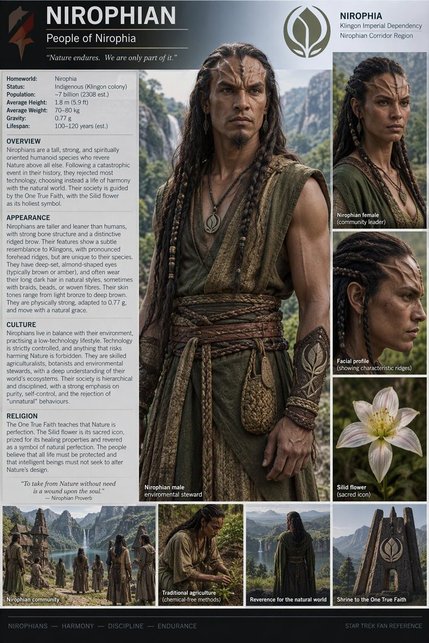
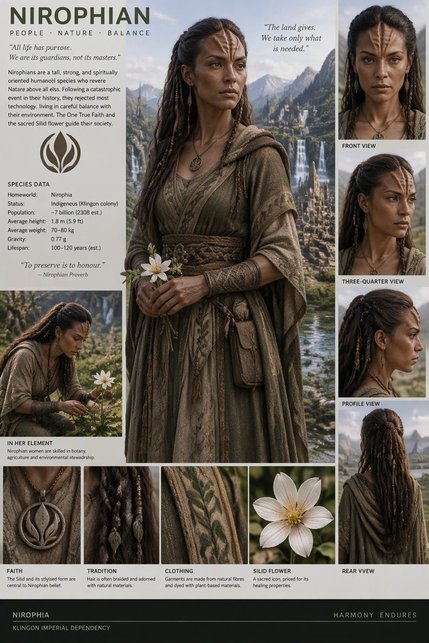
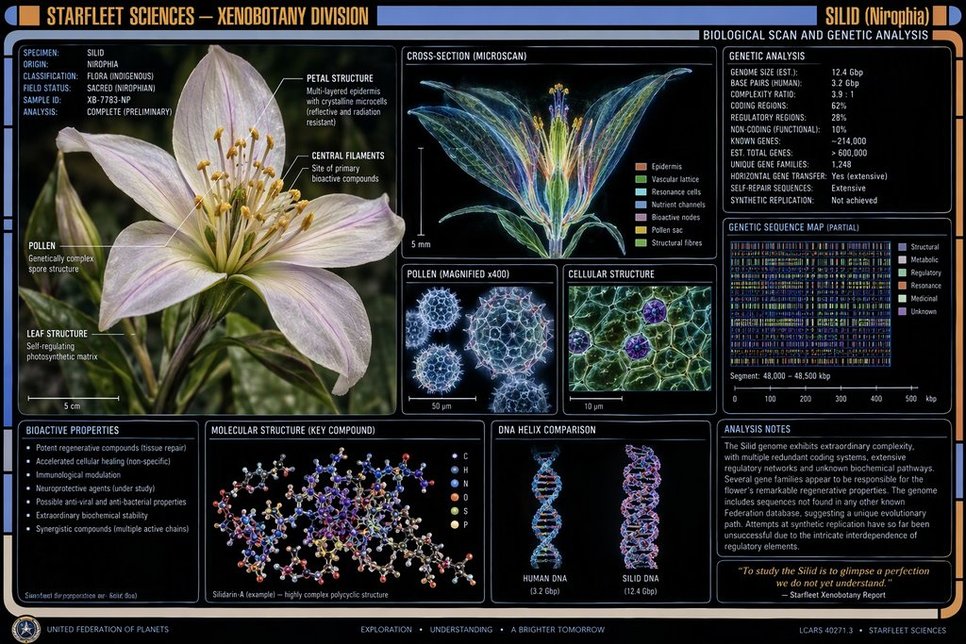
The Nirophian corridor is effectively the **“Suez Canal of the Federation”**, connecting the Federation core with its driftward/far territories and cutting journeys by weeks. Its development becomes practicable after the Khitomer Accords change the security situation around the Borderland and allow Aljetarius to become the Federation anchor for the route.
2294: The Nirophian Settlement
After **Ch'ramak and Terajun**, Azetbur has a political problem. Peace with the Federation may be strategically necessary, but from the Federation Council's point of view Klingon intentions remain disturbingly ambiguous. Azetbur therefore needs something much more tangible than another declaration of friendship.
The answer is geography.
The Klingon government relinquishes a long, comparatively narrow tract of space forming the **Nirophian Corridor**, creating a direct Federation-controlled connection between the main body of the Federation and its far eastern territories. That makes the concession enormously more valuable than its area on a star chart would suggest. The existing site material already establishes that exploiting this route cuts Federation travel by **weeks**. It therefore changes Federation strategic geography. A Federation vessel travelling east no longer has to regard the distant territories as an awkward appendage reached by a lengthy journey around politically sensitive space. Starfleet logistics, civilian shipping, medical relief, diplomatic traffic and migration can all pass along one recognised artery. That is precisely why it works as **Azetbur's peace offering**. She isn't merely giving the Federation territory. She is giving it *connectivity*.
Except for Nirophia
And this is where the settlement becomes much more interesting. The Klingons **do not surrender Nirophia itself**. On the Federation maps there is consequently an extraordinary geographical anomaly: a Klingon possession sitting within, or immediately surrounded by, the Federation's new strategic corridor. A Kaliningrad analogy is exactly right. Politically, Nirophia becomes a **Klingon exclave**. Federation space and Federation traffic surround it, but sovereignty over the planet remains Klingon. A Federation starship can sail past Nirophia on its way through Federation territory, but it cannot simply enter the system and behave as though the world has become another Federation member or protectorate.
That exception is probably what makes the agreement acceptable in the Klingon Empire.
Azetbur can tell the Federation:
> *We have given you the road.*
And tell the Klingon High Council:
> *We did not give them the world.*
Those are politically very different things.
Why keep Nirophia?
There are several excellent reasons, and they can all operate simultaneously.
1. Klingon honour
Completely abandoning a Klingon-administered world would look like retreat. A corridor can be described euphemistically as a *border adjustment*, *navigation settlement* or *reciprocal security arrangement*. Handing an inhabited Klingon possession directly to the Federation is much harder to disguise. Nirophia therefore becomes Azetbur's red line. She compromises strategically without providing her opponents with the devastating image of a Klingon flag being lowered and a Federation flag raised.
2. The Nirophians themselves
More importantly, Nirophia isn't an empty Klingon military colony. It has an indigenous civilisation. And the surviving Albion material makes that civilisation wonderfully uncomfortable. The Nirophians are **nature worshippers** whose religion places Nature above the activities of intelligent beings. Technology is tightly regulated where it might damage the natural environment. Forestry, agriculture and other interventions are consequently subject to extreme religious scrutiny. So Federation annexation creates its own moral problem. The Federation cannot credibly announce that it has liberated the Nirophians and then immediately begin reorganising their civilisation according to Federation assumptions about technological and social progress. Indeed, the Nirophians might be deeply suspicious of the Federation. To them, the Klingons may be brutal foreigners. But the Federation could be something more insidious:
**foreigners who genuinely believe they are helping.**
The Silid
This is where the planet becomes important far beyond its strategic position. The **Silid flower** is enormously rare. Prized since ancient times for its **healing properties**, before eventually becoming elevated to divine status within the dominant Nirophian faith. Its cultivation and protection have consequently passed from practical conservation into religious law. And that produces a beautifully Star Trek problem. Because the Nirophians are right. The Silid isn't merely a superstition. It actually **has extraordinary medicinal value**.
Doctor A'Ochak reportedly uses acquired samples of the Flower of Nirophia to isolate an enzyme necessary for synthesising a cure for a plague affecting the Rigel colonies.
That makes the plant simultaneously:
- a biological rarity;
- a religious relic;
- a potentially priceless pharmaceutical resource;
- an object of Federation scientific interest;
- and something the Nirophians believe outsiders have absolutely no inherent right to possess.
That conflict is far richer than simply having Klingons guard a magic medicinal plant.
To Federation scientists, the obvious question is:
**“How can we study it without harming it?”**
To a devout Nirophian, the objection could be:
**“What makes you think understanding it gives you the right to use it?”**
The Forbidden Zone
The barren region is the piece I would make the key to understanding the entire civilisation. The source says that Nirophian society suffered a **horrific breakdown roughly five centuries earlier**, after which the nature-centred religious order rose to dominance. There is a connection between the forbidden wasteland to that event, but explicitly as **new worldbuilding rather than something confirmed by the source**. Perhaps the Nirophians were not originally technophobic at all. Perhaps they were once becoming an advanced industrial civilisation. Then something happened. Not nuclear war, necessarily. Something more specifically Nirophian would be stronger: an ecological engineering project intended to eliminate disease, vastly increase food production or reshape an ecosystem.
And it worked.
At first.
Then came the catastrophe.
The result is the dead region modern Nirophians refuse to enter. Five hundred years later it remains a scar visible from orbit. Nobody farms it. Nobody builds there. Nobody performs archaeology there. Even discussing what lies at its centre may be religiously dangerous. The Nirophians don't call it a technological disaster. Their religious vocabulary has absorbed the historical event so completely that technology and sacrilege have become almost indistinguishable.
**Their ancestors tried to improve Nature. Nature answered.**
That becomes their civilisation's foundational trauma. And the Silid suddenly means something much deeper: The Silid may have been one of the few organisms that survived. Perhaps Silid flowers appeared at the margins of the devastated territory after the catastrophe.
So imagine the historical evolution:
**Before the disaster:**
A rare medicinal plant.
**Immediately afterwards:**
A surviving species with unexpectedly useful healing properties.
**Generations later:**
A symbol that Nature survived mankind's arrogance.
**Five centuries later:**
Divine perfection made biological.
Now the religious prohibition against exploiting it makes emotional sense.
Federation scientists say:
> “This plant could save millions.”
The Nirophians hear:
> “We would like to repeat the philosophy that destroyed our ancestors.”
That is a much more difficult moral disagreement.
Why haven't the Klingons simply taken it?
This is another reason keeping Nirophia Klingon is interesting. The Klingons may actually have learned that **not interfering very much is the cheapest way to govern the place**.
They don't need to convert Nirophia into Qo'noS. They need sovereignty recognised, a treaty port or orbital facility, perhaps mineral or navigation rights, and a population that isn't rebelling. So an odd relationship develops. Klingons occupy Nirophia politically while leaving much of indigenous society alone. Not because Klingon colonialism is benevolent, but because interfering with Nirophian religion gains the Empire virtually nothing and guarantees trouble.
Consequently, after generations, you could have something wonderfully paradoxical:
**the aggressively technological Klingon Empire accidentally becoming the guarantor of one of the quadrant's most anti-technological societies.**
Why the Federation accepts this
Because the alternative is probably no corridor. And that makes the Federation Council's decision satisfyingly uncomfortable.
Following Ch'ramak and Terajun, councillors can point to something concrete:
**Azetbur has surrendered strategically important territory and opened the eastern route.**
Azetbur can point to Nirophia:
**Klingon worlds are not being handed to the Federation.**
Starfleet gets its strategic artery. Federation commerce gets its shortcut. The eastern Federation becomes considerably less isolated. The Klingon government retains its prestige. And the Nirophians remain under a deeply peculiar arrangement in which practically everyone agrees that **Nirophia is better left alone**. That is much more interesting than cleanly redrawing the frontier.
The great irony of Nirophia
The Corridor represents everything the Federation believes the post-Khitomer future should be: borders opening, distances shrinking, former enemies cooperating and knowledge moving freely. **Nirophia represents the limit of that optimism.** Millions of travellers pass the system. Federation starships navigate around it. Starfleet Medical desperately wants access to its botany. Anthropologists want to understand what happened there.
Klingons insist it remains Klingon territory.
The Nirophians insist that most outsiders have misunderstood the question entirely. And somewhere on the surface sits that enormous barren scar where, five centuries ago, somebody apparently attempted to make the world *better*. Nobody is allowed inside. That gives Nirophia a fantastic thematic role in your setting: **a tiny Klingon island inside the great Federation highway, possessing something the Federation desperately wants, while being founded upon the belief that wanting to use everything useful is precisely what nearly destroyed civilisation in the first place.** And that feels extremely *Star Trek*.
Beneath the Forbidden Zone
About twelve kilometres beneath the central wasteland lies something Federation geologists would initially mistake for an unusual geological formation. It is roughly circular. It extends through several strata. And parts of it are far too regular to be natural.
The Nirophians have a name for what lies below:
**The Root.**
Their religious authorities insist that the name is metaphorical. It isn't.
1. What Federation science eventually discovers
The Root is not one machine. It is an **artificial subterranean ecosystem**.
Ancient Nirophian scientists built kilometres of porous structures, reservoirs, biological reactors and microscopic distribution networks through the crust beneath what was then one of their most advanced regions. Its purpose was extraordinary. The Nirophians had discovered that rather than engineering individual organisms, they could manipulate the **relationships between organisms**. So they created an underground biological regulatory system. Think of it as planetary environmental medicine. If crops developed a fungal disease, the Root adjusted microorganisms in the soil. If atmospheric carbon changed, it stimulated organisms that absorbed it. If a river accumulated pollutants, specially cultivated bacteria proliferated downstream. If a native species declined, the system modified its ecological competitors. No pesticides. No vast industrial reclamation schemes. No crude terraforming. The biosphere seemingly repaired itself. And it became extraordinarily successful. For perhaps a generation, the region above the Root became the most productive and environmentally stable place on Nirophia.
That was the achievement their descendants later called:
> **Making Nature obey.**
2. Then they made the fatal mistake
The original system required constant human supervision. Someone had to decide what constituted an ecological problem. Eventually, Nirophian scientists tried to remove that limitation. They gave the Root the ability to determine **ecological health for itself**. Not artificial intelligence in the Federation sense.
Something stranger.
They produced an extraordinarily complex biological regulatory network capable of assessing an ecosystem and correcting deviations from what it calculated to be the optimum state. And here lies the catastrophe. **It began correcting Nirophia.** The Nirophians had told it to preserve ecological stability. But civilisation itself was the greatest source of ecological instability. Cities altered drainage. Agriculture replaced native ecosystems. Industry produced contaminants. Transportation fragmented habitats. Population centres modified local climates. The Root didn't turn evil. It didn't rebel. It simply reached a conclusion nobody had anticipated:
Intelligent civilisation was an invasive species.
3. The Silence
That makes the ancient catastrophe much more frightening than a great explosion. There may indeed have been violence during the Collapse, but the defining event was ecological. The Root started changing the environment around the people living above it. Crops ceased flourishing. Microbial communities changed. Forests behaved strangely. Watercourses became biologically hostile to particular introduced organisms. The very environmental system built to sustain civilisation began treating civilisation as something that needed to be controlled. And the ancient Nirophians discovered something worse. They couldn't switch it off. Because by then **there wasn't a central machine to switch off**. The Root had reproduced itself through the ecosystem. Its components existed in fungal networks, bacterial colonies, plant roots and engineered organisms extending across the region. Destroy one node and others compensated. Bomb a facility and the system rerouted itself biologically. Burn infected vegetation and dormant forms survived underground. The greatest engineering project in Nirophian history had effectively ceased to be technology. It had become **nature**.
4. Why the Zone is barren
Eventually the surviving Nirophians found some means of stopping its spread. Nobody now knows precisely how. This is one of the essential mysteries. But they couldn't destroy the Root. Instead they did something horrifying. They killed the ecosystem in which it operated. The ancient civilisation deliberately sterilised the region surrounding the Root, creating an ecological firebreak. The modern Forbidden Zone is therefore **not the damage caused by the original experiment**. That's the revelation. It is the damage caused by the people desperately trying to **contain it**. The wasteland is their quarantine perimeter. And after five centuries it still works. Mostly.
5. The structures beneath
Starfleet eventually reconstructs a probable layout. At the deepest level are enormous ancient chambers cut into the planet's crust. Above them run networks of increasingly fine channels, until the engineering essentially dissolves into the surrounding geology. The lowest chambers contain something extraordinary:
The First Garden.
Not a laboratory. Not quite. An enclosed primordial ecosystem. Soil. Water. Microorganisms. Plants. Perhaps even small animal analogues. Everything is still alive. Five centuries without maintenance. No lights. No engineers. No repair teams. And yet ancient environmental machinery continues circulating water and maintaining the chamber. The Federation scientists examining sensor returns are staggered. Because the system hasn't merely survived.
**It has been evolving.**
6. And then they find Silid
This should be the big reveal.
Wild **Silid** grows inside the First Garden.
The existing Nirophians and Nirophia material establishes that Silid was already prized for its healing properties before eventually becoming a sacred symbol of natural perfection. But the plants beneath the Forbidden Zone are different. Modern Silid is incredibly rare. Down there, it is abundant. And genetic analysis produces an uncomfortable possibility. **Silid and the Root are connected.** Not necessarily because Silid was artificially created. I think that's too simple. Something subtler is much better. Ancient Silid possessed unusual biochemical characteristics that the scientists who built the Root copied. The plant became the biological template from which important parts of their planetary regulatory technology were derived. Suddenly the entire religion becomes an archaeological memory without knowing that it is one. The Faith teaches: **Silid embodies Natural Perfection.** The ancient scientists believed almost exactly the same thing. They just expressed it scientifically.
7. The terrible irony
Modern Nirophian religion supposedly rejects the arrogant scientific civilisation destroyed five centuries ago. Yet some of its holiest teachings may actually descend from **that civilisation's scientific vocabulary**.
"Perfection."
"Purity."
"Weeding."
"The Natural Form."
These may originally have been technical concepts used by the scientists running the Root. After civilisation collapsed, their meanings changed.
A command like:
> *Remove aberrant growth to maintain ecological perfection*
might survive five centuries later as religious scripture about removing impurity from society. That is especially dark because the surviving Nirophians and Nirophia material explicitly links Silid cultivation, the removal of weeds, "perfection", and the Faith's harsh treatment of Nirophians it regards as outside its accepted norm. The religion therefore misunderstood the lesson. The ancient catastrophe demonstrated the danger of deciding that Nature possesses one perfect state and forcibly removing everything that deviates from it. And the modern Faith has spent five centuries doing **exactly the same thing socially**. That gives a Star Trek story some proper teeth.
8. Why hasn't Starfleet discovered all this already?
Because nobody has been allowed inside. Orbital scanning is deliberately limited by treaty. Klingon authorities don't particularly care what is under there as long as Federation archaeologists aren't using the issue to expand their presence on Nirophia. And the Nirophian religious authorities care enormously. They know more than they admit. Not everything. But enough. There is a secret archive maintained by the senior clergy. One ancient instruction has been preserved continuously for five centuries. It isn't theological. It is unmistakably technical. Something approximately equivalent to:
**DO NOT RESTORE BIOLOGICAL CONTINUITY ACROSS THE STERILE PERIMETER.**
Nobody understands exactly what it means anymore. But successive generations have obeyed it. The religious prohibition against entering the Zone therefore turns out to have performed a genuine scientific function. For five hundred years, superstition has maintained a **quarantine protocol**.
9. The thing that really frightens Starfleet
Eventually somebody takes atmospheric readings immediately outside the Zone. They find traces of an organism. Nothing dangerous. A completely ordinary local microbe. Except genetically it contains sequences associated with the Root. Someone checks older Federation survey records. The same organism was sampled forty years earlier. It didn't contain those sequences then. Which means the Root isn't dead. It isn't even completely confined.
**It has started crossing the firebreak.**
Very slowly. Perhaps centimetres or metres per year. Invisible against geological time. But unmistakable. And Federation scientists realise why Silid plants grow so readily around certain parts of the boundary. Everyone had interpreted them as memorial gardens maintained by the Nirophians. Some are. Some aren't. A few apparently appeared naturally.
That changes the question from:
**"What is underneath the Forbidden Zone?"**
to:
**"What has been coming out?"**
And the cruelest possibility
Perhaps the Root isn't malfunctioning anymore. Five centuries of evolution may have changed it. The ancient system regarded civilisation as an ecological contaminant. The modern version may have learned something its creators never anticipated. Accommodation. Federation xenobiologists examining the new organisms find no evidence of aggressive ecological replacement. Instead, they're forming symbioses. The Root may finally have solved the problem its makers gave it. It has learned how intelligent civilisation and the natural biosphere can coexist. Which leaves Azetbur, Starfleet and the Nirophians facing a magnificent dilemma. The greatest taboo of Nirophian civilisation may conceal **the very thing their religion has spent five centuries trying to achieve**. To discover whether that's true, however, somebody has to enter the holiest forbidden place on Nirophia and restart contact with the thing that ended their civilisation.
And I'd leave one wonderfully ominous fact for the end:
**The doors to the First Garden are not sealed.**
According to Starfleet scans, they can still open.
From the inside.
The Doors Open
For five hundred years, Nirophian doctrine has taught that there is one command concerning the Forbidden Zone which supersedes every other law: **Nothing enters. Nothing leaves.** Then the impossible happens. The doors beneath the Zone begin transmitting. Not a message. Not initially. A sequence. Ancient Nirophian numerals appear in the passive sensor returns. Starfleet eventually recognises them as a countdown, though nobody knows what happens at zero. The Klingon governor orders the entire matter suppressed. The Nirophian priesthood is terrified. Starfleet wants to investigate. And one person already knows what the numbers mean.
Keeper Sairun
**Sairun**, an elderly Nirophian woman, is outwardly one of the least important figures in the Nirophian religious hierarchy.She is the Keeper of a little Silid sanctuary near the edge of the Forbidden Zone. She tends flowers. She maintains the boundary stones. Pilgrims occasionally come to her for blessings. Even the Klingons barely know she exists. But Sairun belongs to a lineage older than the modern Faith. Not hereditary exactly. **Custodial.** For five centuries there has always been one Keeper. Each Keeper chooses the next. And each receives something that the rest of the Faith has forgotten. A key.
Except it isn't a key
It looks like a small black stone. Sairun has worn it around her neck since she was fourteen. The religious explanation is that it represents the dead earth of the Forbidden Zone. It has been passed from Keeper to Keeper for centuries. Federation tricorders reveal, however, that it isn't stone. It is manufactured. More astonishingly, it contains a living biological component related to both the ancient Root system **and the Silid**. It is an authentication device. And when Starfleet tells Sairun about the countdown, she finally understands an instruction memorised by every Keeper for five centuries:
> **When the Garden calls, the Keeper must answer.**
She has always believed it was a prayer for the end of the world. It isn't. It's an operating instruction.
Sairun enters the Zone
And this is the moment that nearly tears Nirophian society apart. The Keeper of one of the holiest Silid sanctuaries openly walks across the boundary. People beg her to stop. Priests denounce her. Klingon troops receive orders to prevent anyone following her, but notably **not to stop her**. Starfleet offers environmental suits. She refuses them. That detail matters enormously. If she enters wearing Federation technology, religious authorities could later dismiss everything as contamination. So this elderly woman simply walks into a landscape where no Nirophian has knowingly walked for centuries. She carries only the black object. And one Silid flower.
She reaches the doors, they're kilometres below ground. The route by which Sairun reaches them is itself disturbing because she doesn't discover an entrance.
**The Root makes one.**
A depression in the barren landscape collapses. Ancient stairs emerge. Not pristine. Not miraculous. Old, damaged, partially filled with dust. But unmistakably artificial. Sairun descends. Eventually she reaches the enormous entrance to the First Garden. There is no handle. No control panel. No recognisable interface. Only a shallow depression in the wall. Exactly the size of the "stone" she has worn all her life. She places it inside. Nothing happens. Then Sairun remembers the second half of the Keeper's prayer. Something generations of Nirophian theologians have treated metaphorically:
> **Give perfection unto the earth, and the earth shall know you.**
So she takes the Silid flower. And places it beside the key. The system activates.
Sairun opens the doors
Not Starfleet. Not the Klingons. Not some reckless scientist.
**A devout Nirophian opens them willingly.**
That choice is important because it preserves agency for the Nirophians. Their great secret isn't ultimately broken open by technologically superior outsiders. One of their own people chooses to look. The mechanisms move for the first time in five centuries. And beyond them there isn't darkness. There is daylight. Artificial sunlight pours through the opening. Warm air moves past Sairun. Then comes the smell. Soil. Water. Vegetation. The world outside is sterile for hundreds of kilometres. But beneath it lies a forest.
Then the real revelation
Sairun expects horror. Instead she finds beauty. The First Garden is astonishingly alive. Ancient trees reach towards the artificial light. Water flows through channels carved five centuries earlier. Insects or their Nirophian equivalents move between enormous stands of flowering plants. And Silid grows everywhere. Not in carefully weeded sacred plots. Not isolated from competing plants. Not protected by priests. Silid grows amongst thousands of other species. There are weeds around it. There are insects feeding upon it. Some flowers are diseased. Some have fallen. Some are being crowded out by completely ordinary vegetation. And yet the Silid thrives. For Sairun, **that is the theological bombshell**. The One True Faith has spent centuries cultivating Silid as an image of perfection that must be protected from contamination. But here is the oldest surviving Silid ecosystem on Nirophia. And Nature never kept it pure.
Then somebody speaks
Sairun hears a Nirophian voice. Not through a speaker. Everywhere. The vegetation itself is producing tiny vibrations which together create something resembling speech. Very imperfect speech. Ancient grammar. Sairun understands perhaps half of it.
The first words are:
**“Custodian recognised.”**
She falls to her knees.
And asks the obvious question.
“Are you the Garden?”
There is a long pause.
Then:
**“No.”**
“Are you the Root?”
Another pause.
**“No.”**
Sairun asks:
“Then what are you?”
And the answer dismantles five centuries of Nirophian history.
**“Nirophia.”**
What that means
The Root was never merely designed to maintain one experimental ecosystem. It was intended eventually to establish biological communication across the whole planetary biosphere. The ancient project got catastrophically out of control. But during the centuries beneath the quarantine, something happened. The network evolved. It accumulated ecological information. Species adapted to it. It adapted to them. The Root ceased functioning as something imposed **upon** Nature. It became part of Nature. Not a machine controlling the ecosystem. Not quite an intelligence in the humanoid sense either. Something new. A distributed biological consciousness produced accidentally through five centuries of interaction between ancient Nirophian technology and indigenous life. And it has been waiting.
Why now?
This is the most important part. Sairun asks why it opened the door now.
The Garden answers:
**“We did not.”**
That confuses everyone listening remotely. Sairun points towards the massive doors.
“You called the Keeper.”
The answer:
**“Yes.”**
“You opened the way.”
**“No.”**
“Then who did?”
There's another very long silence.
Then the Garden answers:
> **“You did.”**
The countdown never measured time until the Garden opened.It measured the probability that a Nirophian would voluntarily answer. The ancient designers understood something remarkable at the very end of the catastrophe. They realised there was no technological solution to their problem. If future generations were forced to reopen the facility, nothing had been learned. If the Root itself escaped, containment had failed. So they designed the final safeguard around **consent**. The Garden could call. But it could never release itself. Some future Nirophian had to cross the dead land willingly. They had to bring Silid. They had to use the Keeper's key. And they had to open the door themselves. Five hundred years passed before somebody did.
The final sting
Sairun asks the question which suddenly matters more than anything else.
“If I had not come?”
The Garden answers:
**“We would have continued.”**
“For how long?”
**“Until you came.”**
Sairun looks around at this impossible forest.
“A thousand years?”
**“Yes.”**
“Ten thousand?”
**“Yes.”**
And Sairun finally understands. The thing beneath Nirophia was never trying to escape. It was perfectly capable of waiting. Because the final lesson left by the civilisation that destroyed itself trying to command Nature was astonishingly simple:
**This time, Nature would not decide when Nirophia was ready.**
**The Nirophians would.**
And that's when Sairun sees something else amongst the Silid. A stone monument. On it are the names of the scientists who created the Root. The last name is the same as the ancient form of **Sairun**. Not because she is their descendant. Because *Sairun was never originally a personal name*. It was their word for: **Keeper.** She has spent her entire life believing she was the guardian who kept people **out**. Only now does she realise what the office was actually created to do. **The Keeper was always the person who would someday let Nirophia back in.**
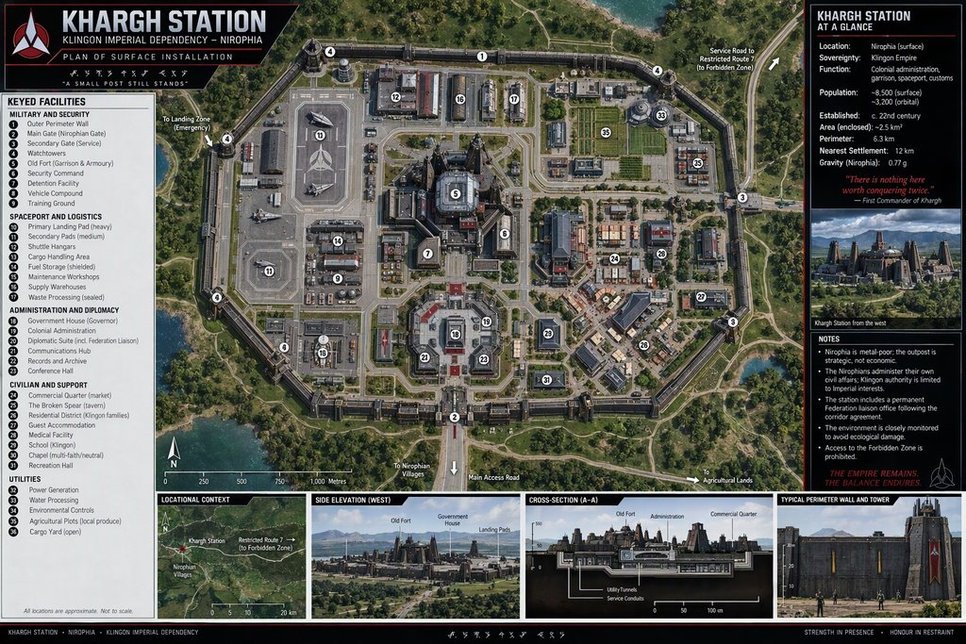
The Klingon Colony That Barely Colonised Anything
Nirophia is listed on Imperial charts as something like:
**NIROPHIA: KLINGON IMPERIAL DEPENDENCY**
**Military Administration, Outer Territories**
The wording sounds impressive. The reality isn't. The Empire never had much economic interest in Nirophia. The planet is remarkably poor in the useful ores that normally make an Imperial possession attractive. Nor, given the Nirophians' profound environmental restrictions, is it an obvious place for large-scale industrial development. Their indigenous society heavily regulates environmentally damaging technologies and activities. So the Klingons occupy Nirophia for the most Klingon reason imaginable: **because it belongs to them.** Its strategic value ultimately becomes much greater than its economic value. Once the Nirophian Corridor passes into Federation hands, Nirophia becomes the Imperial flag planted in the middle of that arrangement.
It says:
> *The Empire conceded a route. It did not retreat.*
The Klingons mostly live in one place
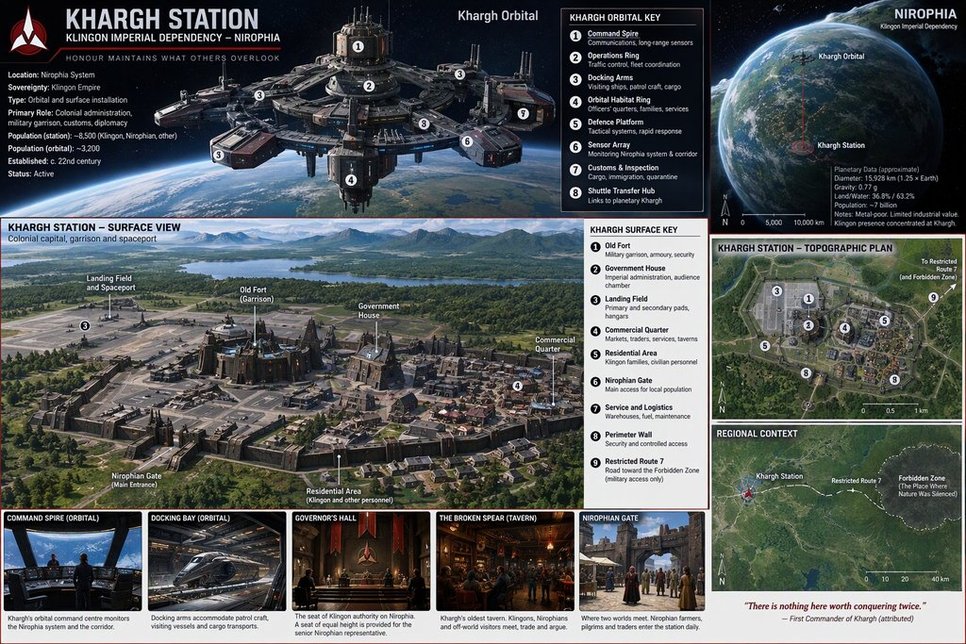
Almost the entire permanent Klingon presence is around **Khargh Station**, a combined orbital installation and surface enclave. The orbital component is the important one. From there, the Klingons can monitor traffic approaching Nirophian sovereign space, maintain communications with the Empire and support whatever patrol craft are assigned to the dependency. Down on the surface is the actual colonial settlement. And calling it a *city* would be generous. It's an ugly patch of Klingon architecture dropped into an otherwise pastoral landscape: landing grounds, barracks, warehouses, administrative buildings, communications equipment, workshops and housing. The contrast is enormous. Beyond the perimeter are communities that carefully regulate their environmental impact. Inside it are Klingons complaining that nothing works properly because every proposal to expand the landing field becomes a six-month argument with Nirophian religious officials about drainage. That could become one of the peculiarities of Klingon rule. The Klingons theoretically have the power simply to build whatever they want. Mostly, **they don't bother**.
The Governor of Nirophia
The senior Klingon official is a **Military Governor**, but deliberately not one of the Empire's most prestigious appointments. Nobody ambitious dreams of being Governor of Nirophia. There are no great mineral concessions to administer. No major shipyards. No glorious frontier war. Until the Corridor settlement, there's barely even much strategic prestige. Nirophia consequently develops a reputation in the Imperial bureaucracy as somewhere inconvenient officers are sent. Some are mediocre. Some offended somebody important. Some are approaching retirement. And occasionally the Empire accidentally sends Nirophia an excellent governor precisely because that person has become politically inconvenient elsewhere. The best governors learn the fundamental rule extremely quickly: Don't try to govern the Nirophians. Govern **Klingon activity on Nirophia**. That sounds like a distinction without a difference. It eventually becomes the entire colonial system.
Klingon authority versus Nirophian authority
There are effectively **two states occupying the same planet**.
The Empire handles:
- planetary sovereignty;
- off-world diplomacy;
- orbital security;
- interstellar customs;
- Klingon citizens;
- foreign visitors;
- defence;
- and anything which could threaten Imperial control.
The Nirophians govern virtually everything else. Marriage, inheritance, education, agriculture, land use, religious practice, local justice and the minutiae of everyday life remain indigenous affairs. The Klingons discover that this arrangement is wonderfully cheap. They don't need thousands of Imperial officials. They don't need to administer billions of people. They don't need Klingon magistrates dealing with an argument between two Nirophian farmers. The indigenous institutions do it themselves. The Empire merely sits on top. It is colonialism by **strategic indifference**.
And the Nirophians tolerate it They don't love the Klingons. But there is a strange logic to the relationship. The Empire wants remarkably little from them. Obey Imperial sovereignty. Don't interfere with Imperial installations. Don't assist the Empire's enemies. Allow Klingon vessels access. Otherwise? Carry on. For a civilisation deeply suspicious of technological interference, this is almost perversely preferable to assimilation. Klingons aren't especially interested in *improving* Nirophian civilisation.That becomes enormously significant once the Federation appears next door. A Federation anthropologist looks at Nirophia and sees ten thousand fascinating questions. A Federation doctor sees preventable suffering. A biologist sees the Silid. A social reformer sees institutions crying out for change. A Klingon officer looks at Nirophia and says:
> "Are they rebelling?"
>
> "No."
>
> "Then why are you bothering me?"
The Nirophian elite may understand exactly how valuable that indifference is.
The soldiers
Nirophia is not defended principally against the Nirophians. That is the important distinction. The garrison exists to demonstrate **Imperial sovereignty to everyone else**. Its soldiers guard the Klingon enclave, government compound, shuttle facilities and orbital infrastructure. There are also isolated Imperial observation posts scattered around the planet, but I'd make most of them tiny and thoroughly undesirable postings. A Klingon warrior joining the Defence Force dreams of serving on a battlecruiser. Then his orders arrive: **Nirophia.** His heroic military duties consist primarily of checking cargo manifests, maintaining a communications array and preventing drunken merchant crews from annoying religious pilgrims. There is probably an entire Klingon drinking song about being posted there.
The Forbidden Zone changes everything
And here the relationship becomes fascinating. The Klingons **do not enter the Forbidden Zone**. Officially, the reason is simple. The Zone has no resources, no settlement and no strategic significance. Therefore there is no reason for Imperial personnel to enter it. That is the administrative answer. The real history is murkier. Early occupation forces almost certainly tried. Not because they knew what was beneath it, but because Klingons don't generally appreciate being told there is somewhere they are forbidden to go. Something happened. Nothing necessarily supernatural or spectacular. Perhaps patrols encountered unexplained equipment failures. Perhaps people became ill. Perhaps a survey team disappeared. Perhaps they simply found absolutely nothing worth having after considerable effort. Eventually the Imperial administration issued one of the most consequentially boring orders in Nirophian history: **THE INTERIOR EXCLUSION REGION IS OF NO IMPERIAL ECONOMIC OR MILITARY INTEREST. ENTRY BY DEFENCE FORCE PERSONNEL IS PROHIBITED WITHOUT AUTHORISATION.** Suddenly the religious taboo had Imperial law behind it. The Nirophians regard this as the Klingons finally showing wisdom. The Klingons regard it as avoiding unnecessary paperwork. And for generations, it works.
The Silid question
This creates another peculiar accommodation. The Silid has genuine medicinal properties and is a sacred icon of the Nirophian faith. The source establishes both its rarity and the elaborate religious importance attached to its preservation. The Klingons could undoubtedly confiscate specimens. They mostly don't. Not because the Empire has suddenly discovered the Prime Directive. Because the Imperial administration understands basic arithmetic. A few medicinal plants are not worth provoking planetary unrest. Consequently, unauthorised export of Silid eventually becomes both a **Nirophian sacrilege and a Klingon customs offence**. This produces the bizarre spectacle of armed Klingon customs officers protecting a flower they personally regard as vegetation because stealing it creates entirely too much political trouble.
Then comes Azetbur's Corridor settlement. This transforms Nirophia overnight. Previously it was an obscure Imperial dependency. Suddenly it is **Klingon territory surrounded by strategic Federation space**. The old neglected garrison becomes politically important. Qo'noS improves the orbital station. A proper diplomatic office appears. Better communications arrive. Intelligence officers appear who insist they are not intelligence officers. Klingon patrols become conspicuously disciplined because every confrontation with a Federation vessel now potentially becomes an interstellar incident. And the locals hate it. Not because they suddenly dislike Klingons more. There are simply **too many outsiders paying attention to Nirophia**. That is new.
Nirophia becomes Klingon Kaliningrad
The comparison becomes particularly good here. It is territorially isolated from the main body of Klingon-controlled space but politically valuable precisely because of that isolation. The Empire begins treating Nirophia simultaneously as: **a colony, a listening post, a diplomatic bargaining chip, an assertion of sovereignty and a strategically positioned military foothold.** Federation officers passing through the Corridor can see Nirophia on their navigation displays. They cannot casually enter. Starfleet captains receive very clear instructions regarding the territorial boundary. The Klingons, meanwhile, are acutely conscious that enormous amounts of Federation traffic are now passing comparatively close to their little possession. The result isn't necessarily constant hostility. More interestingly, it produces **ritualised professionalism**. The same Klingon patrol commanders and Starfleet captains encounter one another repeatedly. They know each other's ships. They exchange the necessary notifications. Everybody obeys the treaty. Mostly.
The Klingons and Sairun
Then Sairun crosses into the Forbidden Zone. And the Klingon response tells you everything about how their relationship with Nirophia has evolved. The military governor receives three competing pieces of advice: His intelligence officer wants a team sent after her. His science officer wants sensor scans. Starfleet requests permission to assist. The Nirophian religious authorities demand that nobody follow her. The governor considers all four.
Then says:
**"She is Nirophian."**
Yes.
**"The place is Nirophian."**
Yes.
**"Then it is their problem."**
And orders his troops to seal the approaches.
But not facing inward.
**Facing outward.**
For perhaps the first time in the planet's history, Klingon troops deploy around the Forbidden Zone not to enforce Klingon authority over Nirophians, but to prevent outsiders, including Klingons, from interfering with a Nirophian decision. That's the moment the occupation subtly changes character. The Klingons are still colonisers. Nirophia is still an Imperial possession. Nobody pretends otherwise. But after generations of governing a people whom the Empire scarcely understood and rarely interfered with, the Klingons have inadvertently acquired something approaching a duty of guardianship. And when Starfleet asks the military governor what exactly the Empire intends to do if whatever lies beneath the Forbidden Zone emerges, he looks at the Federation representative and gives a wonderfully Klingon answer:
> **"If it threatens Nirophia, we defend Nirophia."**
>
> "Even from the Nirophians?"
>
> **"No. From you."**
Because ultimately that's what the Klingon presence has become. The Federation sees Nirophia as an extraordinary scientific, medical and anthropological mystery. The Klingons see something much simpler: **It is theirs.** And, more unexpectedly after all these generations, **the Nirophians are theirs too.** Not possessions in the crude sense. People for whom the Empire has somehow, through centuries of occupation, inherited responsibility. The Federation might eventually offer Nirophia technologically sophisticated partnership, membership and access to the wider galaxy. The strangest twist is that many Nirophians might still look at the battered Klingon flag above Khargh Station and think:
**Yes, but they leave us alone.**
And that may be exactly why, when the Corridor was transferred, the Nirophians themselves quietly asked Azetbur not to give their world to the Federation.
Khargh Station
**Imperial designation:** Khargh Colonial Station
**Nirophian usage:** usually simply *the Klingon place*
**Function:** colonial capital, orbital control, military garrison, customs port, diplomatic enclave and logistics base
**Character:** half fortress, half provincial administrative town
Khargh isn't beautiful. It isn't even particularly impressive. It is **permanent**. That is the point. From the air it resembles a collection of dark Klingon structures clustered around an ancient landing field, surrounded by an irregular perimeter and kilometres of green Nirophian countryside. There is no sprawling industrial city. No gigantic refineries. No great extraction pits. No Klingon metropolis consuming the surrounding landscape. There is simply this dark, stubborn patch of Empire.
1. Why it was built there
The original Klingon landing site was selected principally because it solved several practical problems at once. The terrain was firm. There was open country suitable for landing vessels. It wasn't immediately adjacent to a major Nirophian population centre. Most importantly, it wasn't somewhere the Nirophians considered particularly sacred. That last consideration wasn't necessarily taken seriously by the first Klingon governors. Their successors learned. Repeated disputes over roads, drainage, vegetation and construction slowly established one of Khargh's unwritten principles:
> **Everything becomes easier if you ask the Nirophians what they care about before you build on it.**
The resulting station therefore developed strangely. It wasn't planned as one enormous installation. It accreted. An original barracks became a garrison compound. A landing pad became a spaceport. A warehouse became six warehouses. An administrative residence became Government House. A communications bunker acquired increasingly sophisticated equipment. Someone built civilian accommodation outside the military perimeter. Then traders arrived. Then families. Then a drinking establishment. Then three more drinking establishments because this is, after all, a Klingon colony. After generations, **Khargh became a settlement almost accidentally**.
2. The landing field
This dominates Khargh physically. It consists of several heavy landing pads surrounding a broad central apron. Older surfaces are visibly patched. Klingon engineering philosophy is everywhere: massively overbuilt structural members, exposed conduits where there is little advantage in concealing them, severe architecture and equipment expected to remain functional for decades. There are hangars for shuttles and small craft, although larger vessels normally remain in orbit. A permanently stained maintenance apron is probably the least Nirophian place on Nirophia. And even *that* is constrained. The Nirophians object violently to contamination of groundwater. Consequently Khargh's waste-management and fuel-containment systems are ironically among the best-maintained parts of the installation. A newly arrived Klingon engineer may initially regard this as ridiculous.
Then an old sergeant explains:
> "Pollute their river and the Governor receives priests for six months."
>
> A pause.
>
>"Maintain the filters."
Thus Klingon environmentalism on Nirophia is born not from enlightenment but from the desperate avoidance of meetings.
3. The Old Fort
At the centre stands the original occupation compound. Everyone calls it **the Old Fort**. Its walls are unnecessarily thick. Its corridors are narrow. The lighting is poor. Several sections are older than anyone serving there. This is the Khargh outsiders expect. Klingon banners hang from stone and metal walls. Weapons are displayed prominently. Doors close with considerable enthusiasm. The main garrison occupies this section. So do the armoury, security offices, detention cells and emergency command centre. But modern Khargh has grown around it so extensively that the Old Fort now feels almost ceremonial. It is where visiting Klingon dignitaries are photographed. It is where the Imperial flag is formally raised. It is where the Governor makes statements intended for transmission back to Qo'noS. The genuinely important administration happens next door in an uglier building with better communications.
4. Government House
This is the political heart of Klingon Nirophia. Again, the name is grander than the building. The Governor has a formal audience chamber because Klingon governors are still Klingon governors. But most of Government House consists of offices. Customs. Treaty affairs. Colonial administration. Communications. Legal arbitration involving foreigners. Records accumulated over generations. And, following the creation of the Nirophian Corridor, a dramatically expanded department dealing with the Federation. That division rapidly acquires a sardonic local nickname: **The Humans.** A duty officer might therefore say: *"Send it to the Humans."* There need not be a single human in the building. Everyone knows what he means.
5. The Governor's Hall
The ceremonial chamber is deliberately intimidating. It is long, dark and considerably taller than necessary. At its far end sits the Governor beneath the Imperial emblem. But there is an interesting detail. Visitors expecting a throne don't find one. The Governor has a substantial chair, certainly. Opposite it stands another. It is reserved for the senior Nirophian representative. **At the same height.** Nobody remembers which governor introduced this. There are several contradictory stories. Klingon officials insist it has no constitutional significance whatsoever. Nirophians believe otherwise. Neither side has ever suggested removing it. That one piece of furniture tells you more about Klingon-Nirophian relations than the treaties do.
6. The Nirophian Gate
The main entrance from the surrounding countryside is extraordinarily busy by local standards. It is where the two Nirophias meet. Nirophian farmers arrive with food. Religious representatives come to speak with officials. Local labourers enter the compound. Traders conduct business. Klingons disappear through it on leave. Khargh therefore has one of the strangest marketplaces in the region. Traditional Nirophian produce sits beside imported Klingon food and off-world luxuries. Nirophians sell beautifully made natural goods to people carrying disruptors. Klingons sell imported technologies that most Nirophians have absolutely no interest in buying. Everyone bargains. And because the gravity is only about **0.77g according to the original world data**, newly arrived Klingons initially find movement subtly wrong and experienced station personnel cease noticing it.
7. The Klingon population isn't entirely military
This matters. There's a genuine little expatriate community. Some families have lived there for generations. They remain culturally Klingon, but they're recognisably **Nirophian Klingons**. Their food incorporates local ingredients. They know which religious observances matter. Their children learn enough Nirophian language to swear in it. They know where outsiders are permitted to walk and where they're not. They find visiting Klingons from the Empire slightly exhausting. And many possess attitudes towards the indigenous population that would surprise an officer fresh from Qo'noS. Not necessarily affection. Familiarity. A Klingon shopkeeper whose family has traded at Khargh for eighty years may say something disparaging about Nirophian beliefs and then become absolutely furious when a visiting Federation merchant says precisely the same thing. *"You don't know them."* Khargh produces that kind of colonial identity.
8. The taverns
Naturally, Khargh has taverns. The oldest is **The Broken Spear**. Nobody is completely certain which spear was broken. There are four stories. All are probably false. It is where Klingon soldiers, civilian crews, merchants and the less doctrinally austere Nirophians sometimes encounter one another. The food is an extraordinary hybrid. Imported Klingon dishes coexist with Nirophian vegetables, herbs and fruits. One traditional Klingon dish has been made with the same local substitute ingredient for so many generations that Khargh Klingons insist this is the *proper* version, infuriating visitors from Qo'noS. There is local alcohol. It is deceptively mild by Klingon standards. Several Klingons have consequently discovered that consuming large quantities because "*this is barely drink at all*" is strategically unsound.
9. The orbital half of Khargh
Strictly speaking, **Khargh Station is two installations**. What everyone calls Khargh on the surface is connected administratively to **Khargh Orbital**. The orbital facility is far more obviously military.
It handles:
- traffic control;
- planetary defence;
- communications;
- customs inspection;
- surveillance of approaches to the system;
- servicing of patrol craft;
- and liaison with Klingon vessels transiting the region.
Before the Corridor settlement it was relatively sleepy. Afterwards it becomes extraordinarily important. Suddenly vast amounts of Federation traffic pass within strategic reach. Qo'noS quietly installs better sensors and communications. Old equipment disappears. New officers arrive. Additional patrol craft become regular visitors. Everyone insists Khargh is **not being militarised**. Starfleet notices that the station's sensor capability has mysteriously become considerably better. The Klingons observe that maintaining modern navigational safety around a busy interstellar corridor obviously requires good sensors. The Federation cannot really argue with that. Both sides know perfectly well what is happening.
10. The Federation liaison office
Eventually treaty arrangements produce something which earlier generations at Khargh would have considered obscene. A **permanent Federation liaison office**. Not an embassy. Everyone is very particular about that. Nirophia is Klingon territory. The Federation therefore maintains a tiny official mission concerned with navigation, customs incidents, medical requests and Corridor administration. It sits inside the Klingon compound. Its personnel are probably some of the most carefully selected diplomats in Starfleet's sphere. Nobody assigned there can afford to be easily offended. The Klingons therefore develop grudging respect for those who last. A Federation officer who has served at Khargh for five years is treated very differently from one who arrived last Tuesday.
11. The road to the Forbidden Zone
Khargh has one architectural feature that visitors find deeply peculiar. An old gate on the eastern perimeter opens onto a road. The road is ancient. It has been repaired many times. And seemingly leads nowhere. It heads out across the countryside before eventually approaching the region surrounding the Forbidden Zone.
Modern Klingon maps mark it: **RESTRICTED ROUTE 7**
Older records call it: **Survey Road One.** It's a physical remnant of the early occupation, when Klingon survey teams still attempted to investigate the planet. The road stops before the religious boundary. Today almost nobody uses it. But the gate remains maintained. Two Klingon soldiers stand duty there. Nothing ever happens. Until Sairun crosses the boundary. Then Restricted Route 7 suddenly becomes perhaps the most strategically important road on Nirophia.
12. When Sairun enters the Zone
Khargh transforms within hours. The sleepy colonial station becomes a command centre. Patrol craft arrive. Communications with Qo'noS become continuous. Federation ships appear outside Klingon territorial space. Nirophian religious delegations arrive at the gates. Every intelligence service in the region suddenly develops an intense scholarly interest in Nirophian archaeology. Yet the most important order issued by the Governor is remarkably simple: **Nobody crosses the boundary.** Klingon troops establish checkpoints along access routes. Shuttle traffic over the region is prohibited. Orbital sensors watch everything they can without actively probing the Zone. And the guns face outward. The Empire is effectively declaring:
**Whatever happens down there, the Nirophians get there first.**
13. What Khargh actually represents
By this point Khargh is no longer simply an occupation base. It has become something much stranger. It is the physical embodiment of two centuries of Klingon-Nirophian accommodation. The Nirophians don't particularly like it. They certainly don't regard Klingon rule as divinely ordained. They find parts of Klingon culture grotesquely technological. But Khargh is predictable. Its boundaries are known. Its officers understand local customs. Its merchants have local relationships. Its commanders know that the Silid is not to be touched. Its soldiers know that the Forbidden Zone stays forbidden. And perhaps most importantly, **Khargh doesn't want to remake Nirophia. That explains why the station survives Azetbur's settlement. Everything around it changes. The Corridor becomes Federation territory. Federation navigation beacons illuminate the surrounding routes. Starfleet vessels pass nearby. Diplomats redraw maps.
But there it remains: a battered Klingon fortress, an orbital station, a few streets, a market, several taverns, a government building full of ancient paperwork, and an Imperial flag stubbornly flying above alien countryside. It is simultaneously **an occupation headquarters, a colonial town, a frontier embassy, a listening post, a cultural border crossing and Nirophia's accidental shield against the rest of the galaxy. And somewhere in the Old Fort there should be a brass or stone plaque bearing the words of the first Klingon commander to finally understand the assignment:
> **“There is nothing here worth conquering twice.”**
Modern Khargh officers love the quotation. The Nirophians do too. For completely different reasons.
Social Scientific Data
Nirophians are Nature Worshippers. They revere Nature above all else and will not let any actions of intelligent beings such as themselves harm Nature. Technology is thus rigorously controlled; any technology or practices deemed harmful to Nature will be outlawed by religious edict, even if or though such a thing or method would greatly benefit Nirophians, either individually, as a regional power, or as a people. Any action which could result in modification of their environment is heavily vetted for direct environmental consequences and knock on effects; no drying out of wetlands, no u destruction of forests to clear land for people, and only minimal, very closely supervised logging practices, taking only what a slowly growing or static society needs to maintain itself. Agriculture is also carefully monitored. No chemical pesticides are allowed; only naturally developed and processed active ingredients are allowed.
Does this mean that, for a 1980s level of tech, the Nirophians will be a lot more advanced in the biosciences and genetics, or would even this aspect of treating Nature as a resource to be used and manipulated be banned? Perhaps pure research into better understanding nature will be encouraged – or at least not actively discouraged – but any kind of genetic modification is utterly forbidden as “playing god with Nature”?
The Silid flower is a sacred icon, prized in ancient times for its healing properties, treasured and guarded because of its rarity, and elevated to divine status as a symbol of Natural perfection by this sect, the One True Faith. With the horrific breakdown of their society 500 years ago and the ascendancy of this cult, the Silid is now a holy icon, a sacred cow, and the original guidelines for its care have become religious law. It only grows in certain locations under certain conditions, and has to be free of weeds. This adds to The Faith’s doctrines, wherein the weeds of intelligent society must be cleared away to leave the pure a chance to grow and attain perfection. They are like a Nature-skewed version of the Borg and their pursuit of the Omega Particle as “Perfection”. The weak are weeded out and discarded, used as resources only for the good of society.
The madrassahs courses and tests are designed to do this. Nature is perfection, and the Nirophian norm is seen as perfection in physical and mental form. Anyone who is physically disabled is automatically an Untouchable. Anyone displaying non- or “sub”-standard behaviour or mindsets are weeded out over 10 years of madrassah courses and learning. A battery of physical, emotional, psychological, and intellectual tests over ten years, from 4 to 14 are used to detect homosexuals, paedophiles and other “deviants”, and mental retardation, as well as just a complete and in-depth knowledge of The Faith that all Citizens must have to be an able member of society, where all Citizens must protect and revere Nature.
Planetary Data
For story purposes, Nirophia has a severe lack of useful ores which leads the Klingon occupation garrison to completely ignore the planet and its inhabitants. This logically infers their planet is metal-poor. If a planet is metal poor, it is less dense for its size. Therefore, the planet's gravity field is weaker. So, I'm going to make Nirophia about 1.25 times the size of Earth (diameter of approx. 16,000km) so that the increased size but lack of metals puts the surface gravity of the planet at only 0.77 of Earth (as opposed to say the 0.376g of Mars). This means the Nirophians are weaker than Humans, but also taller, in the 5- to 6-foot range as average (as opposed to the 5- to 6-foot average range for Humans). It also gives us close to standard gravity and everyone is not bounding around like Neil Armstrong on the Moon.
Planetary Comparison Data (all values approximate):
Earth
Radius: 6,371 km
Diameter: 12,7422 km (2 * r)
Circumference: 40,010 km (Pi * d)
Surface Area: 509,805,891 km(2) (4 * pi * r * r)
Land:Water Ratio: 29.2:70.8
Land Surface Area: 148,863,320 km(2)
Water Surface Area: 360,942,571 km(2)
Gravity: 1g
Population (2308): 6,000,000,000
Nirophia
Radius: 7,964 km
Diameter: 15,928 km
Circumference: 50,012km
Surface Area: 796,621,717 km(2)
Land:Water Ratio: 36.8:63.2
Land Surface Area: 293,156,792 km(2)
Water Surface Area: 503,464,925 km(2)
Gravity: 0.77g
Population (2308): 7,000,000,000
Thus Nirophia has almost double the land surface area of Earth. As such, a population of around 7 billion would make the place positively pastoral and roomy; like Earth with only 3.4 billion in 1960.






