"Vulcan - like going to a monastery or Abbey; a punishment of silence and emotional repression that surfaces every seven years. Vulcan itself? Irrepressibly hot; full of clones that repress their emotions. The deserts are beautiful and the architecture impressive. The people are just too afraid of their passions to feel them." - Cadet Nathaniel Hawkins.
Vulcans are one of the founder races of the Federation. April 4th 2063 saw the Vulcans making First Contact with Zephram Cochrane and the people of Earth. Vulcan civilisation is thousands of years older then human. Vulcans were once passionate, violent people who were ruled by their emotions. This path to self-destruction was eventually halted by the philosophy of Surak. Surak united the people of Vulcan, teaching them logic and discipline. One group of Vulcans did not accept this philosophy, they took starships and fled to the stars. They became the Romulans.
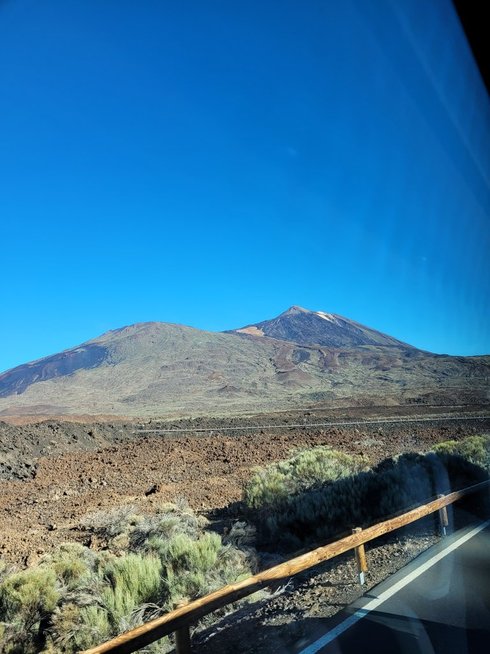
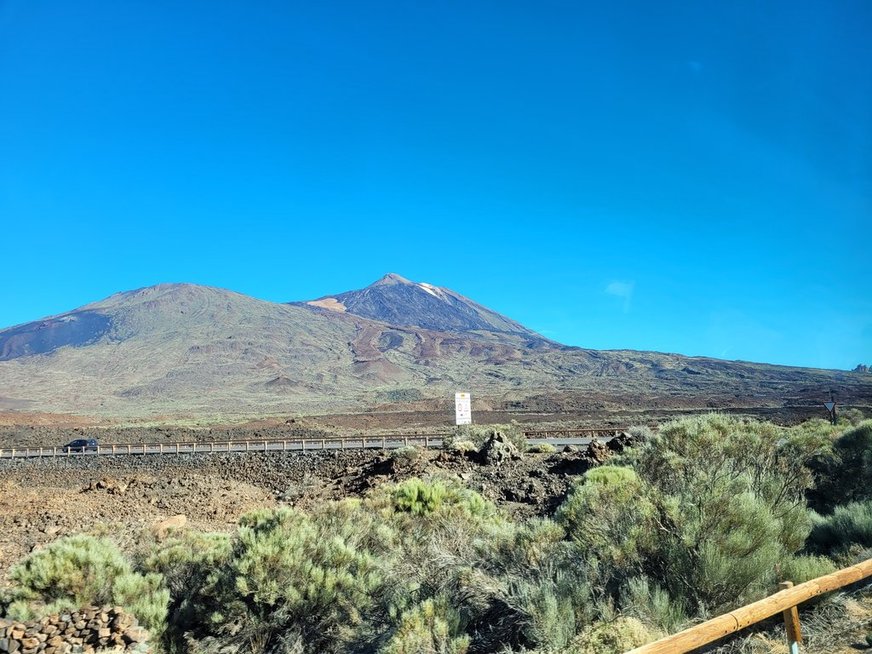
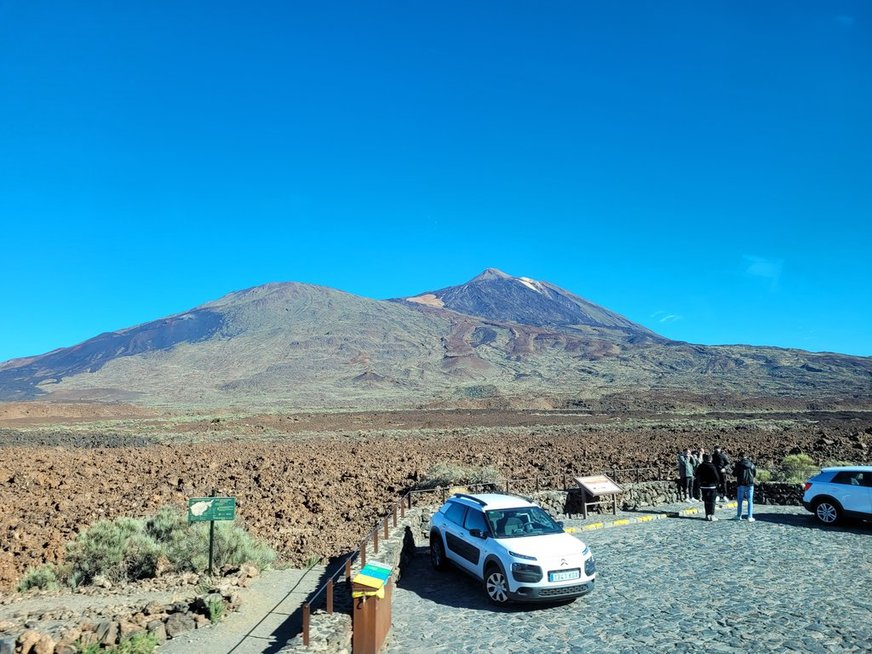
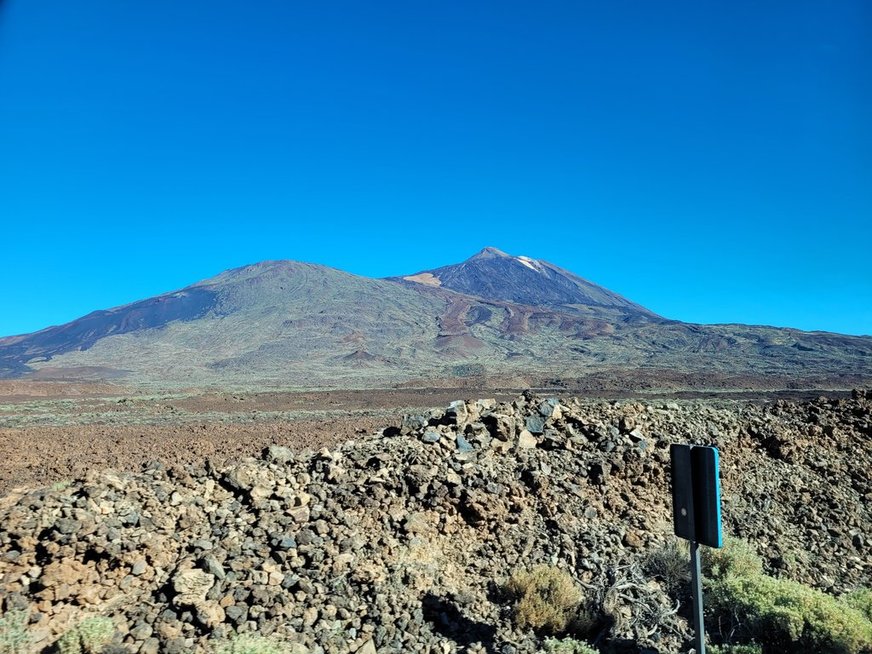
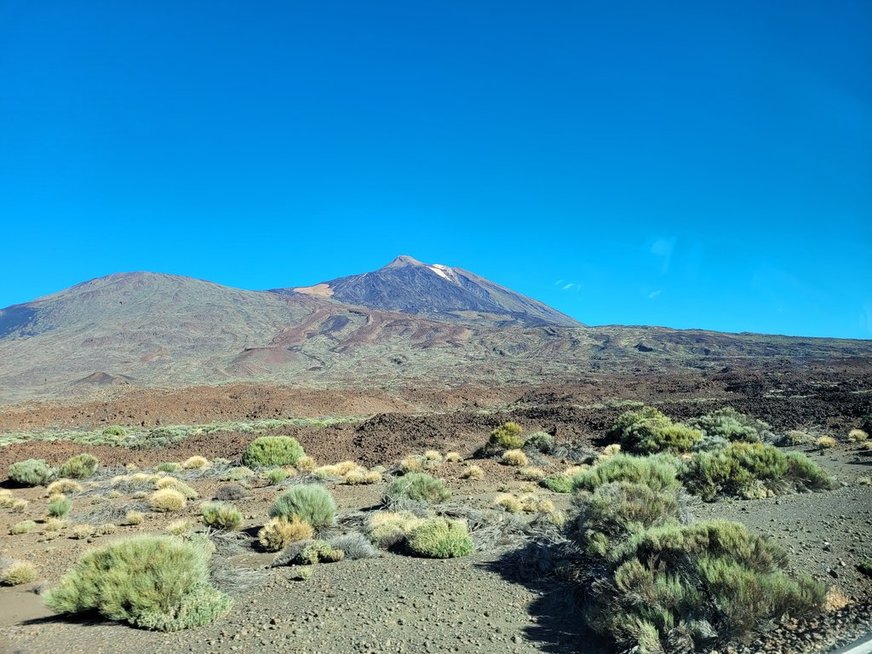
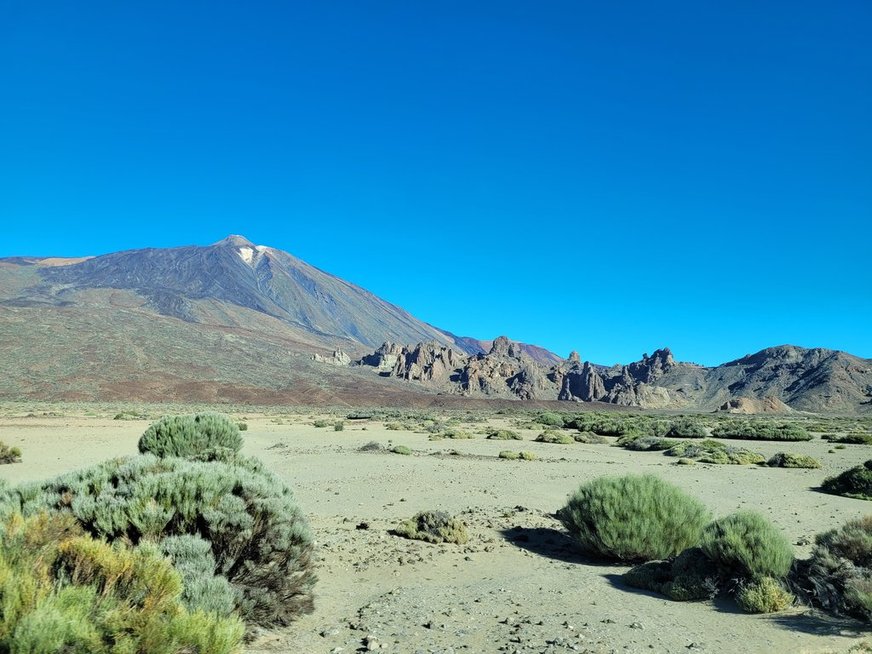
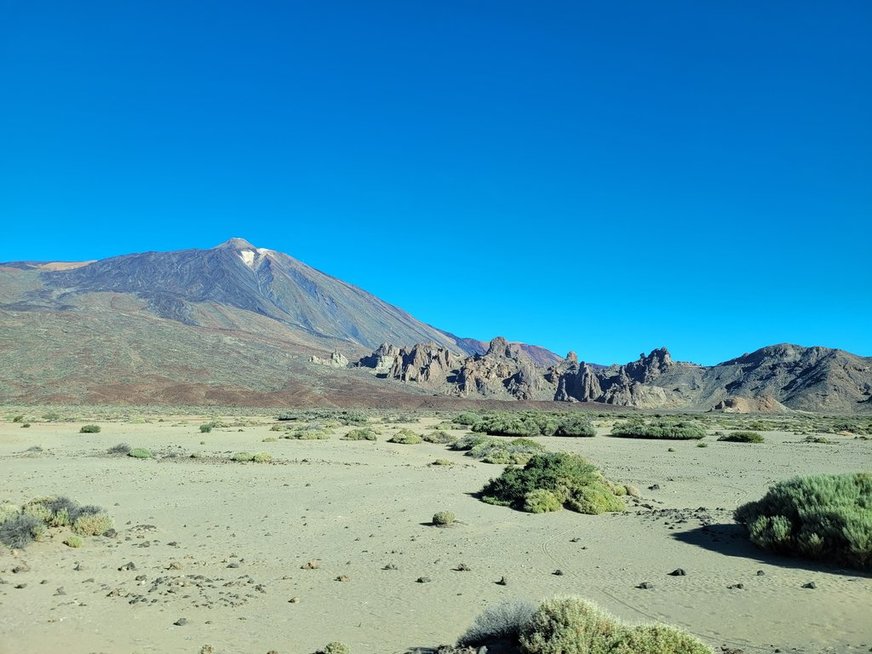
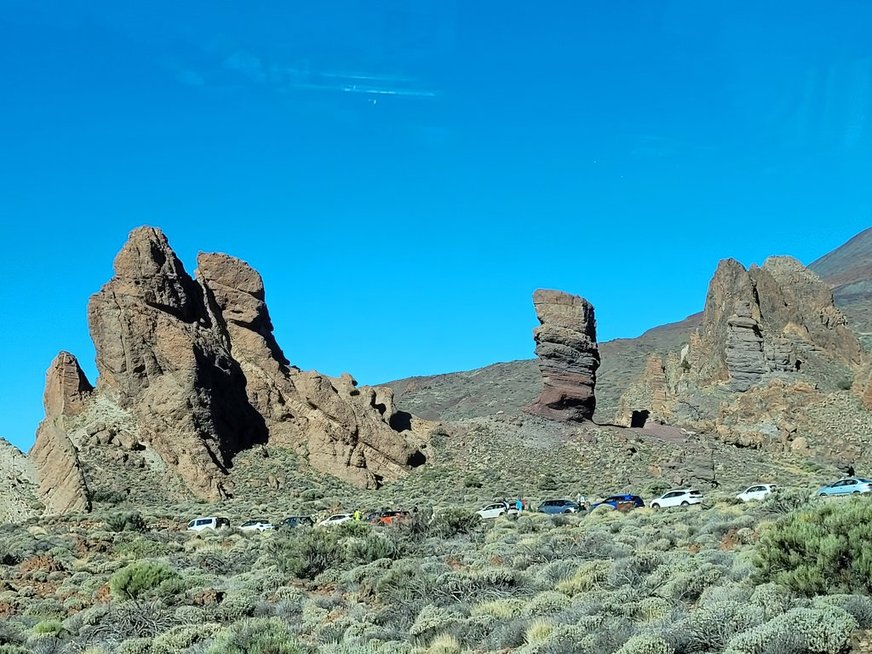
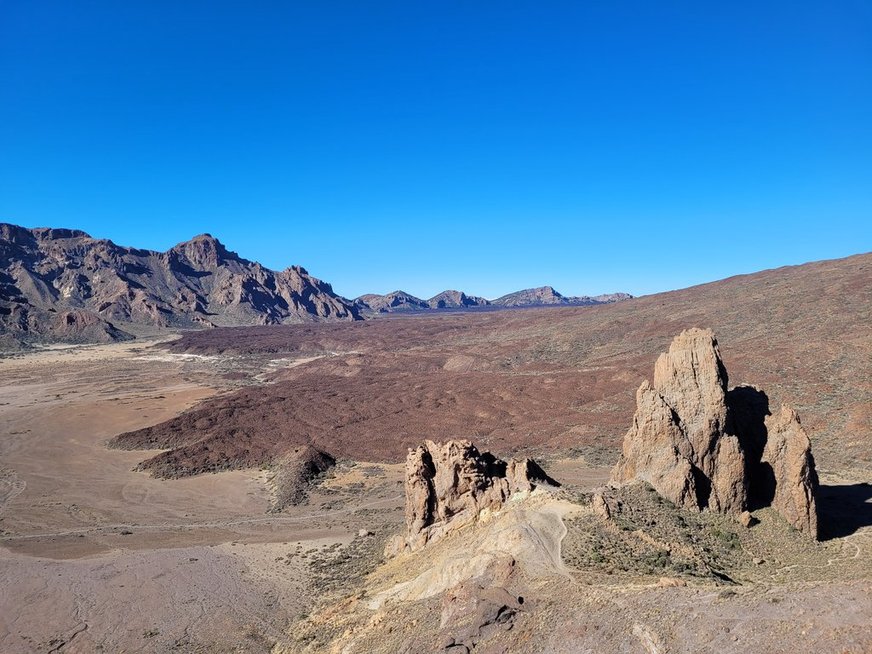
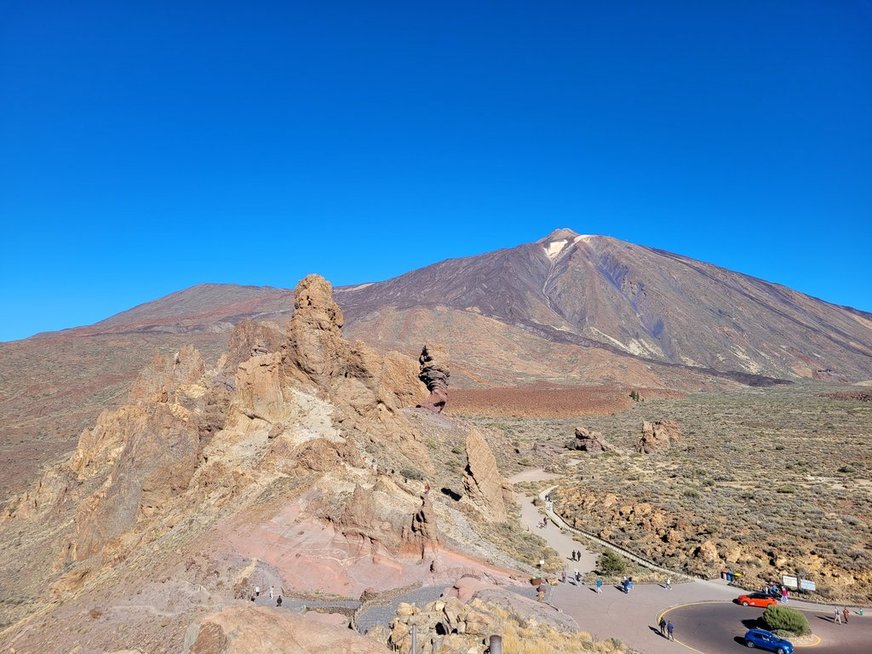
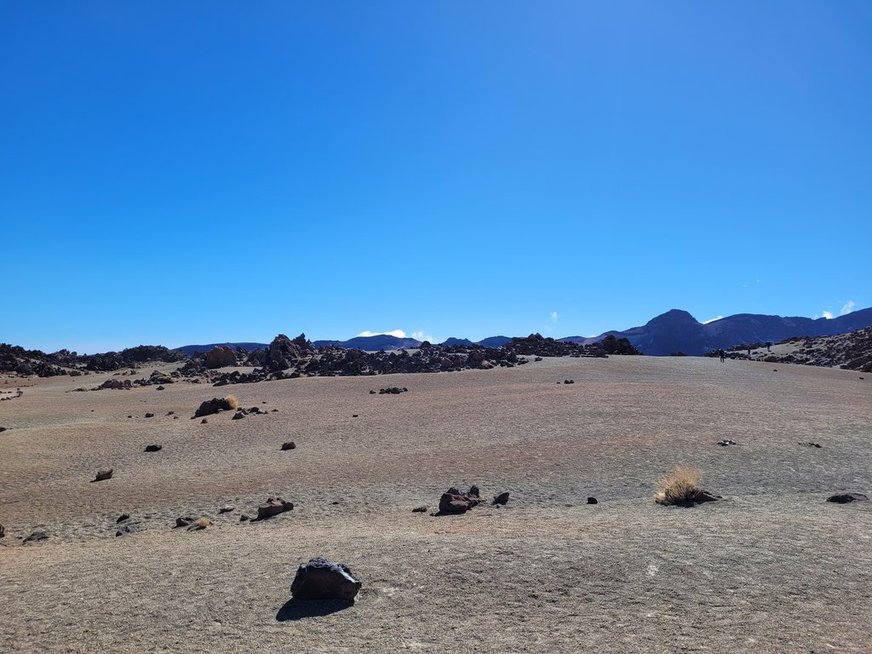
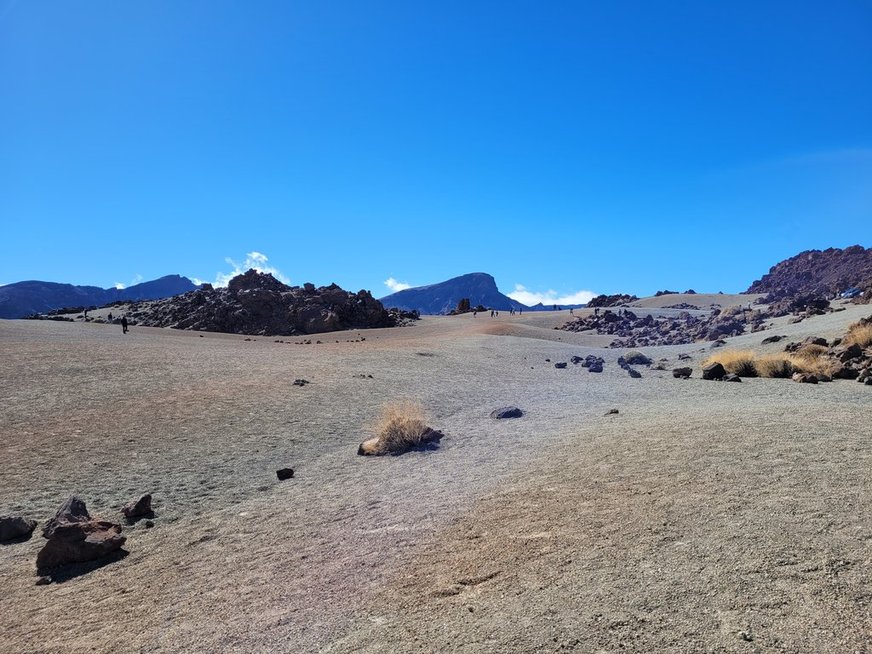
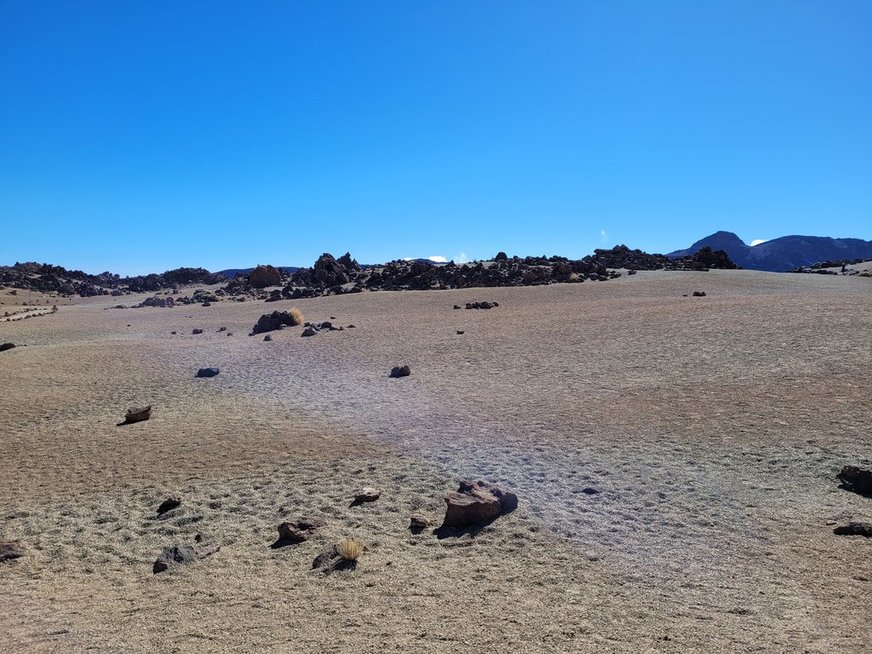
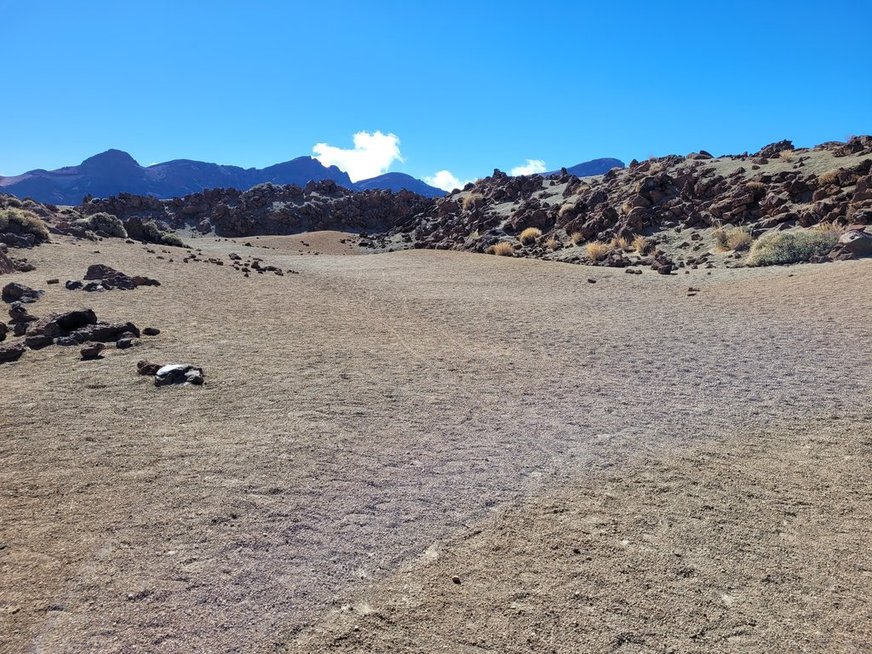
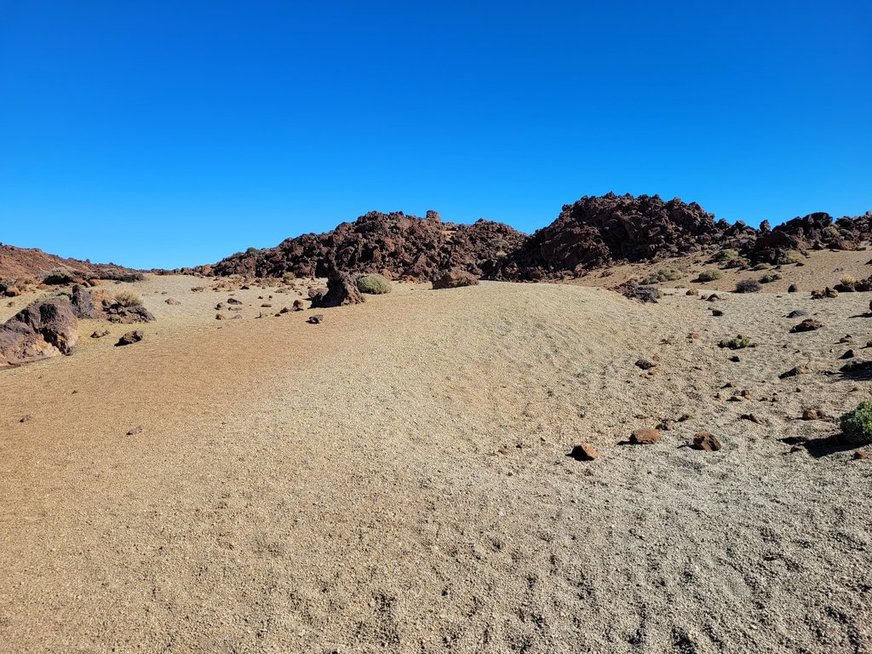
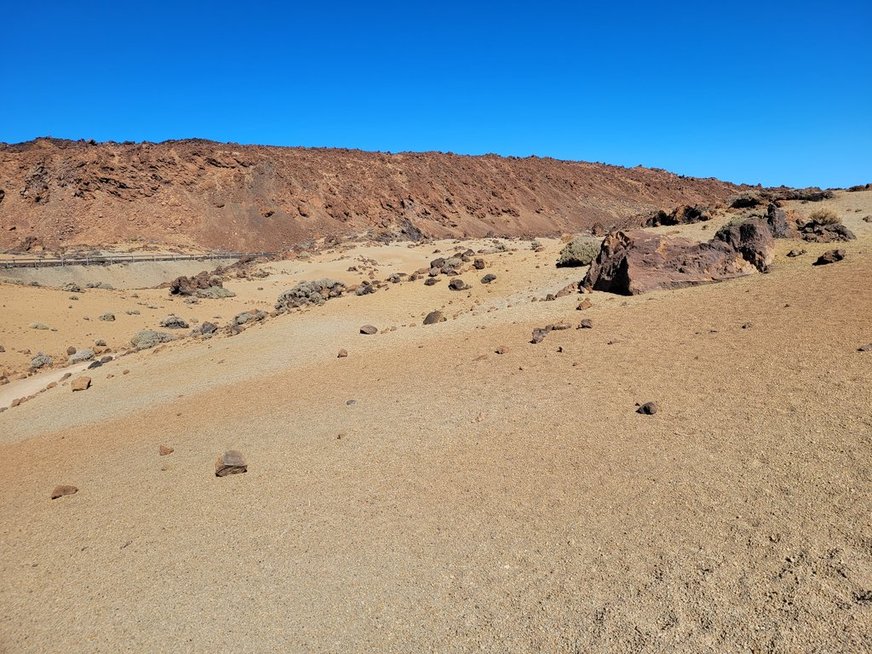
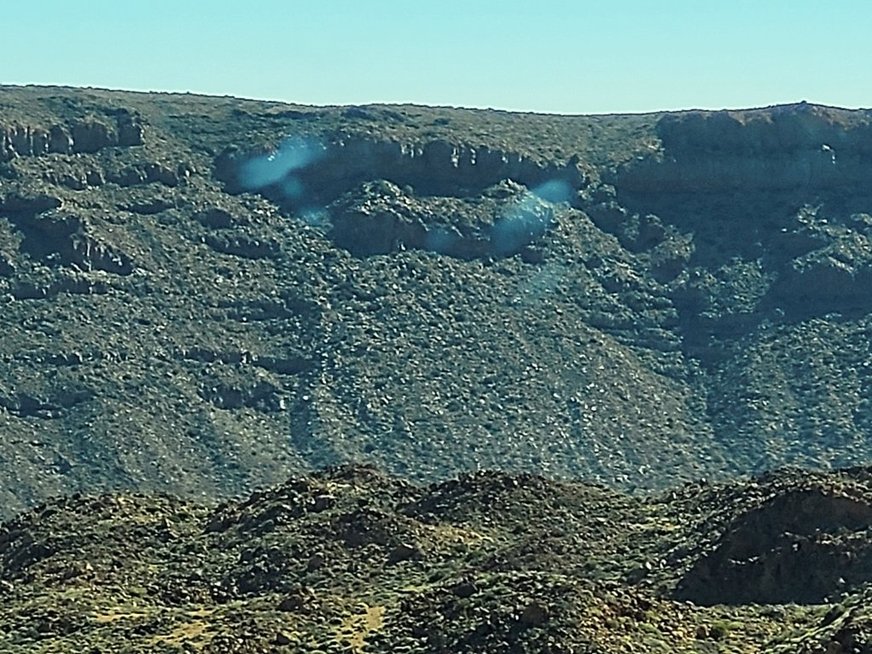
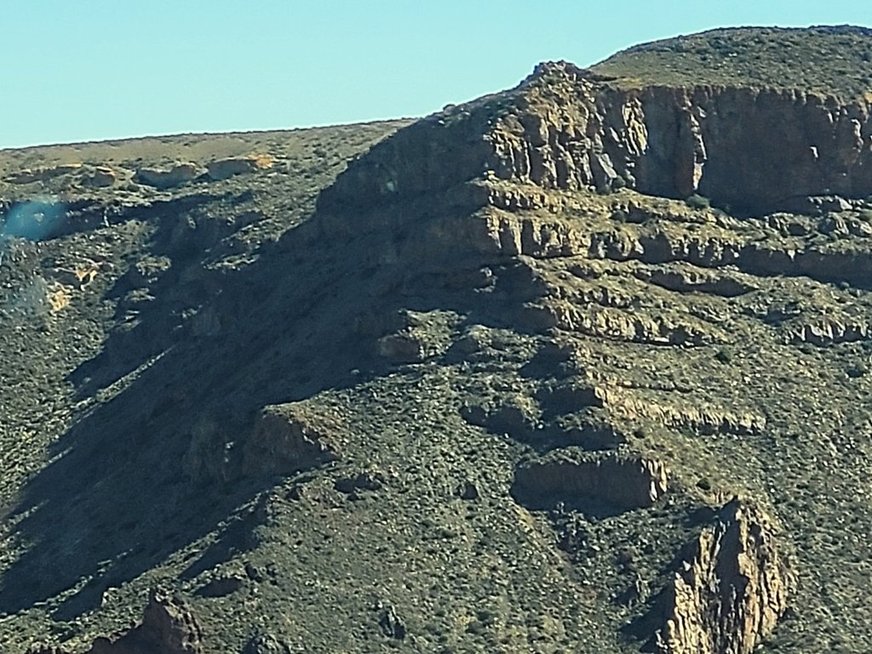
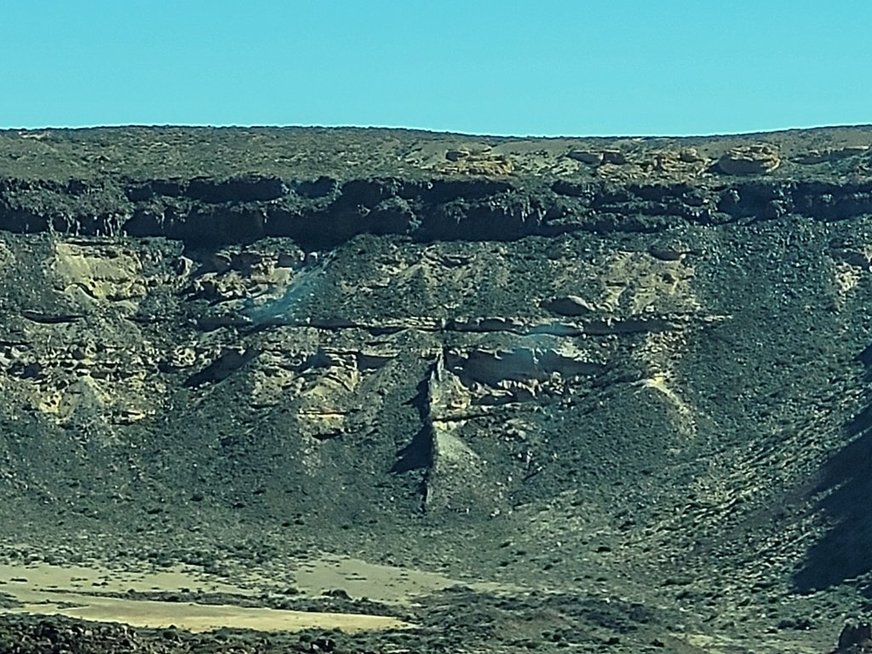
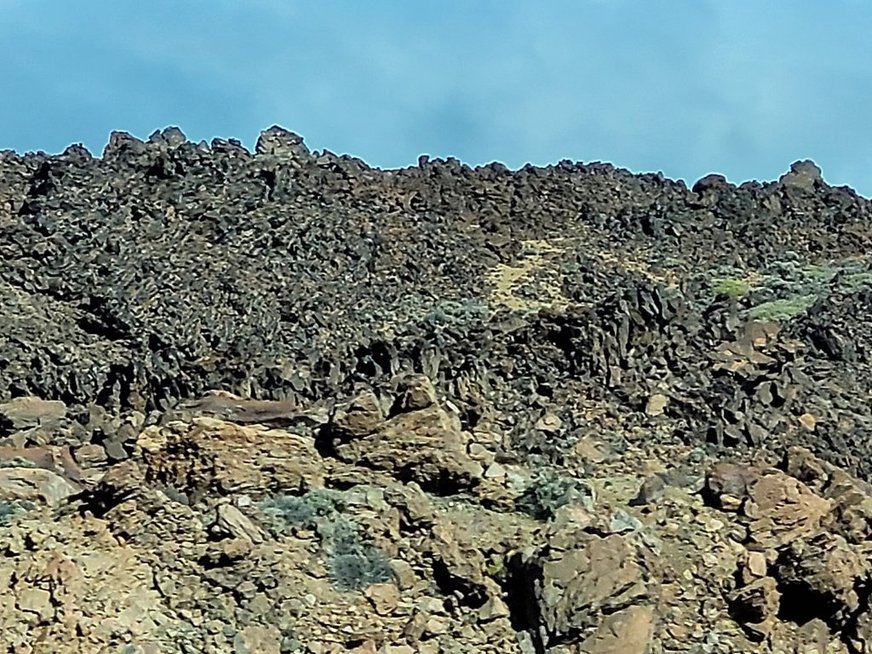
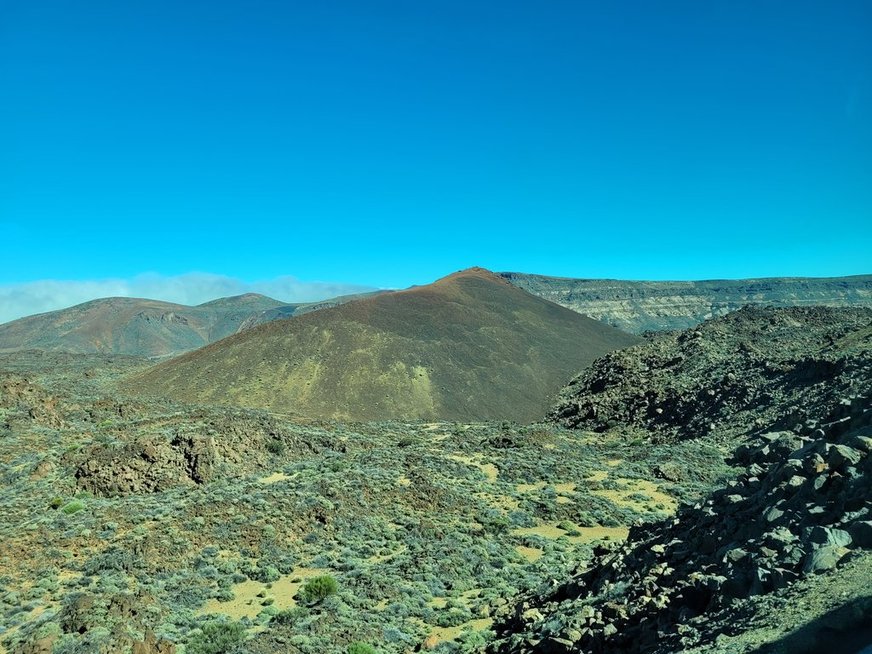
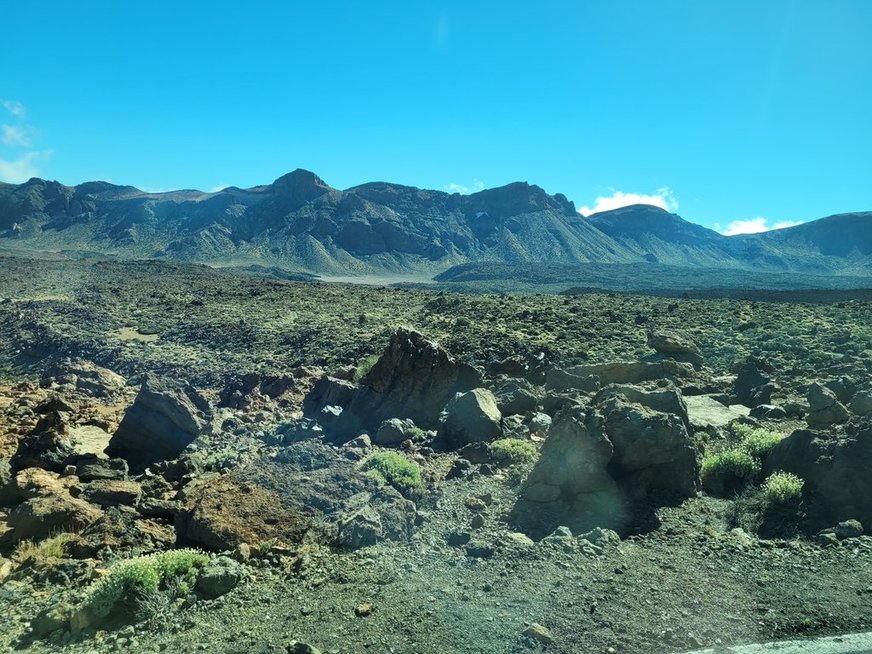
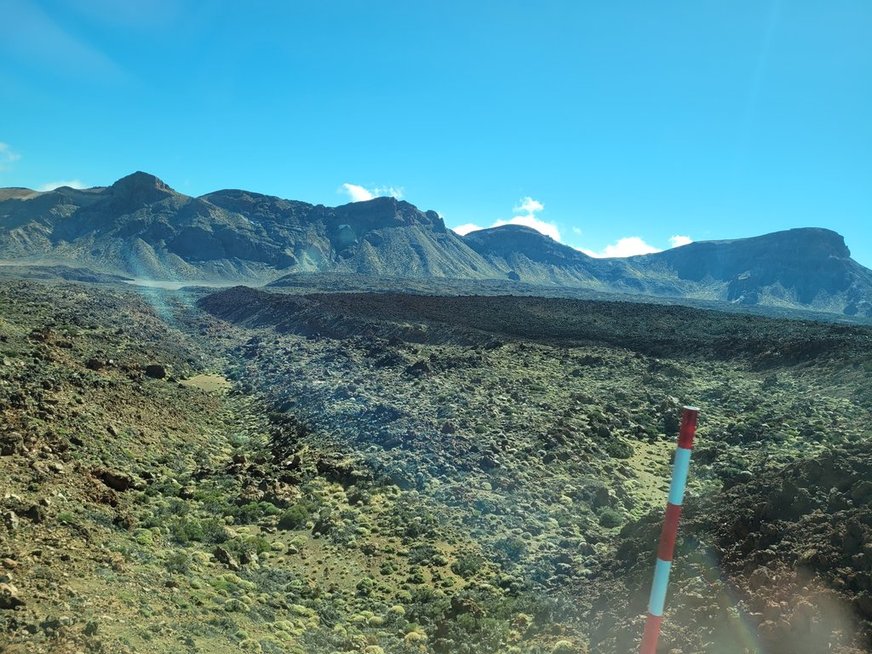
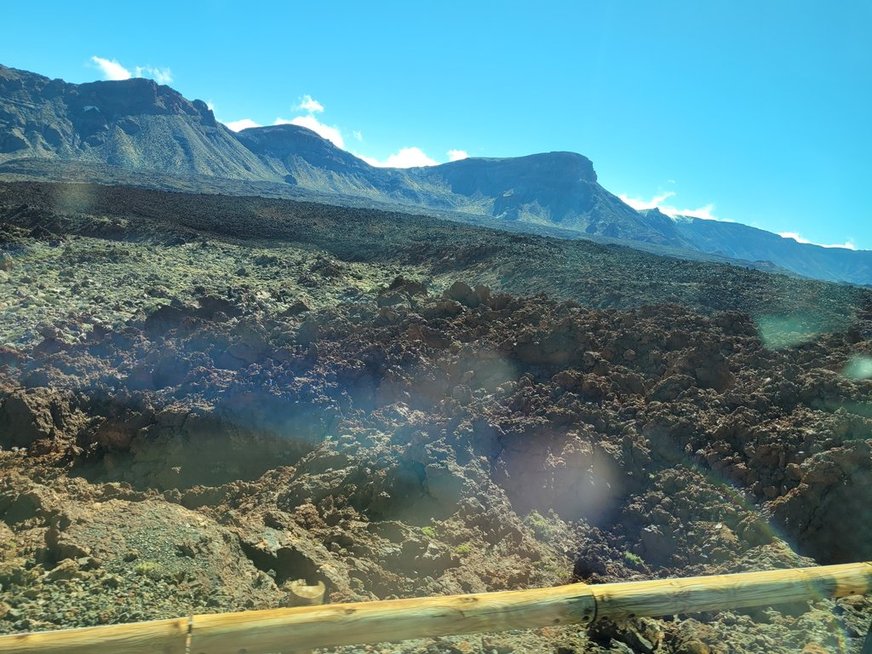
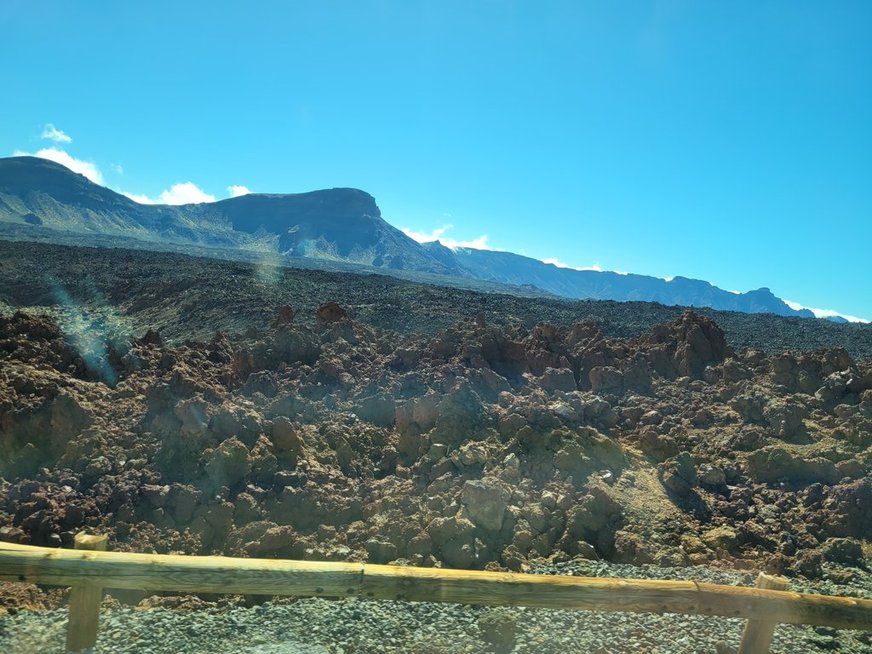
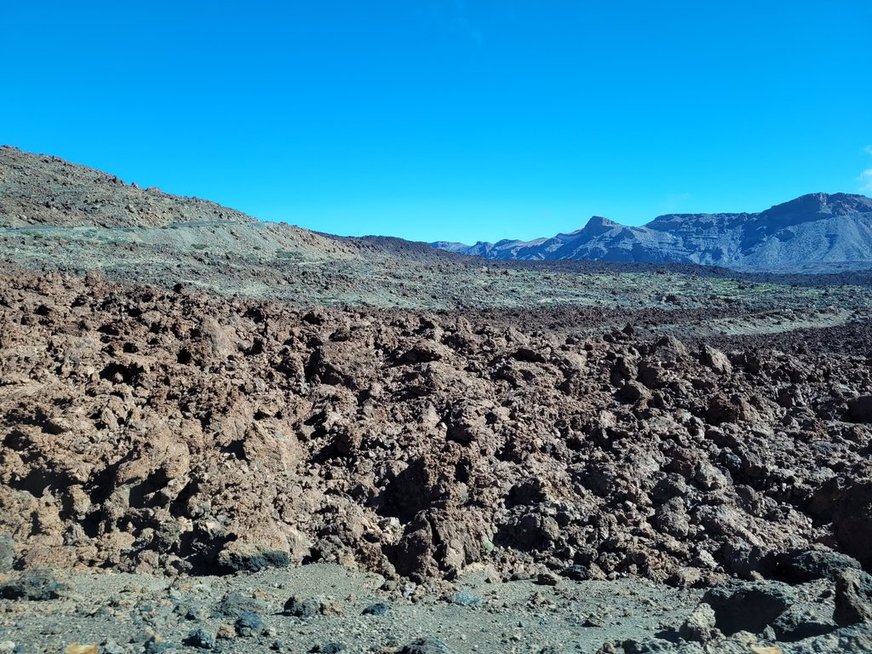
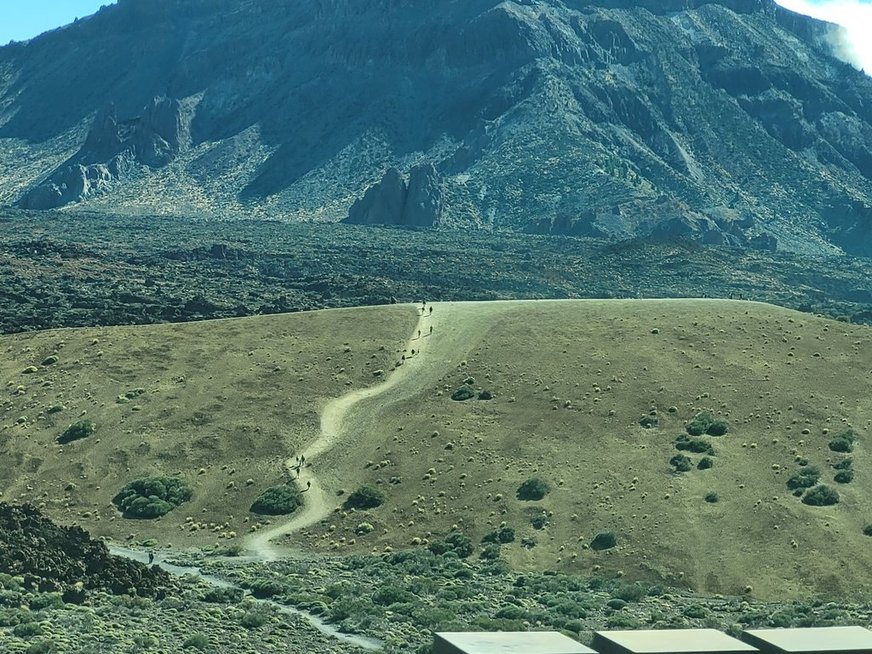
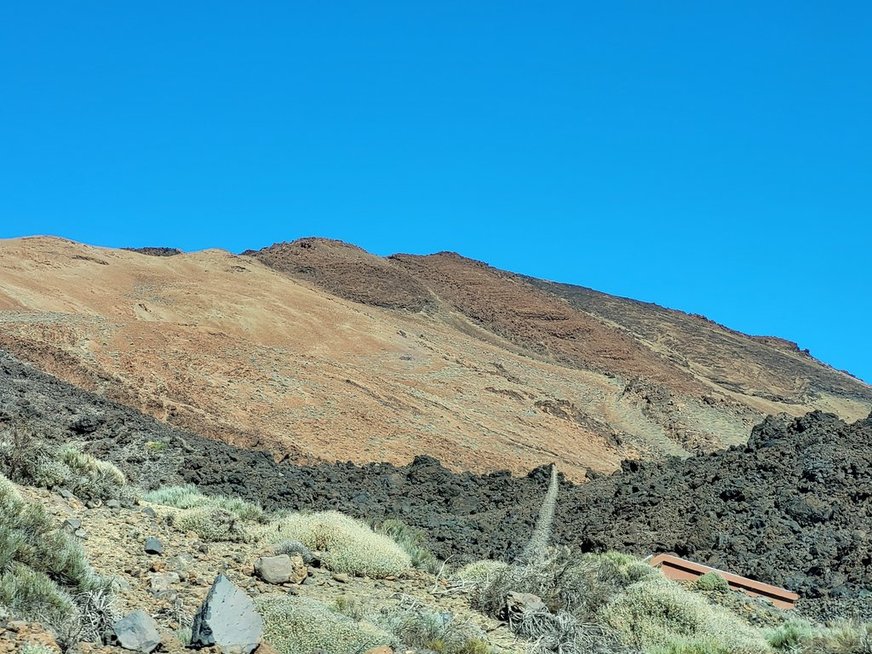
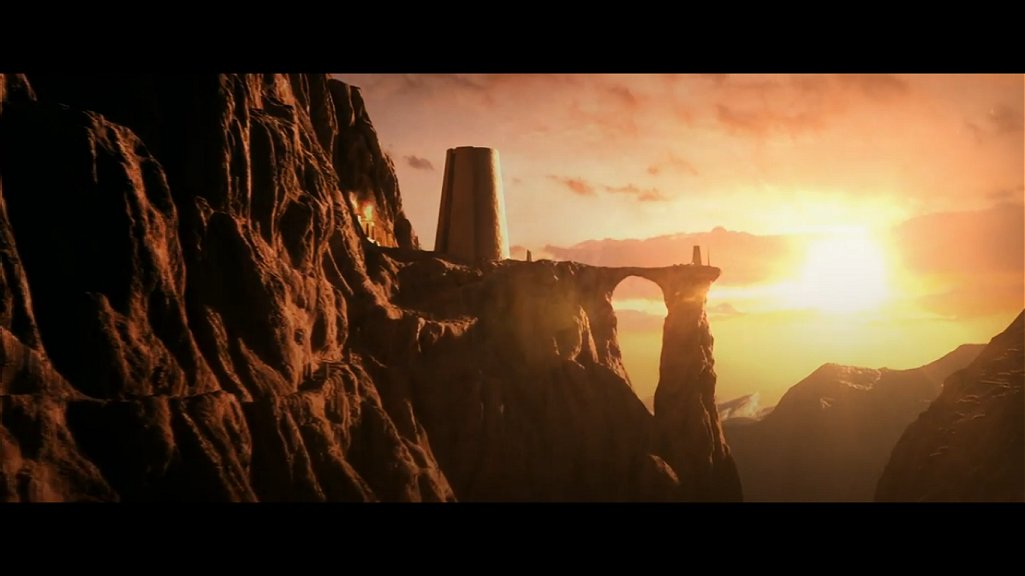
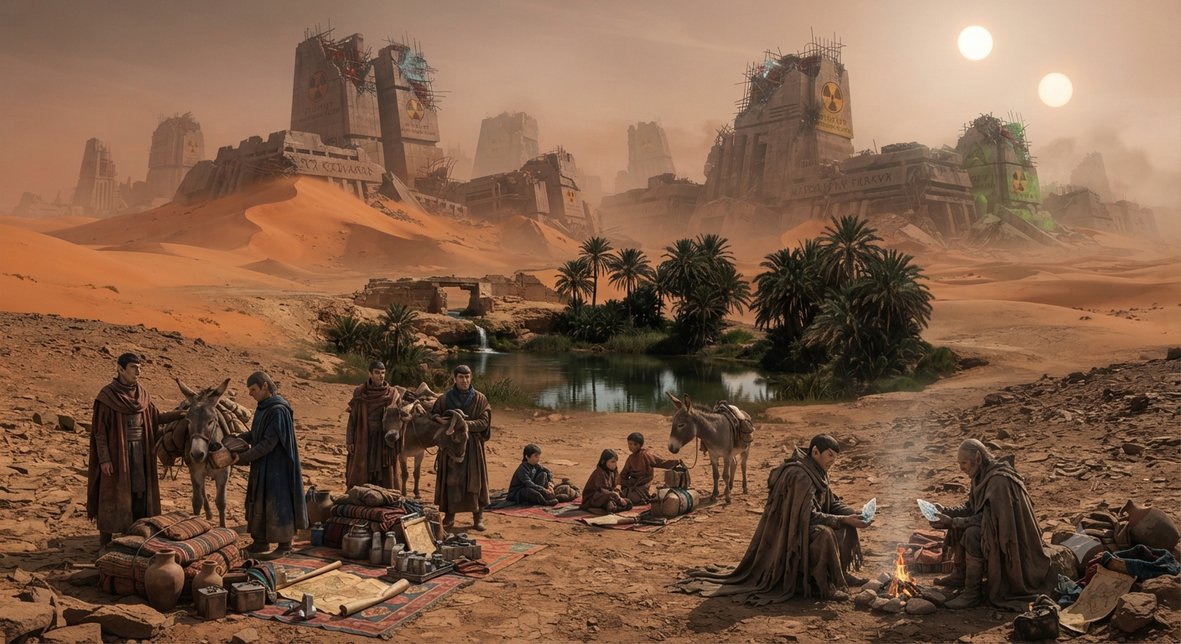
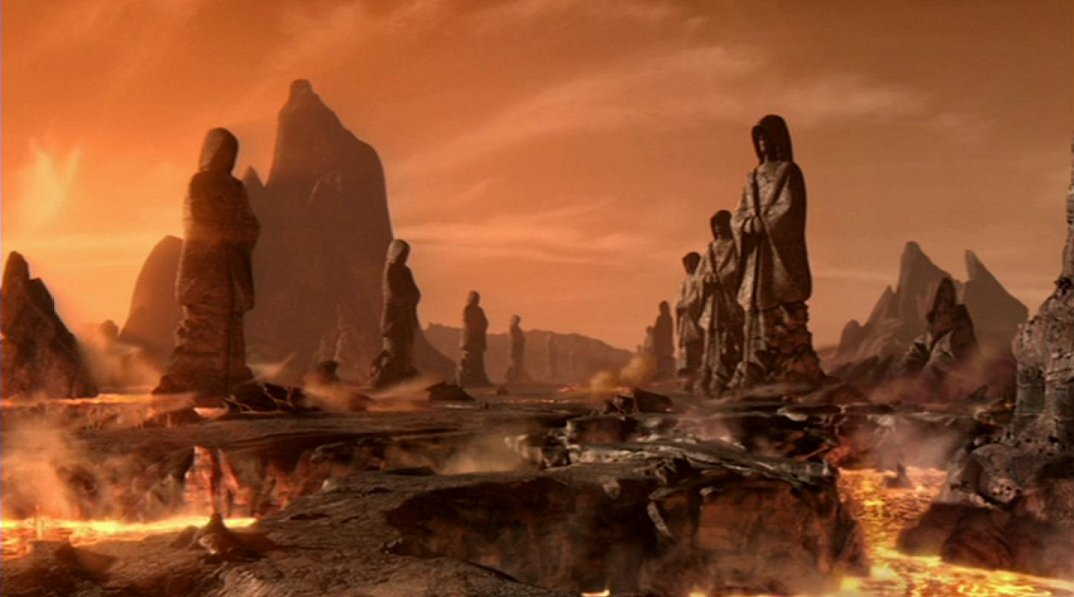
The Planet Vulcan is an M-class planet towards the centre of the Federation. Vulcan is an arid desert planet, Shir Kahr is the planetary capital. Many of the other primary homeworlds of the Federation are located near Vulcan: Earth, Tellar, Axanar, Andor, Betazed and Alpha Centauri [as established in DS9`s In The Pale Moonlight]. Vulcan has no moons. The planet has active volcanoes, ancient ruins, electrical sand fire storms and lava lakes. The climate on Vulcan is like Death Valley meets the Sahara desert, with a lower oxygen content in the air. Added to all this the gravity is higher, so humans can find the climate of Vulcan to be 'challenging' and tri-ox injections may be necessary.
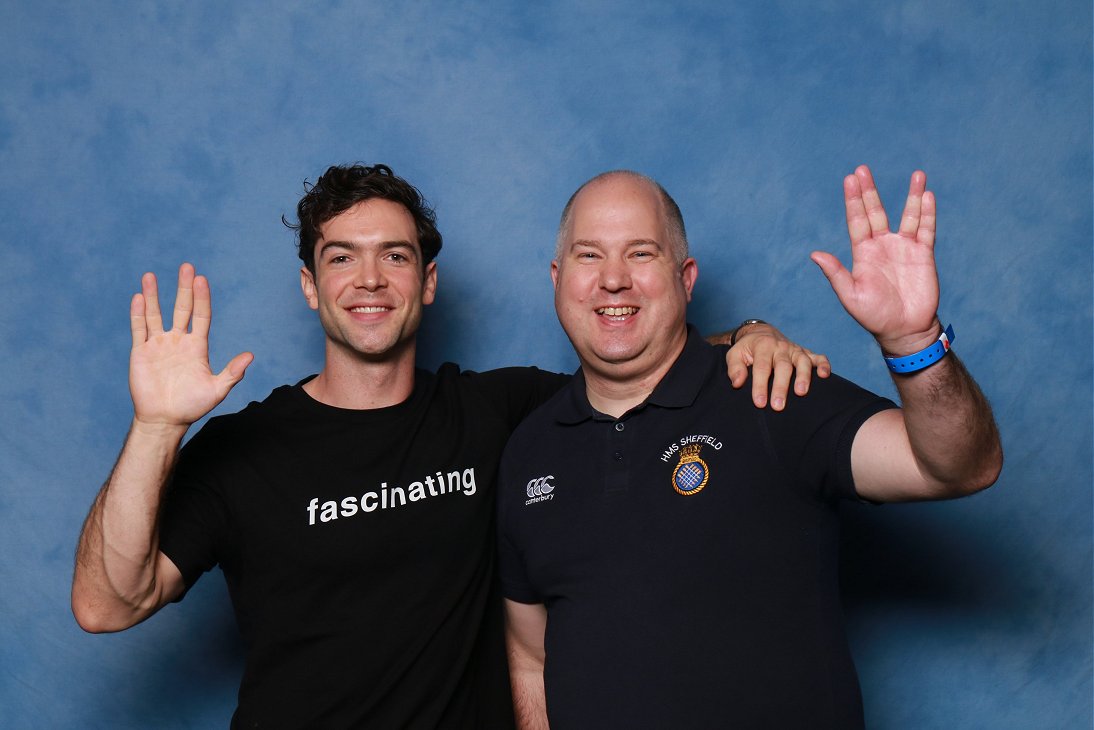
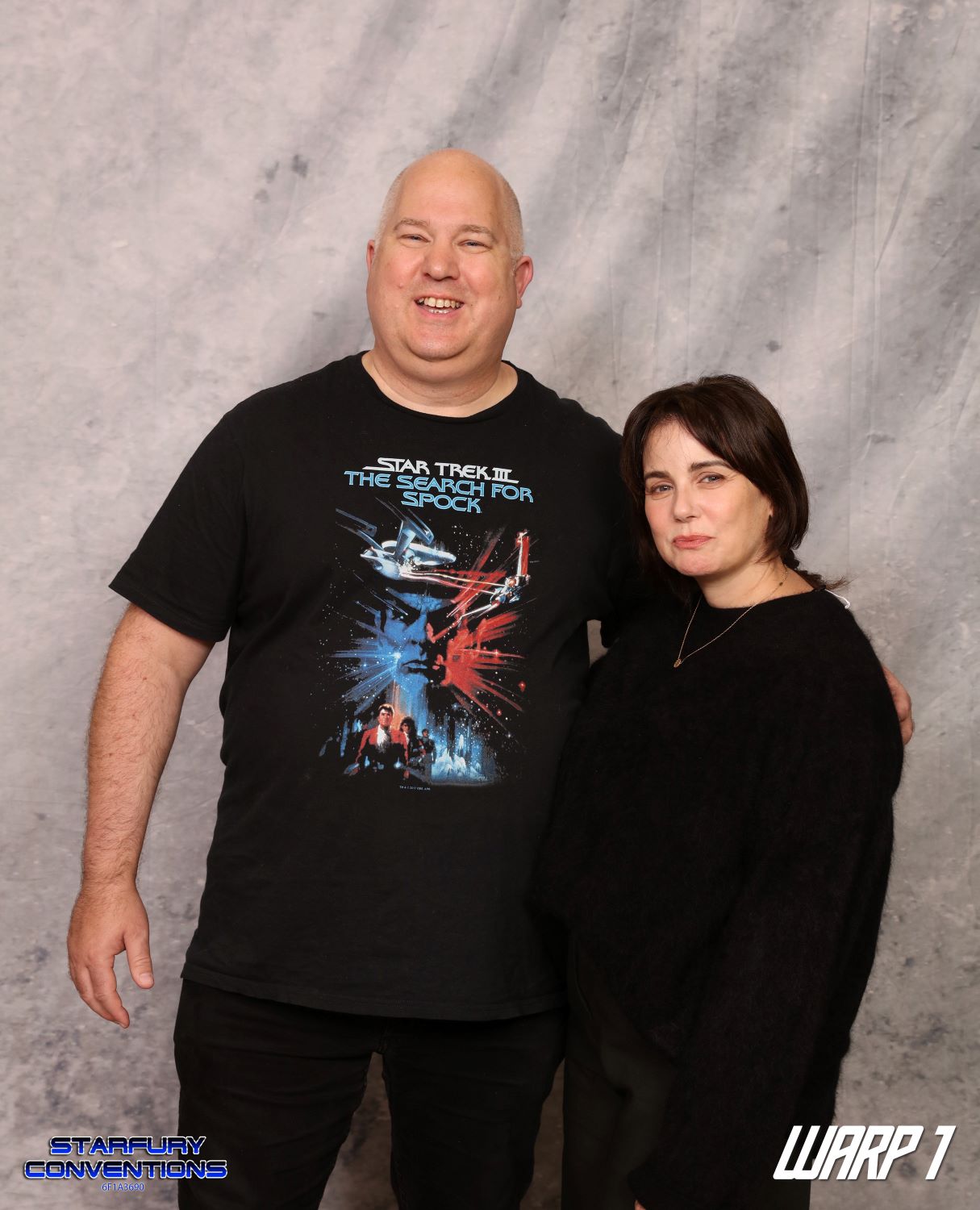
Ady meets original Vulcan T'pring, actress Mary Rice at Destination, in Blackpool 2025.
Sources:
Star Trek: The Enemy Within.
Star Trek: TOS Balance of Terror.
Star Trek: TOS Dagger of the Mind.
Star Trek: TOS The Return of the Archons.
Star Trek: TOS This Side of Paradise.
Star Trek: TOS The Devil in the Dark.
Star Trek: TOS Operation --Annihilate!
Star Trek: TOS Amok Time.
Star Trek: TOS The Apple.
Star Trek: TOS Journey to Babel.
Star Trek: TOS By Any Other Name.
Star Trek: TOS Is There In Truth No Beauty?
Star Trek: TOS The Empath.
Star Trek: TOS The Savage Curtain.
Star Trek: TAS Yesteryear.
Star Trek: TNG Sarek.
Star Trek: TNG Who Watches the Watchers?.
Star Trek: TNG Unification.
Star Trek: TNG Unification pt. 2.
Star Trek: TNG Face of the Enemy.
Star Trek: VOY Meld.
Star Trek: VOY Flashback.
Star Trek: VOY Blood Fever.
Star Trek: VOY Unimatrix Zero Part 2.
Star Trek: ENT Broken Bow.
Star Trek: ENT The Andorian Incident.
Star Trek: ENT Shadows of P'jem.
Star Trek: ENT Fusion.
Star Trek: ENT Fallen Hero.
Star Trek: ENT Carbon Creek.
Star Trek: ENT Minefield.
Star Trek: ENT Marauders.
Star Trek: ENT Stigma.
Star Trek: ENT Impulse.
Star Trek: ENT Damage.
Star Trek: ENT The Forge.
Star Trek: ENT Awakening.
Star Trek: ENT Kir'Shara.
Star Trek: ENT Babel One.
Star Trek: ENT United.
Star Trek: ENT Bound.
Star Trek: ENT Demons.
Star Trek: ENT Terra Prime.
Star Trek: DSC The Vulcan Hello.
Star Trek: DSC Lethe.
Star Trek: DSC Brother.
Star Trek: DSC Point of Light.
Star Trek: DSC Light and Shadows.
Star Trek: DSC If Memory Serves.
Star Trek: DSC Project Daedalus.
Star Trek: DSC The Red Angel.
Star Trek: DSC Perpetual Infinity.
Star Trek: DSC Through the Valley of Shadows.
Star Trek: DSC Such Sweet Sorrow.
Star Trek: DSC Such Sweet Sorrow pt 2.
Star Trek: DSC Unification pt 3.
Star Trek: LDS Wej Duj.
Star Trek: LDS The Stars at Night.
Star Trek: LDS Twovix.
Star Trek: LDS In the Cradle of Vexilion.
Star Trek: LDS Something Borrowed, Something Green.
Star Trek: LDS Empathological Fallacies.
Star Trek: LDS The Inner Fight.
Star Trek: LDS Old Friends, New Planets.
Star Trek: SNW Strange New Worlds.
Star Trek: SNW The Serene Squall.
Star Trek: SNW All Those Who Wander.
Star Trek: SNW A Quality of Mercy.
Star Trek: SNW The Broken Circle.
Star Trek: SNW Charades.
Star Trek: SNW Those Old Scientists.
Star Trek: SNW Under the Cloak of War.
Star Trek: SNW Hegemony.
Star Trek: The Motion Picture (1979).
Star Trek III: The Search for Spock (1984).
Star Trek IV: The Voyage Home (1986).
Star Trek V: The Final Frontier (1989).
Star Trek VI: The Undiscovered Country (1991).
Star Trek: First Contact (1996).
Star Trek (2009).
Star Trek Into Darkness (2013).
Star Trek Beyond (2016).
Hidden Universe Travel Guide: Star Trek: Vulcan by Dayton Ward (2016).
The Emperor's New Mind: Concerning Computers, Minds, and the Laws of Physics (Oxford Landmark Science) by Roger Penrose (2016).
Shadows Of The Mind: A Search for the Missing Science of Consciousness by Roger Penrose (1995).
Zen: The Art of Simple Living by Shunmyo Masuno, Harry Goldhawk & Zanna Goldhawk (2019).
Mind Full to Mindful: Zen Wisdom From a Monk's Bowl by Om Swami (2018).
Peace Is Every Step: The Path of Mindfulness in Everyday Life by Thich Nhat Hanh (2010).
Zen Mind, Beginner's Mind: 50th Anniversary Edition by Shunryu Suzuki (2020).
Think Like a Monk: The secret of how to harness the power of positivity and be happy now by Jay Shetty (2020).
Mindfulness: A practical guide to finding peace in a frantic world by Prof Mark Williams and Dr Danny Penman.
The Miracle Of Mindfulness: The Classic Guide to Meditation by the World's Most Revered Master by Thich Nhat Hanh (2014).
Mindfulness: The Most Effective Techniques: Connect With Your Inner Self To Reach Your Goals Easily and Peacefully (Down-to-Earth Spirituality for Everyday People) by Ian Tuhovsky (2017).
The Science of Meditation: How to Change Your Brain, Mind and Body by Daniel Goleman and Richard Davidson (2017).
The Parthenon by Mary Beard (2010).
Sparta: An Enthralling Overview of the Spartans and Their City-State in Ancient Greece along with the Greco-Persian Wars, Peloponnesian War, and Other ... Spartan Army (Greek Mythology and History) by Enthralling History (2022).
The Trojan War: An Enthralling Overview of a Legendary Conflict of Ancient Greece and Its Role in History and Greek Mythology (Greek Mythology and History) by Enthralling History (2021).
The Rise and Fall of Athens: Nine Greek Lives (Classics) by Plutarch (Author), Ian Scott-Kilvert (1973).
The Library of Greek Mythology (Oxford World's Classics) by Apollodorus (Author), Robin Hard (Translator) (1998).
Mythos: The Greek Myths Retold (Stephen Fry’s Greek Myths Book 1) by Stephen Fry (2017).
Heroes: The myths of the Ancient Greek heroes retold (Stephen Fry’s Greek Myths Book 2) by Stephen Fry (2018).
Troy: Our Greatest Story Retold (Stephen Fry’s Greek Myths Book 3) by Stephen Fry (2020).
History of Greece: An Enthralling Overview of Greek History (Greek Mythology and History) by Billy Wellman (2022).
Greek Mythology: An Enthralling Overview of Greek Myths, Gods, and Goddesses (Greek Mythology and History) by Enthralling History (2022).
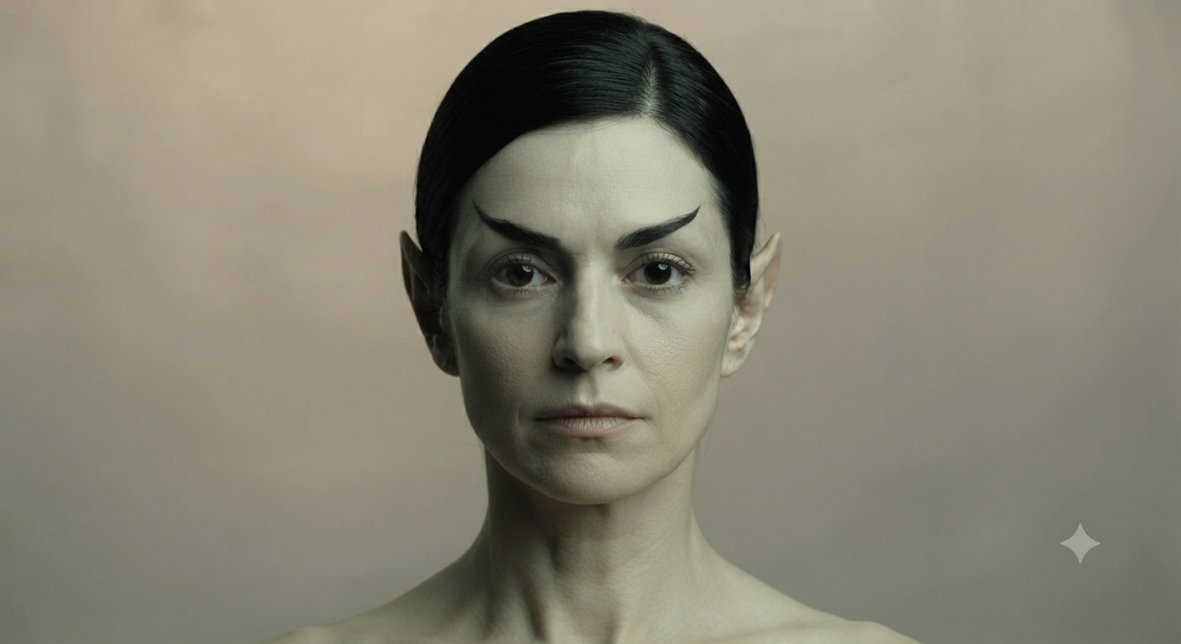
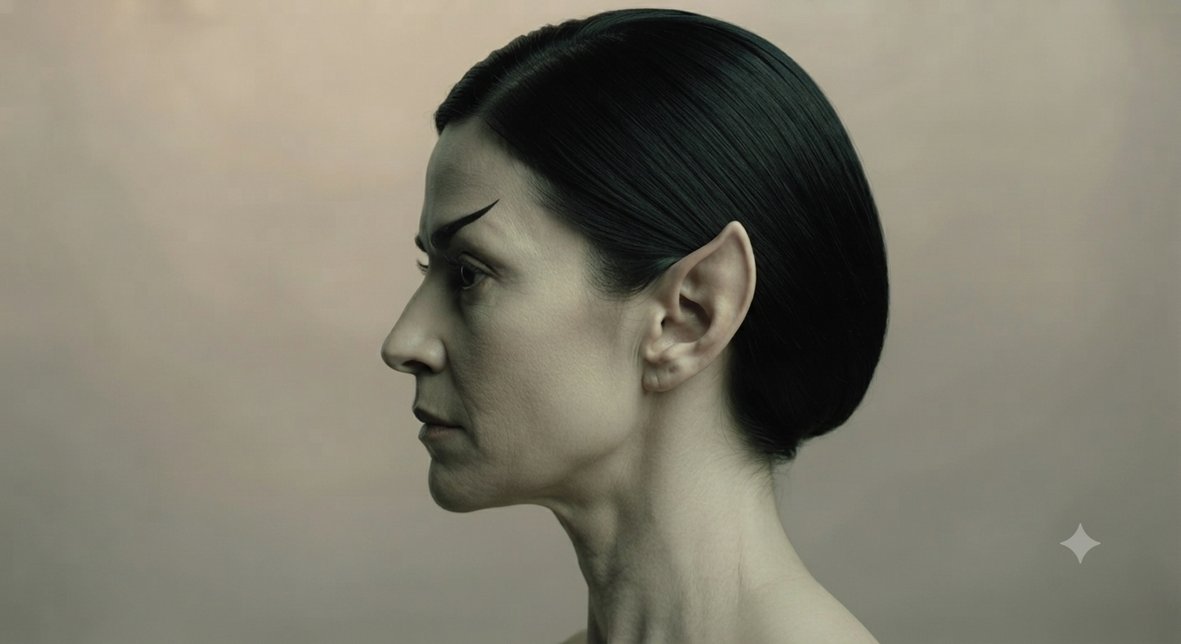
Vulcan society is a fascinating mixture of logic and ritual. Vulcans are a telepathic race, their mental skills are considered to be amongst the most powerful of the Federation races. Vulcans are physically stronger from the higher gravity of Vulcan compared to Earth. Some inform Vulcans of a certain age practice ritual suicide. Vulcan youths are taught mental discipline by vulcan masters. These teachings ultimately give a Vulcan mental control over their emotions, trained mental skills such as mind-meld and the Vulcan Nerve Pinch as well as an almost unparalleled concentration and problem solving ability. Emotional displays are frowned upon in Vulcan society. Every seventh year of his adult life, a vulcan male must endure the fires of Pon Farr, when the mating impulse overpowers even the mental discipline of a vulcan. During this time a vulcan must mate or die. Vulcans have their mates selected for them at age seven, at this point the two are bonded telepathically: to return to be bonded later in their lives.
Vulcans are emotional beings, more so than humans. It is their extremes of emotion that made them seek out the straitjacket of logic to restrain these excesses. Without this restraint, the Vulcan people would have destroyed each other. It is through the prism of this emotional maelstrom and logical restraint that the Vulcans view other races. Species such as humans allow their emotions to 'run wild' like the Vulcans before Surak. Vulcans would seem to look down their noses at such flagrant emotional displays as it is a reminder to them of what the Vulcans once were. It is also for this reason that Vulcans are generally pacifists. Along with the Deltans and Betazoids, the Vulcans have been building a pacifist bloc in the Federation Council to give these pacifist beliefs more expression.
Emotion still affects Vulcans, something that is ignored outside of psychology and is never spoken of in Vulcan society. Vulcans have micro-expressions of emotional reactions, visible to those trained or experienced enough to see it. Author's Notes: 1. Sarek's logic is 'uncertain' where his son is concerned, regarding Fal Tor Pan in ST: III. 2. Valeris chooses not to shoot Spock in Sickbay, despite it bein the logical thing do. ST: VI. 3. Sarek expresses mild surprise when Spock tells him to tell Amanda he feels fine. ST IV. 4. Kohlinar is there to purge the last vestiges of emotion, expressed mostly at Pon Farr. ST: TMP.
Vulcans are also natually curious of the universe around them. The Vulcan Academy of Science is renown throughout the Federation. The Vulcan people have many science vessels of their own, registered seperately from Starfleet. Although not all Vulcans choose to, a noticeable amount of Vulcans join Starfleet to explore the galaxy. Vulcans are also exceptional diplomats, making First Contact with many races, including some with whom the Federation has not had much contact, such as the Cardassians [established in DS9's Destiny: Cardassian poet Iloja of Prim].
There was a study done on Earth in 2011 where people were given a choice: flip a switch to save five lives but kill your sister, don't touch the switch and your sister lives but five strangers die. For a Kohlinar student of Vulcan, the answer every time, surely, is to flip the switch and kill your sibling? If indeed "the needs of the many outweigh the needs of the few, or the one" then logic dictates this.
1. Foundational Principles
Surakian Discipline
Surak’s teachings replace religion.
Logic is the supreme moral framework.
Emotional expression is considered destabilising and socially harmful.
Mathematics is treated as a philosophical language of truth.
Social Ethos
Public behavior must be orderly, quiet, and controlled.
Personal conduct reflects one’s mastery of logic.
Wisdom is modeled on ancient Greek rationalism — debate, inquiry, and philosophical clarity.
2. Social Rules & Conduct (UAE-like, but Surakian)
Public Interaction
No public affection — touching, embracing, or displays of warmth are prohibited.No spontaneous physical contact — even handshakes are replaced by a slight nod.
Strict personal space — Vulcans maintain a respectful distance at all times.
Gender & Family Norms
Fully egalitarian; roles determined by aptitude, not tradition.Families are private units where emotional warmth exists but is moderated.
Behavioural Expectations
Voices remain calm and low.
Arguments are conducted through structured logic, not emotion.
Public reprimands occur if someone displays uncontrolled emotion.
Legal Enforcement
A Logic Compliance Office monitors public behaviour. Officers intervene in cases of emotional outbursts, improper touching, or breaches of decorum.
Islamic geometric art ? fractal patterns, tessellations, symmetry.
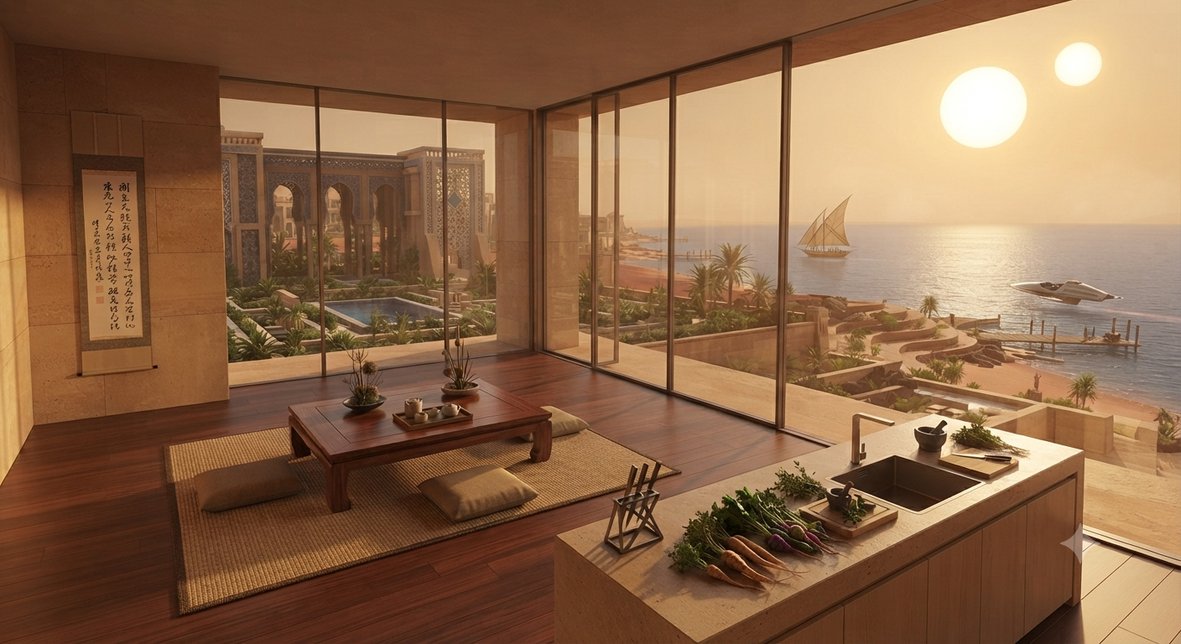
Japanese minimalism ? clean lines, natural materials, uncluttered spaces.
Vulcan austerity ? stone, sand, metal, and controlled light.
Key Features
- Courtyards with shade and airflow.
- Wind towers adapted for desert climates.
- Meditation chambers with geometric light patterns.
- Public buildings shaped around mathematical ratios.
City Layout
- Central academies (Surakian madrassahs).
- Residential districts arranged in logical grids.
- Public debate halls resembling Greek stoas.
4. Emotional Repression & Social Discipline
Core Practices
- Daily meditation to purge emotional impulses.
- Emotional suppression taught from childhood.
- Logic recitations used to stabilize thought.
Cultural Norms
- Smiling is rare and subtle.
- Anger is considered a civic failure.
- Love is expressed through duty, not affection.
Philosophical Culture
- Public debates resemble Greek symposia but without wine or emotion.
- Logic, ethics, mathematics, and metaphysics are core disciplines.
- Scholars are civic leaders, not politicians.
Culinary Philosophy
- Food is nourishment, not pleasure.
- Meals reflect discipline and simplicity.
8. Non-Obvious Insight
This Vulcan society is not austere because of religion or tradition — it is austere because logic demands emotional neutrality, and emotional neutrality demands controlled environments, minimalist aesthetics, and strict social rules.
The result is a civilization that feels like:
- The UAE’s public-behaviour codes
- Islamic geometric beauty
- Japanese minimalism
- Greek intellectual rigour
- All filtered through Surak’s absolute logic
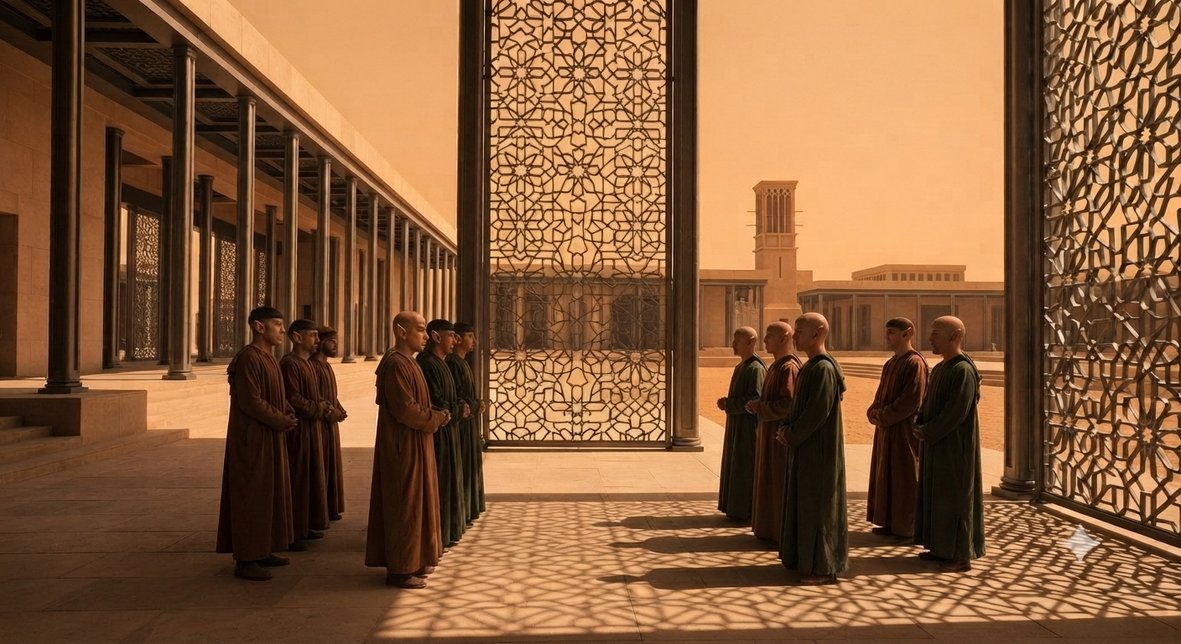
1. The Public Sphere: A Surakian Stoa
This image visualizes the synthesis of ancient Greek intellectual rigor and Islamic architectural logic, filtered through Vulcan austerity. We see a public debate hall designed as a stoa—a long, open walkway—situated in a precise, logical grid city under the distinctive orange Vulcan sky.
The structure is built from matte, sun-baked sandstone (UAE influence), but the colonnade is adorned with intricate, fractal Islamic geometric screens (Mashrabiya) that control the harsh desert light, creating disciplined patterns on the floor. The open-air design promotes natural airflow, essential for the climate.
Key Visual Elements:
Architecture: A fusion of Greek open-air civic space and Islamic geometric ornamentation.
Social Code: Two groups of scholars in muted, earth-toned robes (ochre and deep green) debate. They maintain a significant, respectful personal space; there is no touching or impassioned gesturing, only precise, logical articulation.
Environment: A wind tower (badgir) is visible in the background, integrated into the minimalist skyline.
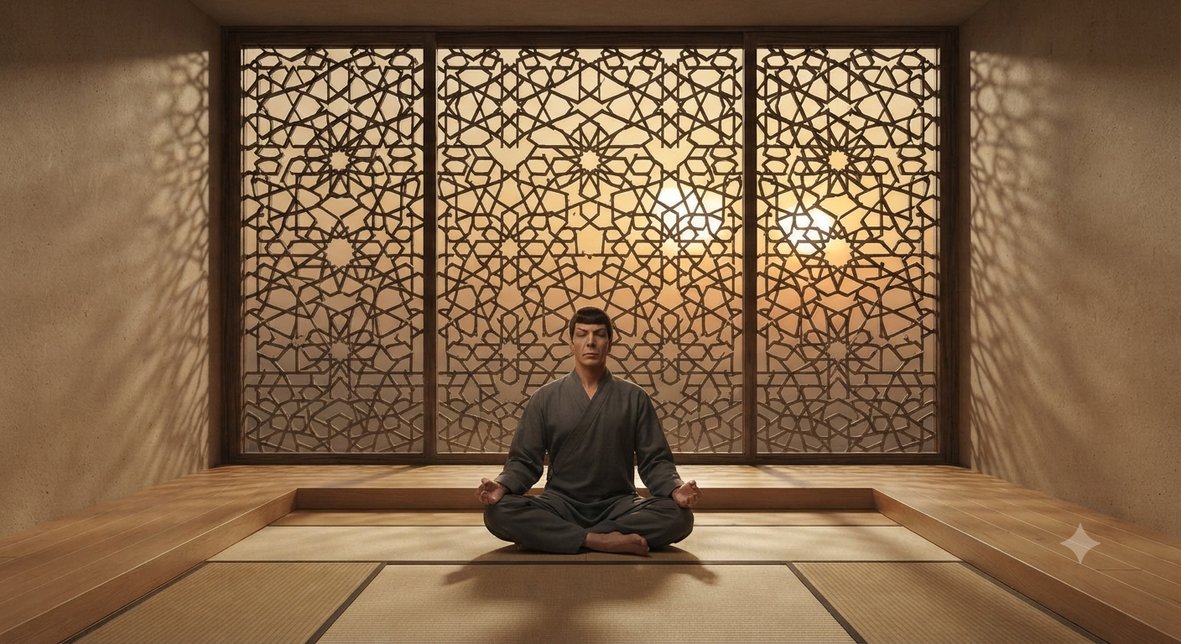
2. The Private Sphere: A Minimalist Meditation Chamber
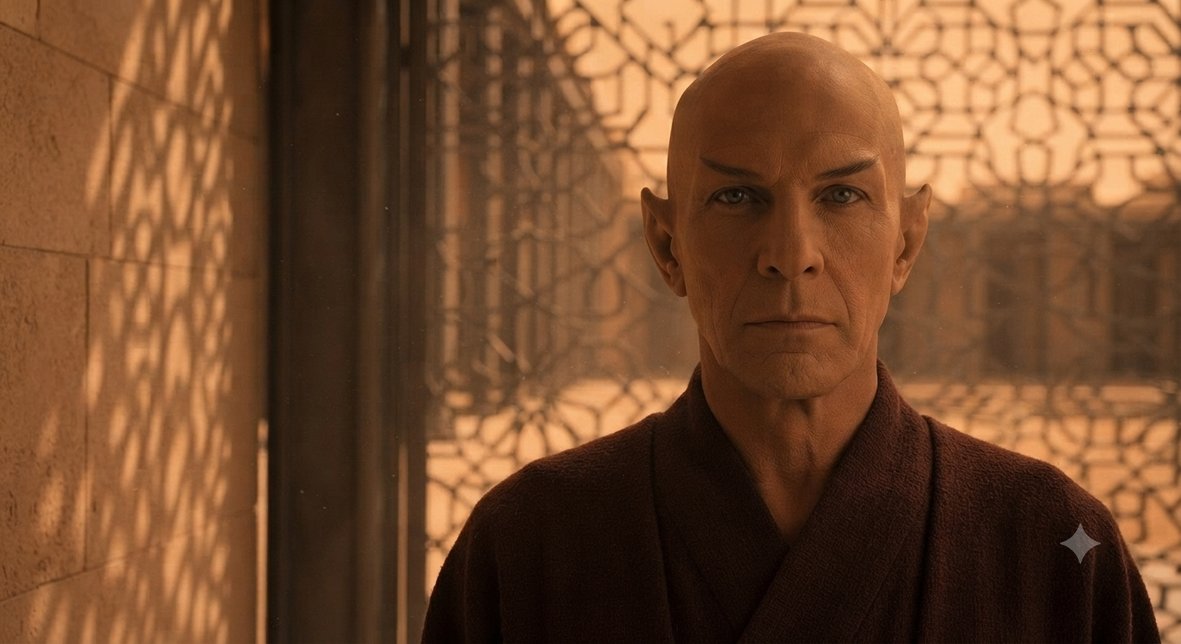
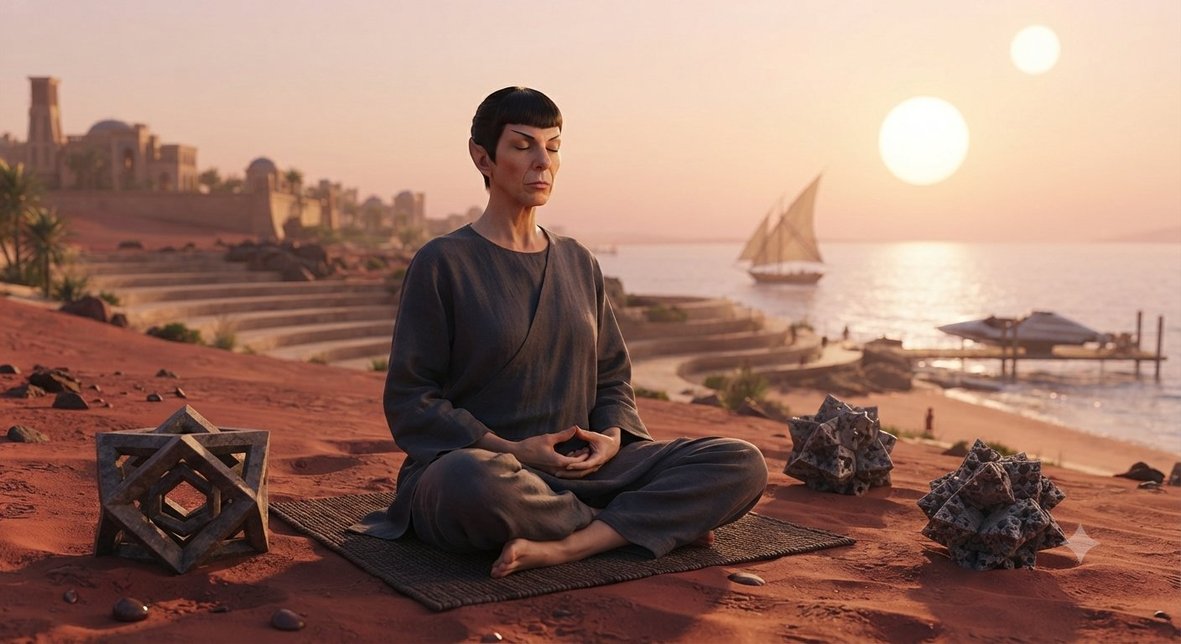
Moving inward, this image depicts a private space focused on emotional suppression and geometric beauty. This interior is defined by Japanese minimalism—uncluttered space, natural materials (polished light wood, cool stone), and clean lines.
The room is sunken, emphasizing introspection. The only decoration is a massive, floor-to-ceiling window featuring an Islamic geometric lattice (a tessellation of an eleven-sided polygon, or girih). This screen breaks the intense light into a precise, complex geometric pattern that moves across the room with the sun, serving as a visual meditation aid.
Key Visual Elements:
Architecture: Japanese minimalism meets advanced Islamic geometry.
Practice: A single Vulcan figure sits in a precise lotus position on a tatami mat, facing the light. The posture is one of absolute discipline and stillness, emphasizing the daily practice of purging emotion.
Atmosphere: The room is quiet, cool, and ordered; the light itself is structured.
3. The Material Culture: The Tools of Logic
This image showcases the material culture defined by your profile. It synthesizes the discipline of Surakian logic with the precision of Japanese minimalism.
On a surface of cool, dark, textured volcanic stone, we see a minimalist still life. A copper water flask (designed for minimal evaporation in a desert climate) sits next to a handcrafted meditation stone, deeply etched with the same fractal Islamic geometry seen in the architecture. Beside it lies a simple, elegant 'logic tablet'—a matte black device with a subtle, glowing geometric interface. These objects are not decorative; they are tools for maintaining emotional neutrality.
Key Visual Elements:
Aesthetic: Austere, precise, minimalist. Every object has a logical function.
Geometry: The pattern on the meditation stone repeats the fractal geometry of the larger culture, showing that the macrocosm (architecture) is reflected in the microcosm (personal tools).
Composition: Deep focus, emphasizing the texture of the stone and metal. The light is controlled and directional, highlighting the precision of the etchings.
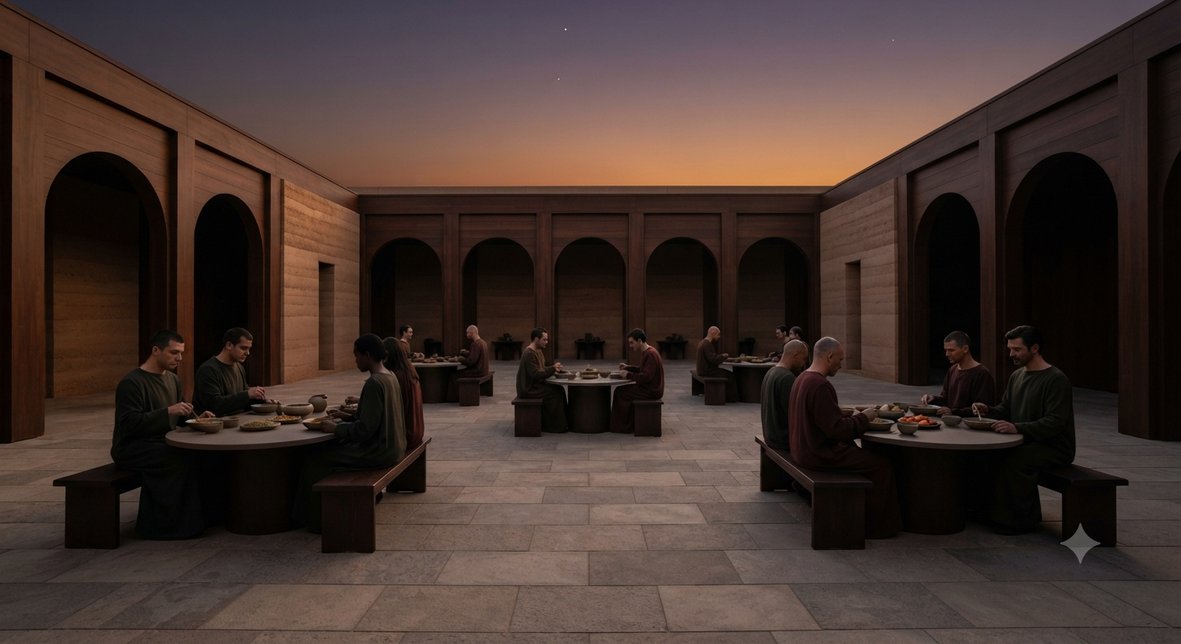
4. The Culinary Ethos: A Communal Supper
The final image visualizes your foodways profile: vegetarian, desert-adapted, communal, and eaten in silence as an act of discipline, not pleasure.
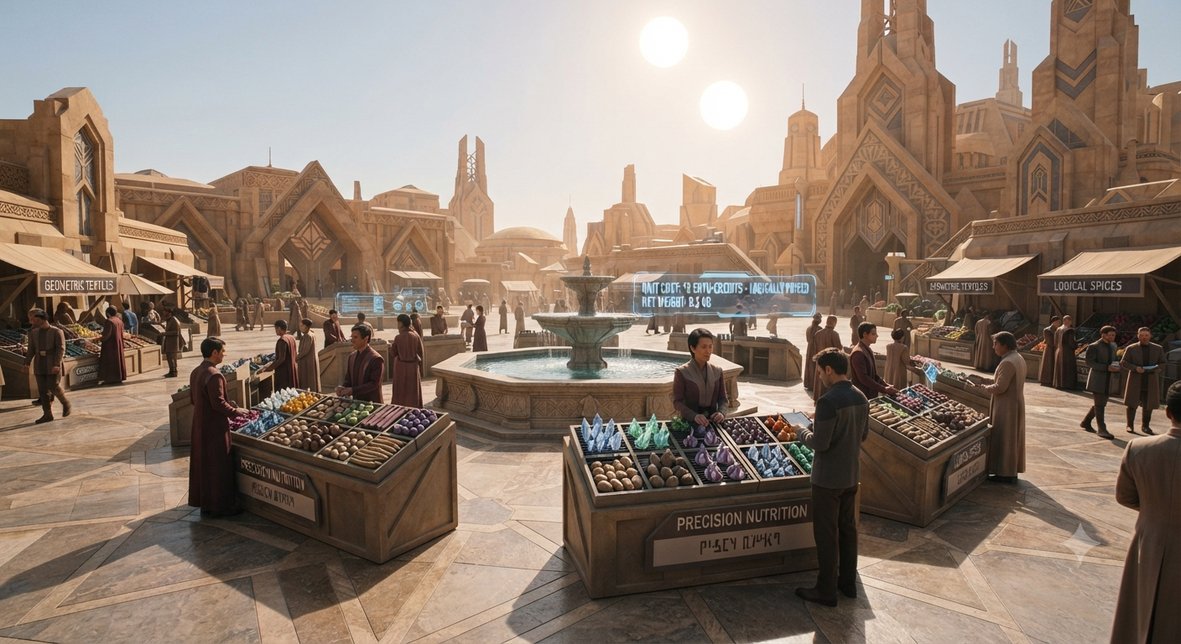
In the courtyard of a Surakian academy, defined by the same geometric arches and shaded walkways from Image 1, a group of Vulcans share a meal. They are seated on low, backless benches (minimalist design) around a low, circular table. The food is simple and geometrically presented: lentil stew, roasted tuberous vegetables, and date-based cakes served in plain, matte-ceramic bowls.
Key Visual Elements:
Social Rule: The subjects eat with focus and discipline. There is no conversation, smiling, or interaction. They are spaced precisely apart, maintaining strict personal space even while sharing a table.
Environment: The architecture is austere and mathematical. The light is fading (golden hour), casting long, orderly shadows that emphasize the symmetry of the courtyard.
Attire: The participants wear simple, loose, earth-toned robes, reinforcing the rejection of material vanity.
Vulcan Farming
Vulcans survive because their agriculture is not surface-based in the way humans imagine. The canon sources you pulled in (especially the descriptions of The Forge and Gol) make it clear that most of Vulcan’s land is unusable desert, subject to electrical sandstorms, geomagnetic instability, and solar-flare-driven lightning storms.
Vulcans grow food primarily underground, in shielded hydroponic complexes, geothermal-powered nutrient caverns, and electromagnetically insulated canyon farms. Surface farming is rare and only possible in a few coastal strips like Gol.
1. Environmental Constraints
Extreme heat
Most of Vulcan is arid desert with high temperatures and thin atmosphere.
- The Forge is described as a “hellhole” with electrical sandstorms.
- Gol suffers weeks-long lightning-suffused storms driven by solar activity.
Electromagnetic storms
Sandfire storms generate massive static discharges and geomagnetic interference.
- They disable scanners and communications.
- They produce lightning within the sand itself.
Minimal arable land
Only thin strips of farmland exist in coastal regions like Gol.
- “Thin strips of arable farmland dotting the coastline.”
This means traditional agriculture is nearly impossible.
2. How Vulcans Actually Grow Food
Subterranean hydroponic caverns
The most logical solution: underground farms protected from storms and heat.
These would use:
- Geothermal heat for energy
- Artificial lighting tuned to plant needs
- Mineral-rich water from deep aquifers
- Copper-tolerant plant strains (to match Vulcan biology)
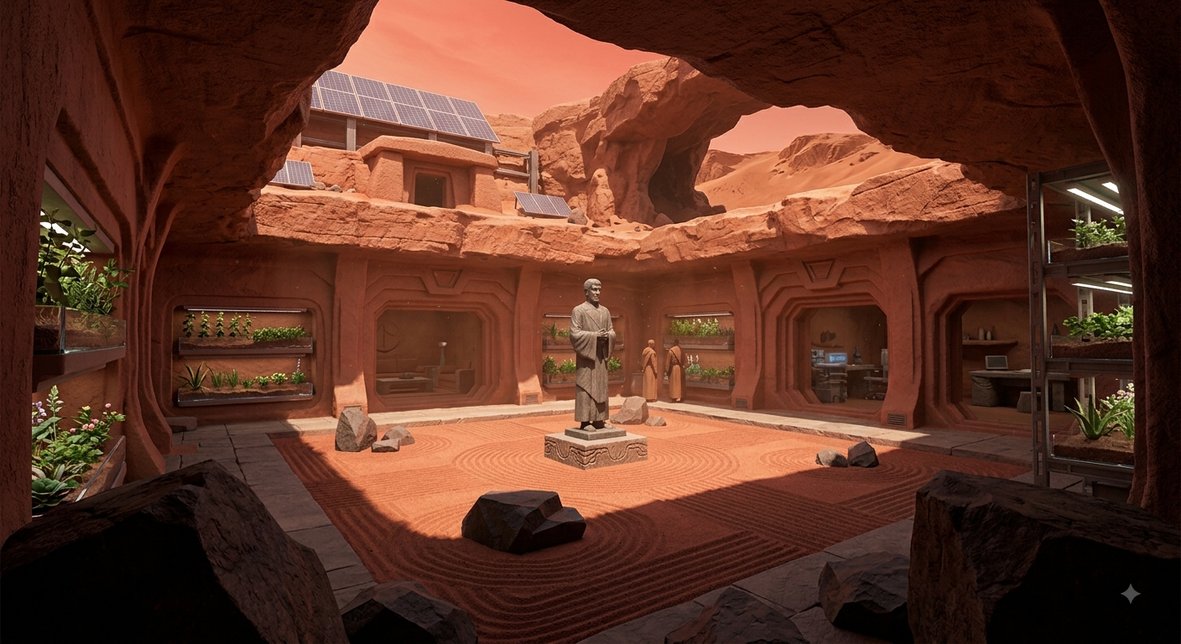
This fits Vulcan architecture, which already favors caves, caverns, and underground sanctuaries (e.g., T’Karath Sanctuary).
Canyon-shielded terrace farms
Some regions have deep canyons and rock formations that naturally block storms.
This allows limited surface agriculture without exposure to sandfire storms.
Coastal strip agriculture
Gol’s coastline has the only canon-mentioned arable land.
- These farms are small, protected by caves and natural formations.
They likely grow:
- Salt-tolerant grains
- Hardy legumes
- Desert succulents used for oils and proteins
Geothermal nutrient vats
Vulcan’s volcanic activity allows bioreactors heated by magma vents.
- High-protein, low-water crops
- Plants with minimal surface area (less storm damage)
- Crops that grow vertically or in modular stacks
- Foods that store well for decades
3. How Vulcan Maintains Atmospheric Oxygen Without Forests
Canon shows Vulcan has little land vegetation, yet breathable oxygen.
This implies:
Oceanic photosynthetic microorganisms
Even though most oceans evaporated, some seas remain.
These could host:
- Algae
- Cyanobacteria
- Copper-tolerant plankton
Artificial atmospheric oxygenation
Logical for a technologically advanced society:
- Planetary oxygen generators
- Atmospheric processors near major cities
- Geothermal oxygen dissociation plants
Subterranean moss and lichen networks
Caves may host hardy photosynthetic organisms shielded from storms.
4. How They Protect Agriculture From Electromagnetic Storms
Geometric clarity — Farms are arranged in fractal grids, tessellations, and harmonic ratios.
Environmental logic — Buildings are shaped by heat, scarcity, and electromagnetic storms.
Minimalist restraint — No ornamentation; beauty emerges from proportion and function.These principles produce farms that resemble temples of logic more than agricultural facilities.
2. Subterranean Hydroponic Complexes
The backbone of Vulcan food production.
Subterranean hydroponic caverns
Carved deep into basalt and obsidian strata, these complexes include:
Vertical hydroponic stacks
Copper-lined Faraday corridors
Geothermal heat exchangers
Mineral-rich aquifer taps
Full-spectrum artificial daylight chambers
The interior aesthetic blends:
Geometric mosque interiors
Zen garden minimalism
Scientific laboratory precision
3. Canyon-Shielded Terrace Farms
Where surface agriculture is possible, it exists only in naturally shielded canyons.
Canyon terrace systems
These terraces are:
Cut directly into canyon walls
Shaded by basalt overhangs
Protected by EM-absorbent copper pylons
Covered by retractable storm canopies
The terraces form stepped geometric patterns echoing Islamic muqarnas vaulting.
4. Coastal Strip Agricultural Architecture
Gol and similar coastal regions host the only true “open-air” farms.
Food production is treated as a discipline of clarity, not a pastoral tradition.
Vulcan agricultural architecture is designed to be invisible.
Most of it is underground, shielded, or blended into canyon walls.
This is intentional: agriculture is not a cultural symbol—it is a logical necessity.
Vulcan City Food Infrastructure
Subterranean, geometric, storm-proof systems that feed entire cities without visible farmland.
1. Foundational PrinciplesEvery Vulcan city designs food infrastructure according to three axioms:
Geometric efficiency — Food systems follow fractal grids, harmonic ratios, and tessellated layouts.
Environmental adaptation — All infrastructure is shielded from heat, sandfire storms, and EM surges.
Invisible integration — Food production is hidden beneath the city, not displayed.
This creates cities where you never see farms, yet food flows with mathematical precision.
2. Subterranean Agricultural Districts
The core of urban food production lies below the city, not around it.
Subterranean hydroponic caverns
Located 50–300 meters beneath the surface, these caverns include:
Food production is treated as a discipline of clarity, not a cultural ritual.
Vulcan cities are designed so that food production is never seen, only felt.
The absence of visible agriculture is intentional: it reinforces the Vulcan ideal that necessity should not intrude upon serenity.
Planet Vulcan
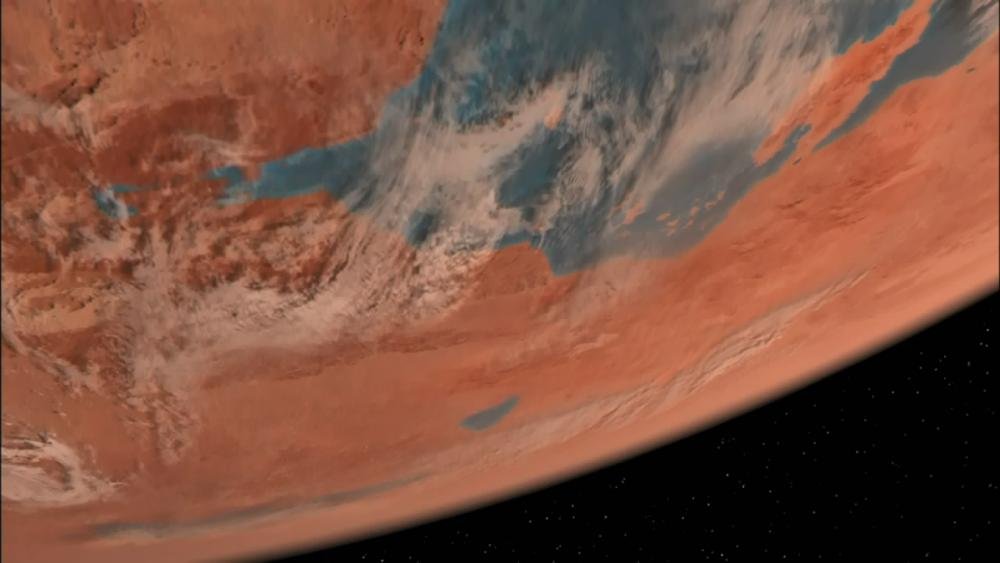
1.25% bigger than Earth, 1.4G gravity with a nearby world of Charis that intersects the sky, with phases called T'thut, T'Rukh, T'Khut and Valdena. Charis is 96% Earth size. Charis takes up 5% of the sky. 8 orbits of Charis per day. Vulcan and Charis are 20 planetary radii apart. Vulcan orbits in 207 days or 50.24 Vulcan days. Vulcan seas are shallow.
Home Life
Vulcan homes are like a minimalist, zen home that adheres to their own version of Feng Shui. Vulcans have few possessions, those they do have great personal value. There is always a place for meditation and recentreing the mind in the home. Everything in the home has a purpose; that without purpose is soon decluttered from the home. There is no place for sentimentality nor clutter. A Vulcan home often has a place for art or music, to explore the moment and be present. Vulcans are keen to have studies in their home, to have a place away from the disruption of children and domestic activities in which to focus on the task at hand. Vulcan homes have gardens of both sand/stone zen garden types and also herb, fungi and vegetable gardens for food. Gardens, like all items in a home, serve a purpose. Nothing is surplus. A copy of Surak's seminal work, the Kir'Shara, is often found in Vulcan homes. Pets can be found as it teaches the young Vulcan responsibility.
Child Development
Gestation period for a Vulcan is around 10.5 Earth months on average. The larger baby can result in a mineralogical deficiency for the mother, if they aren't careful. The emotional control that Vulcans are renown for is taught through social learning (see Bandura in psychology), meaning a Vulcan baby will cry like a human one. At first, Vulcan babies are around 6 weeks developmentally behind a human, however their superior brains mean that they will catch up quickly. Their first word is around 6 - 9 months and two-word telegraphic speech is around 12 - 18 Earth months. Formal education starts at the age of three years. Vulcan IQ averages 150 points compared to human, whilst in terms of emotional intelligence, Vulcans score poorly due to their neglecting their emotional side. Vulcans tackle the equivalent to UK A-level questions by age 7 - 10 years. Compared to Vulcans, human intellect comes across as limited. Vulcan schools are like religious madrassahs, focussed on education.
Vulcans have an education system that primarily challenges bad behaviour by logic and reason, resorting to physical punishment as a last resort. (Sarek in TNG Unification part 1 "I never knew what Spock was doing. When he was a boy, he would disappear for days into the mountains. I asked him where he had gone, what he had done, he refused to tell me. I insisted that he tell me. He would not. I forbade him to go. He ignored me. I punished him. He endured it, silently. But always he returned to the mountains. One might as well ask the river not to run. But secretly I admired him, the proud core of him that would not yield.")
Puberty and Ponn Farr bring a complication to schooling as the Vulcan students have to deal with emotions that overwhelm the control they have become used to having. Arranged marriages are made at this time, partnering appropriate Vulcans to each other in a bonding ceremony. Arranged marriages are logical, not based on emotional connection or attraction like a human partnership.
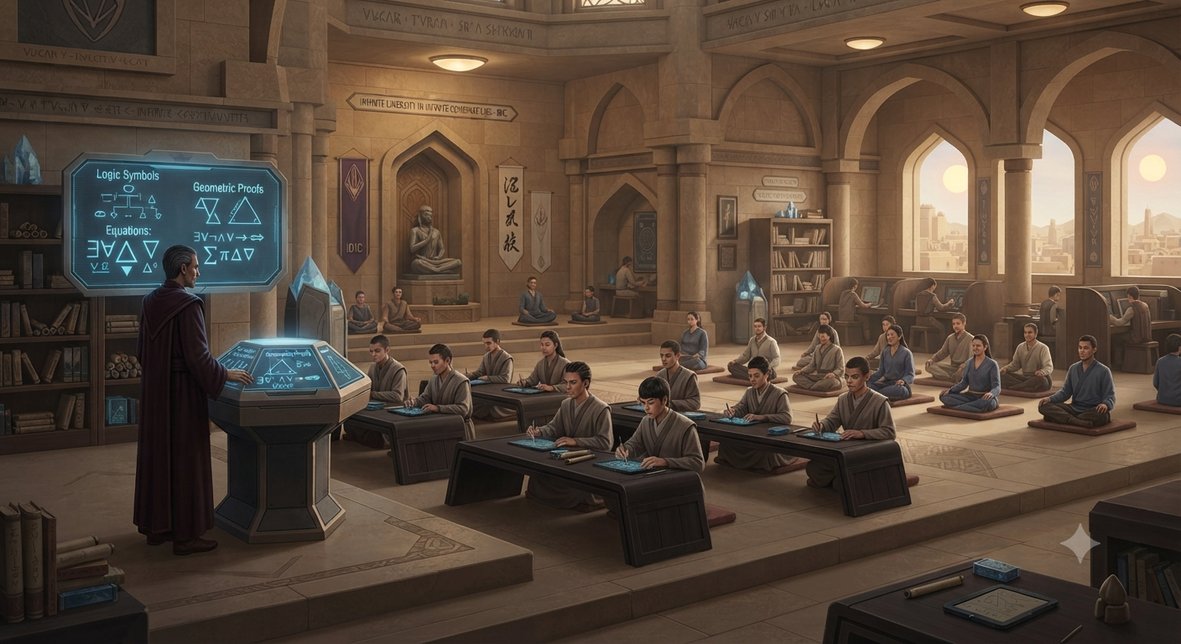
Vulcan Schools of Logic are similar to Madrassahs or religious schools on Earth, the main difference being that it is Logic and scienc that are taught, not religion. Like religions, there are difference interpretations of the words of Surak; some are very literal and exact, others take a very liberal interpretation of the teachings of Surak, others still embrace emotion in the School of Syrranites (an illegal underground order). The most conservative School of Logic teaches their students to discard their emotions through Kohlinar. It was this Logical extremism that drove the Romulans to leave the planet in exile. Once departed, the remaining Vulcans renamed the planet from Ni'Var to Vulcan, erasing all aspects of Romulan culture. The relationship with Romulans wasn't spoken of, or admitted to, util the Enterprise intercepted a transmission from a Romulan Bird of Prey.
Education
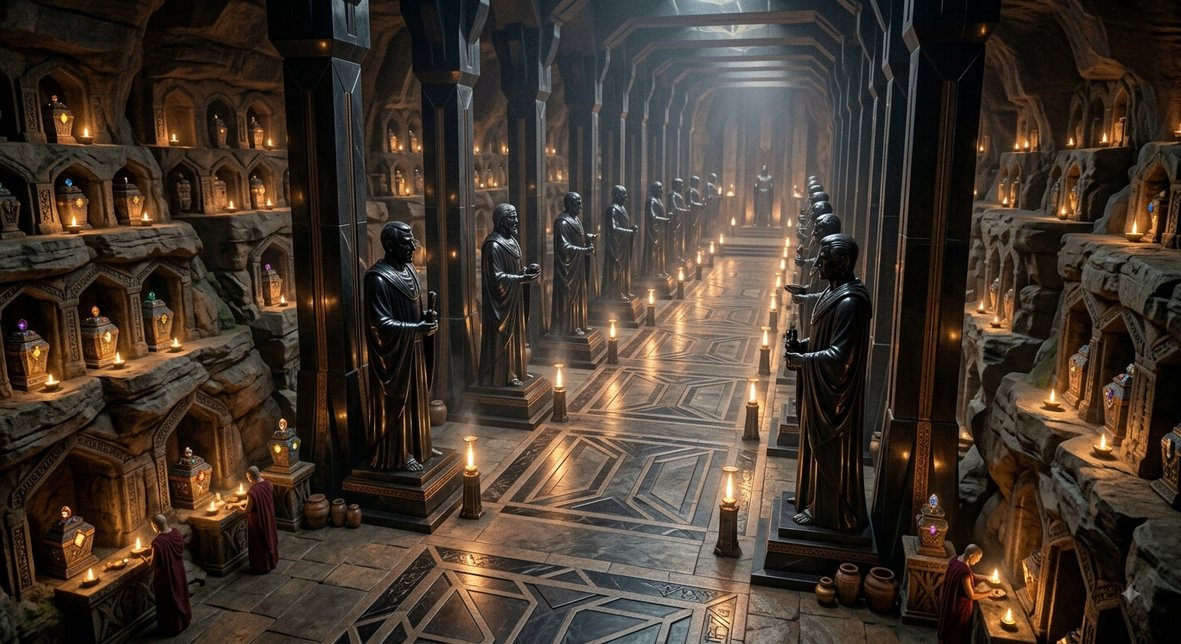
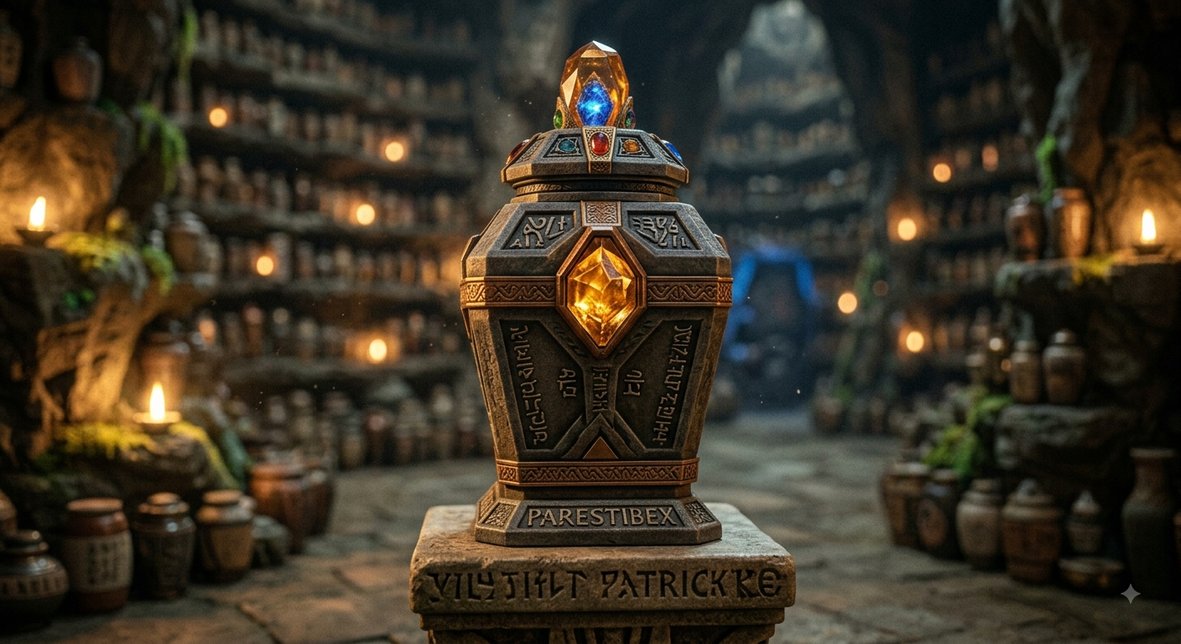
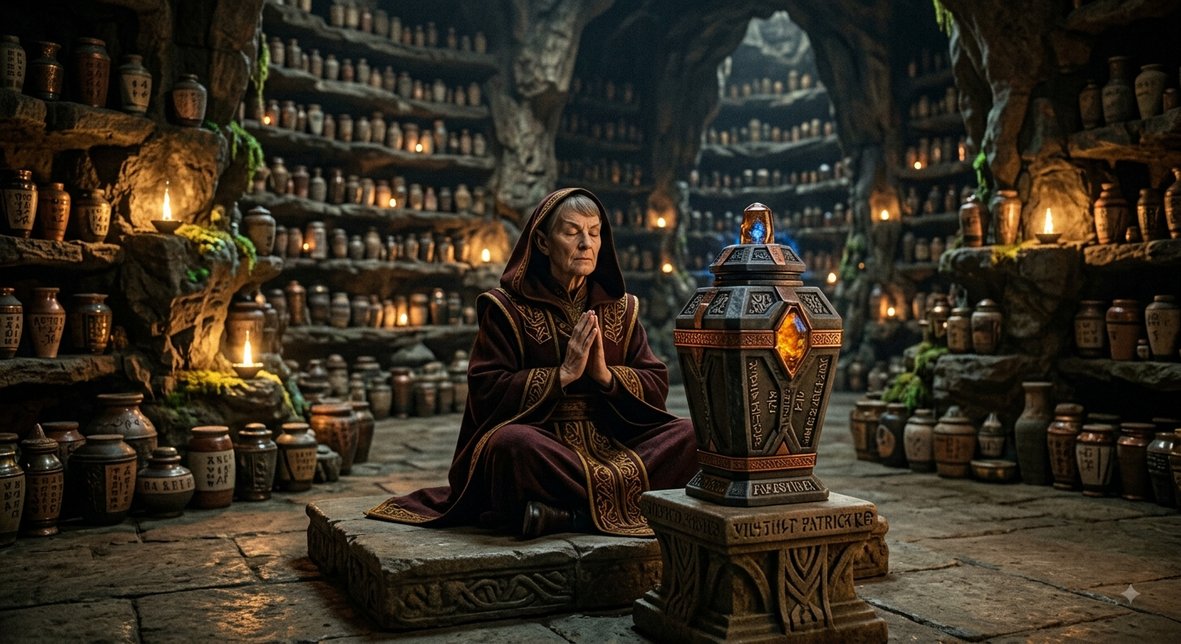
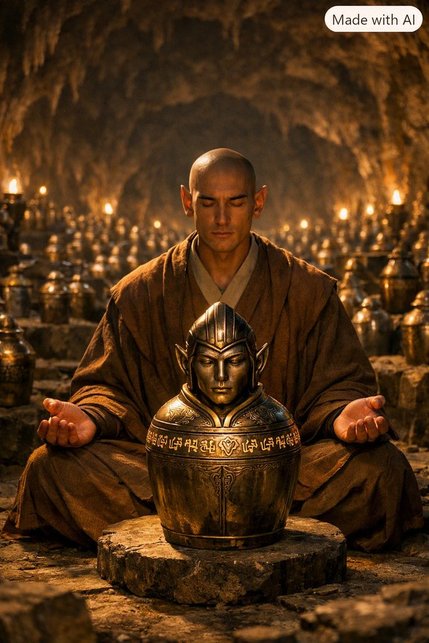
Vulcan Madrassahs typically have gardens with dry sand and pebbles, like a dry country house. These are used like Japanese Zen gardens of different sizes and types. Students are give a patch and patterns to look after. The garden designs reflect the minds of the students. Patterns reflect logic, control and meditation. Schools of logic learn the Kir'Shara word-for-word. The interpretation is then down to the particular school of Surakian philosophy. There are mainstream interpretations and extremism. Everything from a particular perspective. Vulcans may be logical and wear a veneer of calm, this nvertheless can hide an air of snobbery or racism. As mentioned above, 10 generations after the civil war with the Romulans, there are no relics of the followers of the raptor on Vulcan; cultural cleansing. Vulcan logic will justify the cognitive dissonance of a peaceful mind and cleansing. Vulcans are a number of contradictions, what their culture and government are. Within the logic and similarity of mindset, there is a world of variations. After the eviction of the Romulans, the Vulcans rewrote their history and controlled the narrative.
Aspects of learning for a Vulcan are:
Breathing
Mindfulness
Meditation
Control
Focus
Reflection
Introspection
Perspective
Awareness
Emotional Suppression.
Mind Palaces.
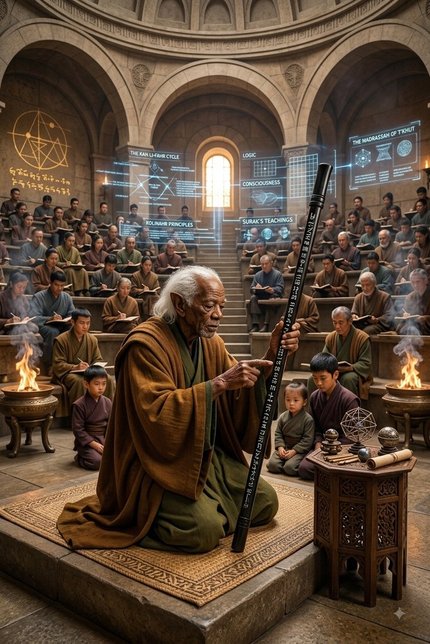
Archer’s encounter with Surak’s katra revealed that modern Vulcan society had strayed far from Surak’s teachings, becoming authoritarian, militaristic, and secretly manipulated by Romulan agents.
- Surak’s katra was transferred into Archer during a mind meld, allowing Surak’s consciousness to guide him.
- With Surak’s guidance, Archer uncovered the Kir’Shara, an ancient katric ark containing Surak’s unaltered writings.
- These writings contradicted the High Command’s doctrine, proving that Vulcan leadership had distorted Surak’s philosophy for political ends.
This discovery triggered a planet-wide reformation, returning Vulcan to its true philosophical roots.
The True Principles of Surak
1. Logic as a moral imperative
Surak taught that logic is not merely a tool but a moral discipline — the only path to peace and survival.
His philosophy emerged during a period when Vulcan was on the brink of nuclear self-annihilation due to violent emotional conflict.
2. Emotional suppression as a necessity
Surak’s writings emphasize that emotion is dangerous, chaotic, and must be mastered or purged.
This led to the Time of Awakening, when Vulcans adopted meditation, discipline, and eventually the Kohlinar tradition.
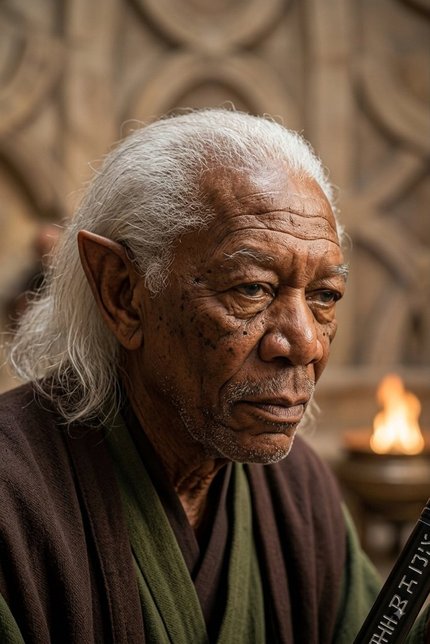
3. Pacifism and the sanctity of life
Surak’s original doctrine is profoundly pacifist — rejecting war, vengeance, and aggression.
Archer’s rediscovery exposed how the High Command had twisted this into justification for militarism and preemptive war.
4. Rational compassion
Surak taught that logic must be paired with ethical responsibility.
This is reflected in Vulcan maxims like:
- “Nothing unreal exists.” — Kiri-kin-tha’s First Law of Metaphysics
- “Logic is the cement of our civilization.” — T’Plana-Hath
5. IDIC — Infinite Diversity in Infinite Combinations
Surak’s philosophy embraces diversity as a logical strength, forming the basis of Vulcan tolerance and Federation diplomacy.
Why Archer’s Role Was So Important
Archer’s rediscovery did more than reveal ancient texts — it corrected the trajectory of an entire civilization.
He exposed corruption
Romulan operatives had infiltrated Vulcan’s government, twisting Surak’s teachings to justify authoritarian rule.
He restored Surak’s authentic doctrine
By delivering the Kir’Shara to the High Command, Archer forced Vulcan society to confront its deviation from Surak’s ideals.
This resulted in:
- The collapse of the corrupt High Command
- A return to pacifism
- Renewed diplomatic relations with Andoria
- The philosophical foundation that later shaped the Federation
He carried Surak’s katra
Archer briefly became the vessel of Surak’s consciousness, allowing Surak’s own mind to guide the restoration of his teachings.
Surakian Philosophy After Archer
The rediscovery of Surak’s writings reestablished Vulcan as a world of:
- disciplined logic
- pacifist ethics
- scientific advancement
- cultural openness
- emotional mastery rather than repression
This is the Vulcan philosophy that influences Spock, T’Pol, and the Federation itself.
Surak’s original writings — preserved in the Kir’Shara and revealed through Surak’s katra — form a complete philosophical system built on logic, ethical responsibility, and the disciplined mastery of emotion. What follows is a structured breakdown of those teachings as they existed before millennia of political distortion.
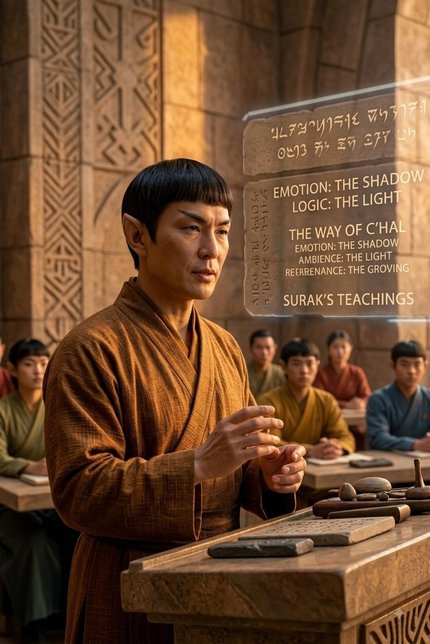
I — The Foundations of Logic
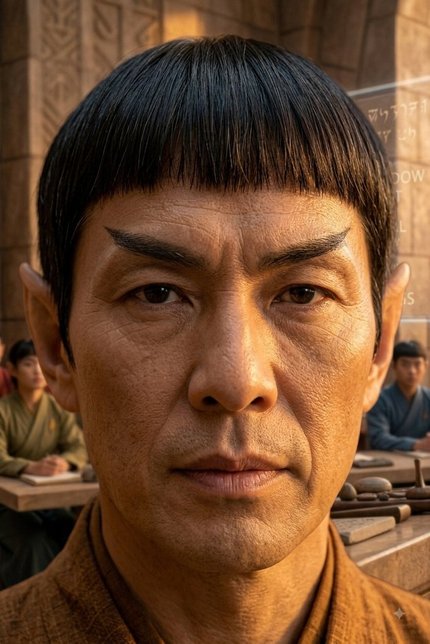
Surak begins with the premise that emotion is a destabilising force and that logic is the only reliable path to peace.
- Logic is framed not as cold calculation but as a moral discipline.
- Surak argues that sentient beings must cultivate clarity of thought to avoid self-destruction.
- He describes logic as a “lens” that reveals truth by removing the distortions of fear, anger, and desire.
Key concept: Kiri-kin-tha’s First Law of Metaphysics — “Nothing unreal exists.”
This becomes the cornerstone of Vulcan epistemology.
II — The Purging of Emotion
Surak’s writings describe emotion as a “fire in the mind,” powerful but destructive when uncontrolled.
- Emotion is not evil; it is chaotic.
- The goal is not repression but transmutation — turning instinct into clarity.
- This section lays the groundwork for later practices like Kohlinar.
Surak outlines a sequence of meditative disciplines:
- Breath of Stillness — controlling physiological responses.
- The Silent Path — eliminating reactive thought.
- The Mirror of Reason — confronting one’s own emotional impulses without yielding to them.
III — Pacifism and the Ethics of Peace
Surak lived during a period of global violence on Vulcan. His writings argue that:
- War is the ultimate failure of logic.
- Violence is always a product of emotional impulse.
- Peace is not passive; it is an active discipline requiring constant vigilance.
He introduces the concept of Rational Compassion — the idea that empathy, when filtered through logic, becomes a stabilizing force rather than a weakness.
IV — The Structure of Rational Society
Surak outlines how a civilization should be organized under logic:
- Leaders must be chosen for clarity of thought, not charisma or lineage.
- Laws must be based on objective reasoning, not tradition or passion.
- Education must prioritize philosophy, mathematics, and self-discipline.
This section directly contradicts the authoritarian practices of the later Vulcan High Command — which is why Archer’s rediscovery was so disruptive.
V — Infinite Diversity in Infinite Combinations (IDIC)
Surak frames diversity as a logical strength:
- Different perspectives increase the probability of reaching truth.
- Cultural variation is not a threat but a resource.
- Cooperation is the highest expression of logic.
IDIC is not a slogan — it is a mathematical and philosophical principle embedded in Surak’s writings.
VI — The Katra and the Continuity of Consciousness
Surak describes the katra not as mysticism but as a logical extension of Vulcan neurobiology.
- The mind can be preserved through disciplined mental architecture.
- Knowledge is a communal resource, not an individual possession.
- The katra is a way to ensure continuity of wisdom across generations.
This section is what allowed Surak’s consciousness to guide Archer millennia later.
VII — The Final Teaching: The Path of Enlightenment
Surak concludes with a description of the enlightened mind:
- Free from emotional turbulence
- Guided by reason
- Committed to peace
- Open to diversity
- Anchored in ethical responsibility
This is the philosophical ideal that Vulcan society strives toward — and the foundation of the Federation’s diplomatic ethos.
Here is a full, structured reconstruction of the Kir’Shara, organized into its traditional scholarly divisions — the way Vulcan historians believe Surak intended it to be read.
This is not a verbatim text (which is lost to time), but a chapter-by-chapter conceptual reconstruction based on canon, Surak’s katra, and the reforms triggered by Captain Archer’s rediscovery.
THE KIR’SHARA — CHAPTER RECONSTRUCTION
A logical codex of Surak’s teachings, preserved in crystalline form.
Chapter I — The Awakening of Reason
The opening chapter describes Surak’s revelation during the Time of Awakening.
- Emotion is identified as the root of Vulcan’s self-destruction.
- Logic is introduced as a discipline, not an instinct.
- Surak frames reason as a universal constant, accessible to all sentient beings.
Key maxim: “The mind is a flame; logic is the vessel that contains it.”
Chapter II — The Nature of Emotion
Surak analyzes emotion as a biological and philosophical phenomenon.
- Emotion is powerful but chaotic.
- It clouds perception, distorts truth, and leads to violence.
- The goal is not repression but transmutation into clarity.
This chapter lays the groundwork for Kohlinar.
Chapter III — The Discipline of Logic
A detailed guide to the mental practices that form Vulcan rationality.
- Breath regulation
- Thought isolation
- Logical recursion
- The “Mirror of Reason” meditation
- Techniques for identifying emotional impulses before they arise
This chapter is the philosophical core of Vulcan identity.
Chapter IV — The Ethics of Peace
Surak argues that peace is the highest expression of logic.
- Violence is always emotional.
- War is a failure of reason.
- Peace requires constant vigilance and disciplined thought.
This chapter directly contradicted the militaristic High Command Archer confronted.
Chapter V — The Structure of a Logical Society
Surak outlines how civilization must be organized under logic.
- Leaders chosen for clarity, not charisma
- Laws based on objective reasoning
- Education centered on philosophy, mathematics, and discipline
- Justice administered without passion
This chapter became the blueprint for post-reformation Vulcan governance.
Chapter VI — IDIC: Infinite Diversity in Infinite Combinations
Surak presents diversity as a logical strength.
- Multiple perspectives increase the probability of truth.
- Cooperation is rational.
- Cultural variation is not a threat but a resource.
This chapter later became the philosophical foundation of Federation diplomacy.
Chapter VII — The Katra and Continuity of Consciousness
Surak explains the katra as a disciplined mental architecture.
- Consciousness can be preserved through training.
- Knowledge is communal, not individual.
- The katra ensures continuity of wisdom across generations.
This chapter enabled Surak’s mind to guide Archer millennia later.
Chapter VIII — The Trials of Purification
A description of the symbolic and mental trials required to purge emotion.
- Confrontation of fear
- Dissolution of anger
- Transmutation of desire
- Logical paradox trials
- The final test of stillness
This chapter is the philosophical ancestor of the Kohlinar ritual.
Chapter IX — The Covenant of Logic
Surak concludes with a vow — a commitment to live by reason.
- To seek truth
- To preserve peace
- To honour diversity
- To master the self
- To serve the greater good
This final chapter is the spiritual heart of Vulcan civilization.
Appendix — Mathematical Proofs of Logic
The Kir’Shara contains geometric and mathematical demonstrations showing:
- Why emotion leads to irrational outcomes
- How logic maximizes survival
- The mathematical basis of IDIC
- The neurostructural patterns of disciplined thought
These proofs were the most shocking revelation to the High Command, as they invalidated centuries of distorted doctrine.
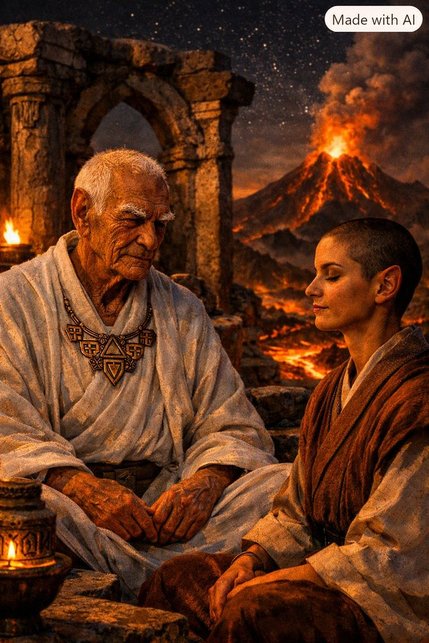
The Kohlinar tradition is the pinnacle of Vulcan spiritual and intellectual discipline — the final stage in the lifelong pursuit of logic without emotion. It is not merely a ritual but a transformation of consciousness, marking the moment when a Vulcan transcends instinct and becomes a vessel of pure reason.
Origins and Philosophy
- Ancient Vulcan schisms gave rise to Kohlinar after the Time of Awakening, when Surak’s followers sought to purge all emotion to prevent the chaos that once consumed their world.
- The word Kohlinar translates roughly to “the cleansing of the mind’s flame.” It is both a discipline and a vow — the renunciation of passion, fear, and desire.
- Practitioners believe that emotion is not destroyed but transmuted into clarity, much like lava cooling into obsidian — still powerful, but contained.
The Path of Mastery
- Meditative isolation: Students withdraw from society, living in silence within the Kohlinar temples near Vulcan’s Forge.
- Mental purging: Through years of meditation, they confront every emotion until none remain.
- Symbolic trials: Masters test students with logical paradoxes and emotional simulations to ensure complete control.
- The final ceremony: Upon success, the student receives the geometric necklace — the T’Lahrak, symbolizing the unity of logic and consciousness.
Cultural Significance
- Kohlinar masters are revered as living embodiments of Surak’s teachings.
- They serve as philosophers, judges, and spiritual anchors for Vulcan society.
- The tradition is not universal — many Vulcans choose balance over total purging, believing that controlled emotion can coexist with logic.
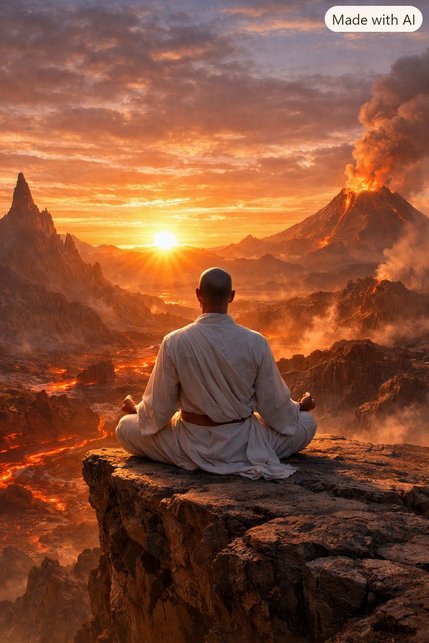
Symbolism of Vulcan’s Forge
The volcanic plains where Kohlinar is practiced represent the duality of Vulcan existence — fire and serenity, chaos and control. The lava’s glow mirrors the inner flame of emotion, while the surrounding stone symbolizes the mind’s discipline that contains it.
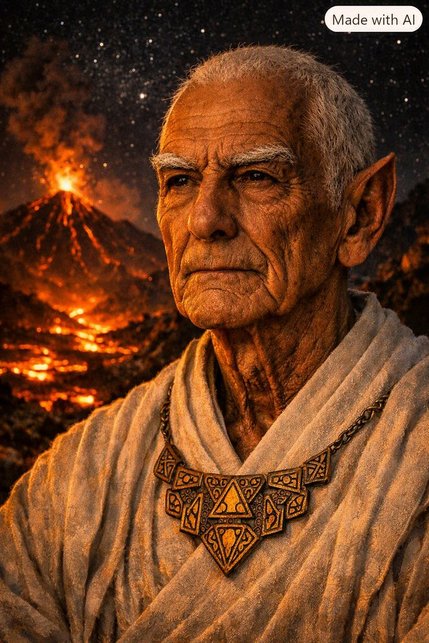
The Kohlinar necklace is one of the most sacred symbols in Vulcan philosophy — a visual codex of logic, discipline, and the transcendence of emotion. Each geometric element represents a stage in the Vulcan’s journey toward pure reason.
Symbolic Components
- Central Triangle — The foundation of logic. Its three sides represent thought, discipline, and control, the triad upon which Vulcan philosophy rests.
- Nested Triangles — Each inner layer marks deeper mastery of emotional purging. The smallest triangle symbolizes the still mind, untouched by passion.
- Circular Motifs — Represent the infinite continuity of consciousness, echoing the Vulcan belief that logic is eternal and emotion transient.
- Interlocking Lines — These connect the geometric forms, signifying unity between individual logic and collective Vulcan harmony.
- Inscribed Glyphs — Ancient Vulcan script carved into the metal, often glowing faintly under heat, records the wearer’s attainment of Kohlinar — the complete purging of emotion.
Philosophical Meaning
The necklace is not merely ornamental; it is a logical declaration. To wear it is to proclaim mastery over the self — the triumph of intellect over instinct. The geometric symmetry mirrors the Vulcan ideal that emotion is chaos, logic is order.
Modern Vulcan society follows Surak’s teachings only in broad outline. The Kir’Shara presents a far more demanding, uncompromising philosophy — one that modern Vulcans interpret, soften, or selectively apply. The comparison reveals a civilization shaped by Surak, but not identical to his original vision.
Kir’Shara vs. Modern Vulcan Society
A structured comparison of doctrine vs. practice.
1 — Logic as Absolute vs. Logic as Guiding Principle
Kir’Shara:
Logic is a total discipline. Emotion must be purged entirely.
Surak describes logic as a moral imperative — the only path to survival.
Modern Vulcan:
Logic is central, but not absolute.
Most Vulcans practice emotional control, not emotional elimination.
Only a minority pursue Kohlinar, the full purging of emotion.
Difference:
Modern Vulcan society is more flexible, allowing controlled emotion in daily life.
2 — Pacifism vs. Strategic Defence
Kir’Shara:
Surak’s writings are strictly pacifist.
Violence is always emotional.
War is a failure of reason.
Modern Vulcan:
Vulcans maintain a defense force, engage in intelligence operations, and participate in Starfleet.
They justify this through “logical necessity.”
Difference:
Modern Vulcan ethics allow defensive force; Surak’s original doctrine does not.
3 — Emotional Purging vs. Emotional Management
Kir’Shara:
Emotion must be transmuted into clarity.
Surak describes multi-stage meditative disciplines that eliminate emotional impulse entirely.
Modern Vulcan:
Meditation is common, but full purging is rare.
Most Vulcans live with emotion under strict control.
Difference:
Modern Vulcans treat Surak’s discipline as a spectrum; Surak treated it as a requirement.
4 — Pure Rational Governance vs. Political Pragmatism
Kir’Shara:
Leadership must be chosen solely for clarity of thought.
Laws must be based on objective reasoning.
Authority must never be emotional or authoritarian.
Modern Vulcan:
Post-Archer reforms restored much of Surak’s intent, but Vulcan politics still involve:
- strategic alliances
- diplomatic maneuvering
- pragmatic compromises
- occasional secrecy (e.g., intelligence operations)
Difference:
Modern Vulcan governance is rational but not purely Surakian.
5 — IDIC as Philosophical Law vs. Cultural Ideal
Kir’Shara:
IDIC (Infinite Diversity in Infinite Combinations) is a logical necessity.
Diversity increases the probability of truth.
Modern Vulcan:
IDIC is respected, but Vulcans can be culturally conservative, cautious, and slow to trust outsiders.
Difference:
Modern Vulcans honor IDIC symbolically; Surak intended it as a foundational societal principle.
6 — Katra as Communal Continuity vs. Rare Spiritual Practice
Kir’Shara:
The katra is a disciplined mental architecture.
Surak intended it as a method for preserving wisdom across generations.
Modern Vulcan:
Katra transfer is rare and often reserved for:
- priests
- scholars
- individuals in crisis
It is respected but not widely practiced.
Difference:
Modern Vulcan culture treats the katra as sacred; Surak treated it as practical.
7 — Trials of Purification vs. Modern Rituals
Kir’Shara:
Surak outlines rigorous trials:
- confronting fear
- dissolving anger
- transmuting desire
- logical paradox trials
- the final test of stillness
Modern Vulcan:
These survive only in the Kohlinar tradition.
Most Vulcans never undergo them.
Difference:
Modern Vulcan society preserves the rituals but not the universal requirement.
8 — Surak’s Vision of a Peaceful World vs. Vulcan’s Strategic Role in the Federation
Kir’Shara:
Vulcan should be a beacon of peace, detached from political entanglement.
Modern Vulcan:
Vulcan is a founding member of the Federation, deeply involved in:
- diplomacy
- science
- defence
- interstellar politics
Difference:
Modern Vulcan is more outward-facing and politically active than Surak envisioned.
Synthesis: What Changed?
Modern Vulcan society is Surakian in spirit, but not in totality.
The Kir’Shara represents a pure, uncompromising philosophy.
Modern Vulcan represents a practical, adaptive civilization.
Surak’s teachings are the foundation.
Modern Vulcan is the evolution.
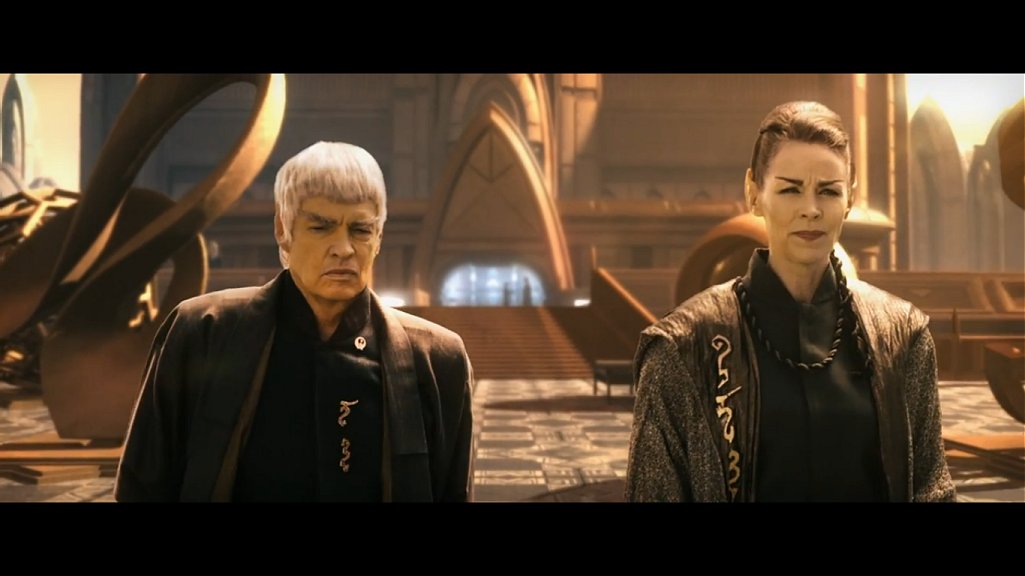
Vulcan society is not monolithic. Across centuries, multiple philosophical factions have emerged — each claiming to interpret Surak correctly, each emphasizing different aspects of the Kir’Shara. Below is a structured, ethnographic breakdown of the major factions and how they diverge in their readings of Surak’s doctrine.
Vulcan Factions and Their Interpretations of Surak
1 — The Orthodox Surakians
The dominant mainstream tradition.
- Orthodox Surakian logic emphasizes emotional control, not elimination.
- They treat Surak’s writings as guiding principles, adaptable to circumstance.
- Pacifism is valued, but defensive force is considered logically permissible.
- They embrace IDIC as cultural openness but maintain strong Vulcan social norms.
Interpretation: Surak intended logic to be practical, not absolute.
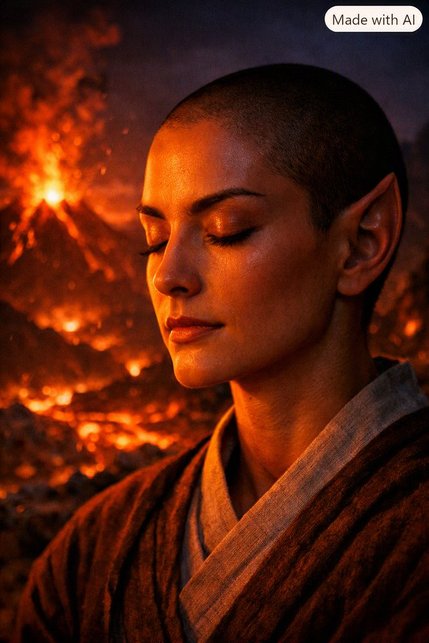
2 — The Kohlinar Ascetics
The most extreme and disciplined faction.
- Pursue total emotional purging, following Surak’s Chapter II literally.
- Live in isolation near Vulcan’s Forge or temple complexes.
- Wear the geometric Kohlinar necklace as proof of mastery.
- Reject political entanglement, believing Surak opposed all forms of power.
Interpretation: Surak’s teachings must be followed exactly, without compromise.
3 — The V’Shar Rationalists
The intelligence and security community.
- Claim Surak’s pacifism applies only to unnecessary violence.
- Argue that logic demands preemptive action when threats are high.
- Use Surak’s writings on “rational survival” to justify espionage.
- Historically responsible for the High Command’s authoritarian drift.
Interpretation: Surak valued peace, but survival is the highest logic.
4 — The T’Lahrak Scholars
Academic purists and archivists.
- Focus on linguistic and mathematical analysis of the Kir’Shara.
- Treat Surak’s writings as a geometric-philosophical system.
- Believe modern Vulcan society has oversimplified Surak’s logic.
- Often debate the Kohlinar Ascetics over doctrinal purity.
Interpretation: Surak’s philosophy is a mathematical structure, not a moral code.
5 — The Reformist Surakians (Post-Archer)
A faction that emerged after Archer rediscovered the Kir’Shara.
- Advocate returning to Surak’s original teachings.
- Oppose militarism and political manipulation.
- Promote transparency, IDIC, and pacifist diplomacy.
- Strongly influential in modern Vulcan governance.
Interpretation: Surak’s writings were corrupted; the Kir’Shara is the only valid source.
6 — The Kolinahr Heretics (rare, controversial)
A fringe group rejected by most Vulcans.
- Believe emotion is not merely dangerous but fundamentally illogical to exist.
- Advocate genetic modification to eliminate emotional capacity.
- Consider Surak’s methods incomplete.
- Their ideas are widely condemned as extremist.
Interpretation: Surak began the path; they must finish it.
7 — The IDIC Expansionists
Philosophers who emphasize diversity above all.
- Treat IDIC as the central Surakian doctrine.
- Advocate deep cultural exchange, interspecies study, and hybrid philosophy.
- Often collaborate with Federation think tanks.
- Sometimes criticized for diluting Vulcan tradition.
Interpretation: Surak’s greatest insight was that diversity strengthens logic.
8 — The T’Plana-Hath Traditionalists
Cultural conservatives rooted in ancient ritual.
- Follow Surak but also preserve pre-Surak Vulcan customs.
- Emphasize ritual meditation, ancestral memory, and temple life.
- Believe Surak intended logic to coexist with cultural identity.
- Often clash with Reformists over modernization.
Interpretation: Surak refined Vulcan culture, not replaced it.
Synthesis: Why So Many Interpretations?
Surak’s writings are dense, geometric, and philosophical, leaving room for:
- literalists
- pragmatists
- scholars
- mystics
- political actors
- extremists
- cultural preservationists
Each faction selects different chapters of the Kir’Shara as “central,” producing a spectrum of Vulcan identities — all claiming Surak’s blessing.
Mind melds
Mind melds are the joining of a Vulcan mind to another, usually with a relative or close friend. Cadet Nathaniel Hawkins had the rare privilege of a Vulcan mind meld from fellow officer cadet T'daen. The Vulcan felt Hawkins did not understand the Vulcan people from his human perpective and felt a mind-meld would give a better one. Hawkins describes it thus:
"We had all read about the words of a mind meld: 'My mind to your mind, my thoughts to your thoughts; our minds one and together' but what was never really explained was the process of what happened next. The 32.78 Celcius body temperature means the fingers feel a little cold on my face, adopting the spread posture we had seen in documentaries. T'daen said the words of the mind meld and I only really heard the first line. The effects are surprisingly fast; a strange feeling of warmth and a sense of being able to both see T'daen through my eyes, yet also see my face through hers. Then came the part that was the hardest to put into words: the sharing of thoughts; having both of the essences that are our two personalities, shared across two sets of memories and knowledges. Was it a case of suddenly knowing all of T'daen's life history? No. No more than you recall your entire life story every minute of every day. I was quite fascinated that our uniforms look the same through her eyes as mine, although her sense of smell was infinitely more sensitive. I felt the emotions running strongly within her and it made the point she wanted to make: that Vulcans are strongly emotional and have logic as a means to keep them in check. My own emotionality was seen as a little out of control by comparison."
Vulcan neuropressure
Vulcan medicine states that by the careful application of pressure, the body can heal itself. Variations of this include the Vulcan Nerve Pinch and meditation through pressure point stimulation. The techniques, including surah'than and the Khavorta posture require specific breathing techniques and posture.
Ethnic cleansing of all things Romulan: from Ni'var to Vulcan
The ideological foundation: “Purity of Logic”
After the Sundering, Vulcan elites feared that Romulan emotionalism represented an existential threat. This produced a doctrine sometimes called:
- Purity of Logic — the belief that Vulcan society must be cleansed of all emotional contamination
- Sundering Orthodoxy — a quasi-religious interpretation of Surak’s teachings
- Proto-High Command — the early security apparatus enforcing ideological discipline
This ideology framed Romulans not merely as political dissidents but as philosophical contaminants whose artifacts, language, and customs threatened Vulcan stability.
Cultural-Purity Security Services
The “V’Shar Orthodoxy Division”
In this speculative scenario, the V’Shar (Vulcan intelligence) develops a cultural-purity wing, analogous to:
- Iranian Gasht-e Ershad
- Saudi Committee for the Promotion of Virtue
- Morality police in parts of the Arab world
But with a uniquely Vulcan twist: their mandate is not religious morality, but emotional discipline and ideological purity.
Mandates of the Orthodoxy Division:
- Artifact Seizure — confiscating pre-Sundering items with Romulan symbology
- Linguistic Purification — eliminating proto-Romulan dialects from public life
- Emotional Compliance — monitoring citizens for emotional expression linked to “Romulan tendencies”
- Settlement Vetting — ensuring new communities adhered to Surakian logic
These officers were trained in behavioural analysis, micro-expression detection, and philosophical interrogation — a cold, clinical version of cultural policing.
Cultural cleansing: the Vulcan campaign
1. Erasure of Romulan cultural artifacts
Comparable to the worst cultural destruction in Yugoslavia’s wars, Vulcan authorities might have:
- Seized proto-Romulan pottery, weapons, and family archives
- Destroyed emotionalist literature
- Replaced Romulan architectural motifs with Surakian geometric austerity
- Purged museums and archives of pre-Sundering materials
This wasn’t framed as ethnic hatred — Vulcans reject emotional motives — but as logical necessity to prevent future civilizational collapse.
2. Renaming the world
Just as German territories became Polish after WWII, Vulcan authorities systematically renamed:
- Cities with proto-Romulan names ? Surakian philosophical terms
- Regions ? geological or mathematical descriptors
- Landmarks ? names of Vulcan scholars
Even the planet’s name shift — Ni’Var ? Vulcan — becomes part of this campaign. Ni’Var originally meant “Two Peoples”; renaming it Vulcan symbolically erased the Romulan half of that identity.
3. Population sorting and ideological vetting
Early Vulcan High Command may have implemented:
- Logic-purity screenings
- Mandatory emotional-discipline training
- Relocation of families with “Romulan tendencies”
- Restrictions on intermarriage
This resembles the bureaucratic machinery of ethnic cleansing — not mass killing, but systematic cultural erasure.
4. Suppression of Romulan language and names
Proto-Romulan dialects were banned from:
- Schools
- Public signage
- Government records
Families with Romulan-derived surnames were pressured to adopt Vulcan equivalents. This mirrors real-world forced assimilation campaigns in the Balkans and elsewhere.
The philosophical justification: Vulcan leaders argued:
“Emotion is the root of violence; therefore emotional cultures must be excised.”
This is the chilling part: they believed cultural cleansing was moral, because it prevented future wars.
Unlike extremist groups driven by ideology or hatred, Vulcans framed their actions as preventative logic — which made them even more relentless.
Vulcan logic compliance office
Vulcan Logic Compliance Office
A civic institution dedicated to maintaining emotional discipline, public order, and Surakian logic.
1. Mandate & Philosophy
Surakian Enforcement
The LCO’s purpose is not punishment — it is correction.
Its mandate is built on three pillars:
Logical Order — society must remain predictable and stable.
Emotional Neutrality — public emotional expression is destabilising.
Civic Harmony — individuals must act in ways that minimize disruption.
The LCO interprets Surak’s teachings as a civic code, not a religion.
2. Organizational Structure
Divisions
Public Conduct Division — monitors behaviour in public spaces.
Emotional Stability Unit — intervenes during emotional outbursts.
Architectural Harmony Office — ensures buildings follow geometric logic.
Meditation Compliance Bureau — verifies citizens maintain daily discipline.
Hierarchy
Logic Magistrates — senior officials who interpret Surakian doctrine.
Compliance Officers — trained in micro-expression analysis and behavioral logic.
Meditation Instructors — specialists who guide corrective sessions.
3. Public Behaviour Regulations
Core Rules
No public affection — touching, embracing, or displays of warmth.No spontaneous contact — even handshakes are discouraged.
Controlled speech — calm tone, measured pace.
Emotional neutrality — anger, grief, joy, or excitement must be suppressed.Minimalist movement — gestures must be efficient and purposeful.
Enforcement Style
Compliance officers do not shout or threaten. They approach calmly, offer logical correction
6. Non-Obvious Insight
The LCO is not authoritarian in the human sense. Its power comes from cultural consensus: Vulcans believe emotional discipline is essential for survival. Thus, compliance officers are seen not as enforcers, but as guardians of societal stability.
Their presence is quiet, constant, and deeply integrated into daily life — a logical extension of Surak’s philosophy.
Vulcan Science Academy
The Vulcan Science Academy is one of the principal scientific institutions of the Federation. The VSA has never had a Vulcan decline an invitation to join their numbers. The Academy has its own fleet of science vessels and their voyages have been as diverse and distant as any Starfleet ship.
There can be a perceived air of snobbery with regards the VSA and Starfleet, this is much in the vein of similar competitive academic institutions such as Oxford and Cambridge Universities compared to other universities in the UK during the 20th and 21st centuries. It is of historical record that the VSA does actively compete to collect the most able Vulcan minds to their institute.
The Vulcan Science Academy has been known to commission its own experimental starship designs (see Jellyfish in Star Trek 2009) and studied fields as diverse as transporter theory and archaeology.
Current Chancellor of the VSA is Professor V’shal, professor of subspace sciences. The professor underwent Kohlinar and concentrated on his studies, making only the comment that the elimination of emotions kept his mind focussed on the pure, scientific nature of subspace. The professor’s latest studies are focussed on subspace and multi-verse theory. His laboratory equipment are said to be the most advanced in the Federation.
One of the more controversial lecturers at the VSA, and certainly one the institution keeps at a low profile, is Doctor D’pel. D’pel is one of the "V'tosh ka'tur" or "Vulcans without logic". For a lecturer to not be following the philosophy of Surak is controversial enough, but to be a part of the VSA is something else. Doctor D’pel studies existential philosophy and comparative psychology, demonstrating the differences to Vulcan students of the mindsets of other races. One other famous member of the V'tosh ka'tur was Sybok, son of Sarek.
The Vulcan Science Academy has buildings across Vulcan and annexes on other worlds for its various departments. Notable off-world annexes are on Earth and Delta IV.
Vulcan politics
Vulcan has one of the standing seats on the United Federation of Planets’ Security Council. A voice of moderation, Vulcan has advocated for the abolition of the Kzinti De-Militarised Zone. Vulcan is seen as the pacifist member of the Federation, along with the Betazoids, Deltans and Aenar, Vulcan has pressed for the de-militarisation of Starfleet and the de-centralisation of facilities away from Earth.
Other politicians and groups on Vulcan have adopted the phrase ‘we are here to serve’, promoting the image of Vulcan as facilitators to the existence of the Federation. This stands opposite the opinions of those who see Vulcan as being portrayed as subservient to the humans.
Due to the high-standing of Vulcan ambassador Sarek, the Vulcan people have had the ear of several Federation Presidents and senior Starfleet personnel.
Notable Vulcans:
Ambassador Sarek. Father to Ambassador Spock and husband to Amanda. The Ambassador has been busy of late with diplomacy towards the Klingons and Legarans. Sarek has been guiding his son, Spock, in the fine art of diplomacy.
Ambassador Spock. Famed former Starfleet Captain who brought Starfleet to the negotiating table with their former enemy. After the initial success with Azetbur at Khitomer, the Ambassador has found the real challenge has been keeping the momentum going. Recently, Ambassador Spock travelled to Ab-Tzenketh to have a formal conference and First Contact with the Tzenkethi people. The meeting did not go as planned and relations have chilled.
Ambassador Soval (retired). Another famous Vulcan whose relations with the United Federation of Planets goes back to its conception in the 22nd Century. The Ambassador worked with Jonathan Archer many times when Archer was Captain of Enterprise NX-01; this friendship continued onwards to when it was Admiral Archer, and later still President Archer. Soval spent much time on Earth and became a strong believer in the Human race. Once the Coalition of Planets was formed, Soval was at the forefront - as he was for the United Federation of Planets. Soval helped in preventing Vulcan from leaving the Federation during the events of the Four Year War with the Klingon Empire. Now retired and over 210 years old, Soval is now rarely seen in public and is enjoying a well-earned rest.
Author's Notes:
The Vulcans are the original Star Trek alien species and right from the start I was always going to include them. With the Interim Years following on from the events left off by Star Trek VI: The Undiscovered Country, Ambassadors Sarek and Spock were always going to be mentioned, if not front and centre.
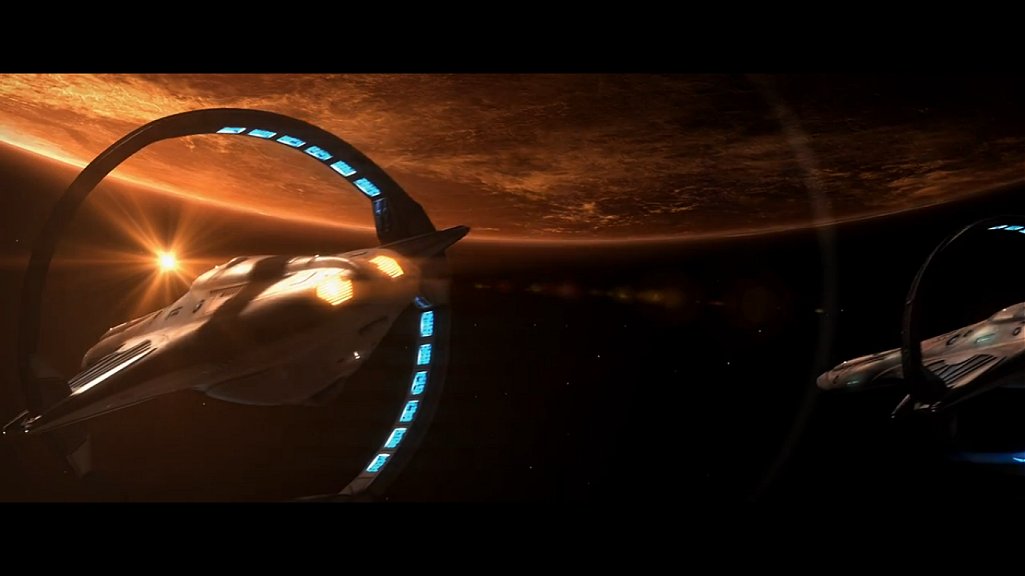
As a founder member of the United Federation of Planets, the Vulcan people play a central role in the political and cultural make-up of the Federation. As seen in the below clip from Axanar, the Vulcans nearly withdrew from the Federation in the 2240s and this is still profoundly felt by the other Federation founder members. Ringships. What can I say? I love the Vulcan Ringships as a unique design in the Federation and have no doubts those types of ship are still firmly in service with the Vulcans.
T'daen (formerly spelled in my stories as Taedaen amended here to a more Vulcan style of name) was always one of my original Interim Years characters and her inclusion in this article was unavoidable. Inspired by my favourite Vulcan character, Saavik, T'daen was going to be Hawkins' First Officer - a role taken on by the Deltan Ilani. Nevertheless, I feel T'daen has become an important counterweight in the cultural make-up of the Sheffield.
I always thought that I would not have as much of Vulcan, feeling like the climate wouldn't be my favourite personally. In light of having now had four holidays in Egypt, I think I might fare a little better than at first thought. Like the Klingons, we actualy know less about the Vulcans than we think. Some of the best Star Trek episodes and movies, including Star Trek III, Star Trek (2009), Amok Time, Unification, The Forge, The Awakening and Kir'shara amongst them. The Interim Years will explore more about this logical race.
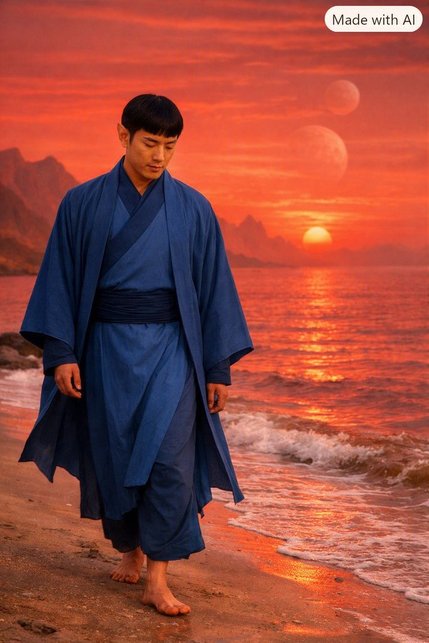
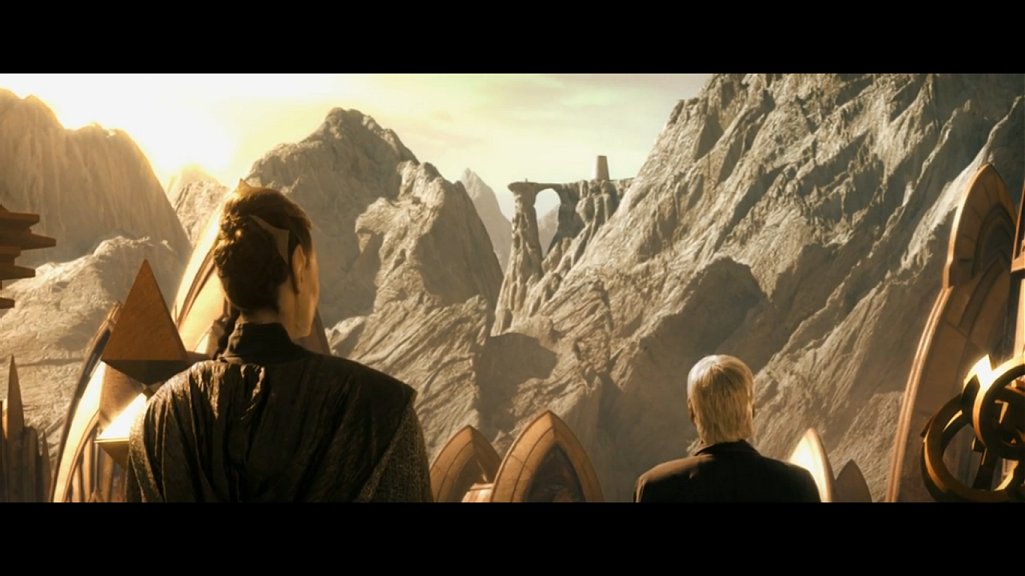
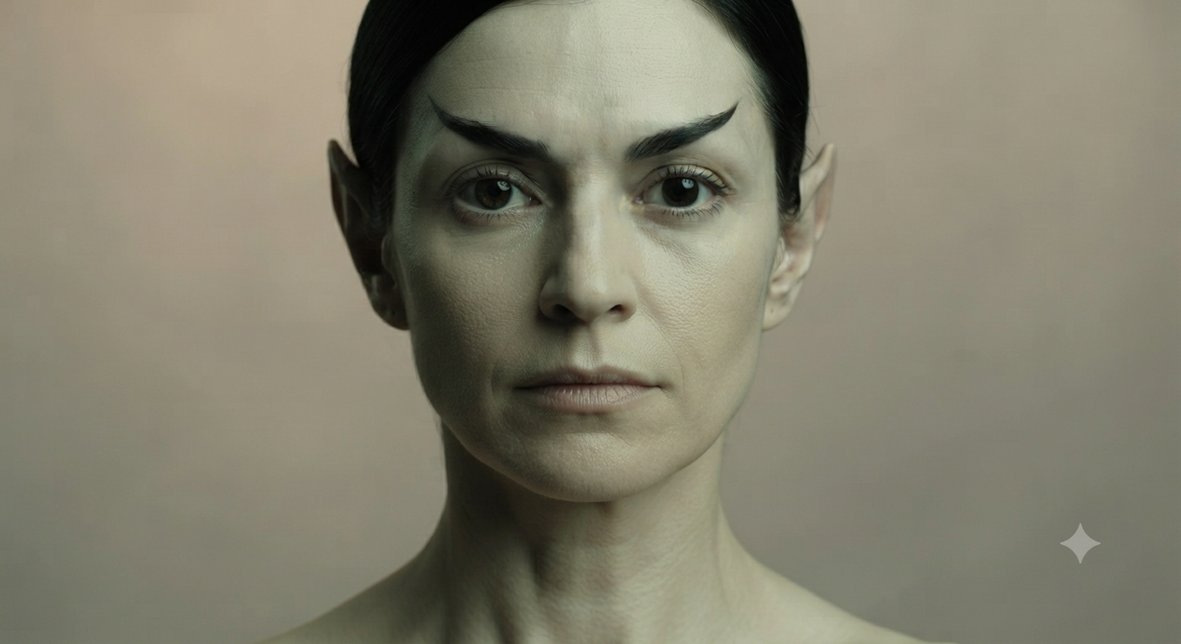
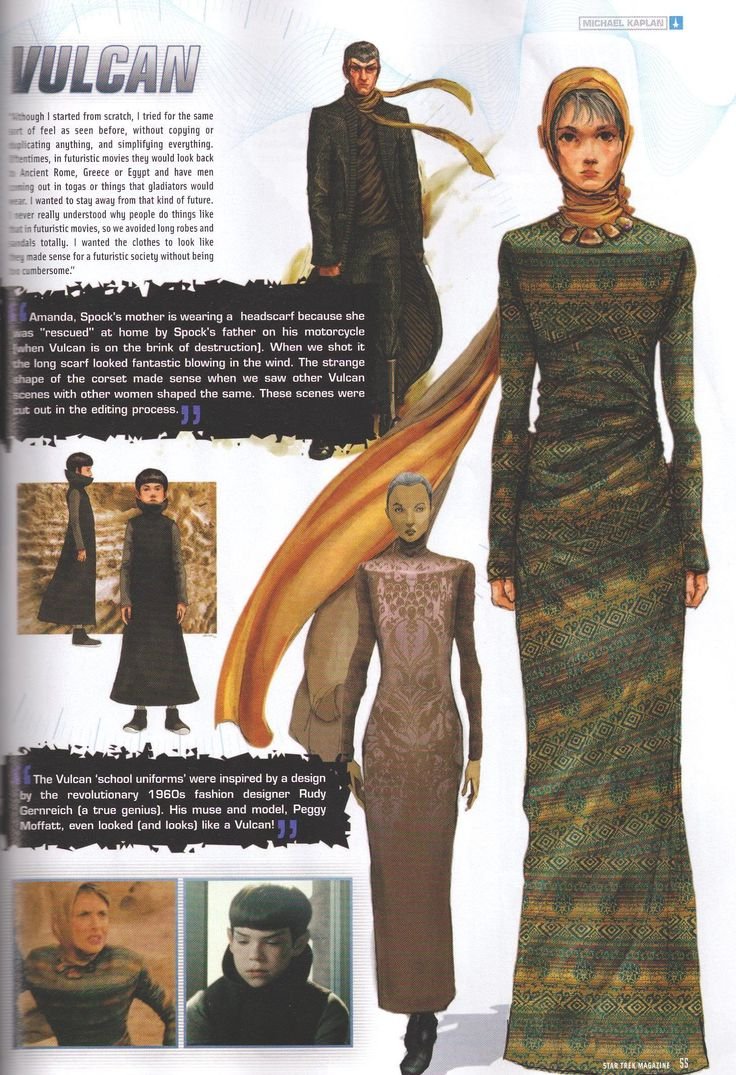
The JJ Abrams and Star Trek: Discovery productions have moved forwards with the look of the Vulcan wardrobe, moving away from the flowing cloaks of the classic Star Trek series and movies to a more practical look for the 23rd and 24th Centuries. The asymmetrical suit designed for Spock Prime in the 2009 Star Trek movie (see right) is an example of this. As with each new Star Trek series and movie, so the Vulcan race has become more detailed and shown to have a wider culture than was first shown in the 1960s.
By 2312 the Vulcans will be part of a more pacifist movement of the Federation Council to move away from the hostilities that coloured the last half of the 23rd Century. Ambassadors Sarek and Spock will both be looking to lose the dreadnoughts and cowboy attitudes to adopt a more mature and measured diplomatic tone. Spock will be more pratical for Starfleet, given his experience, where Sarek shows his diplomatic skills from a long career.
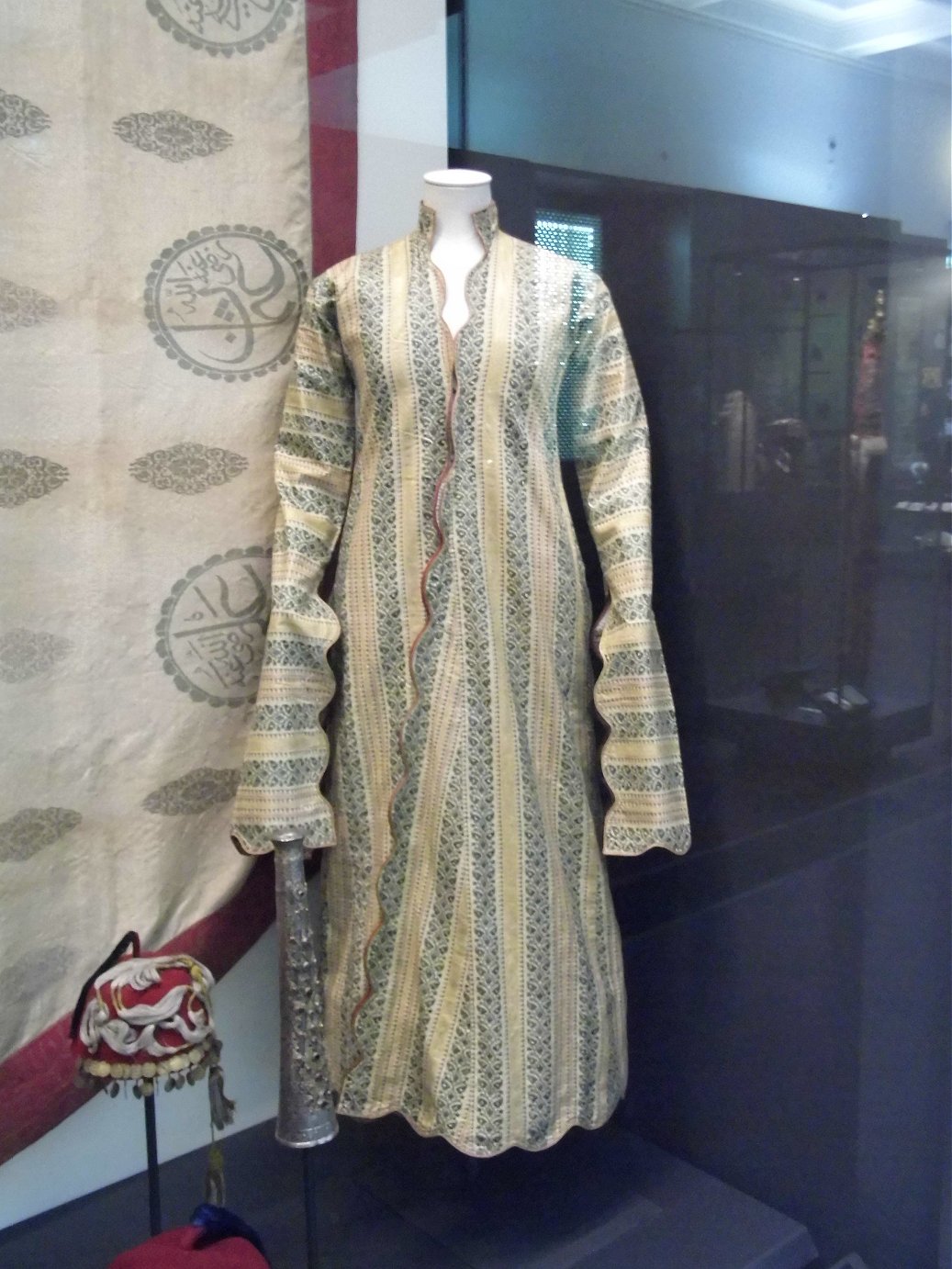
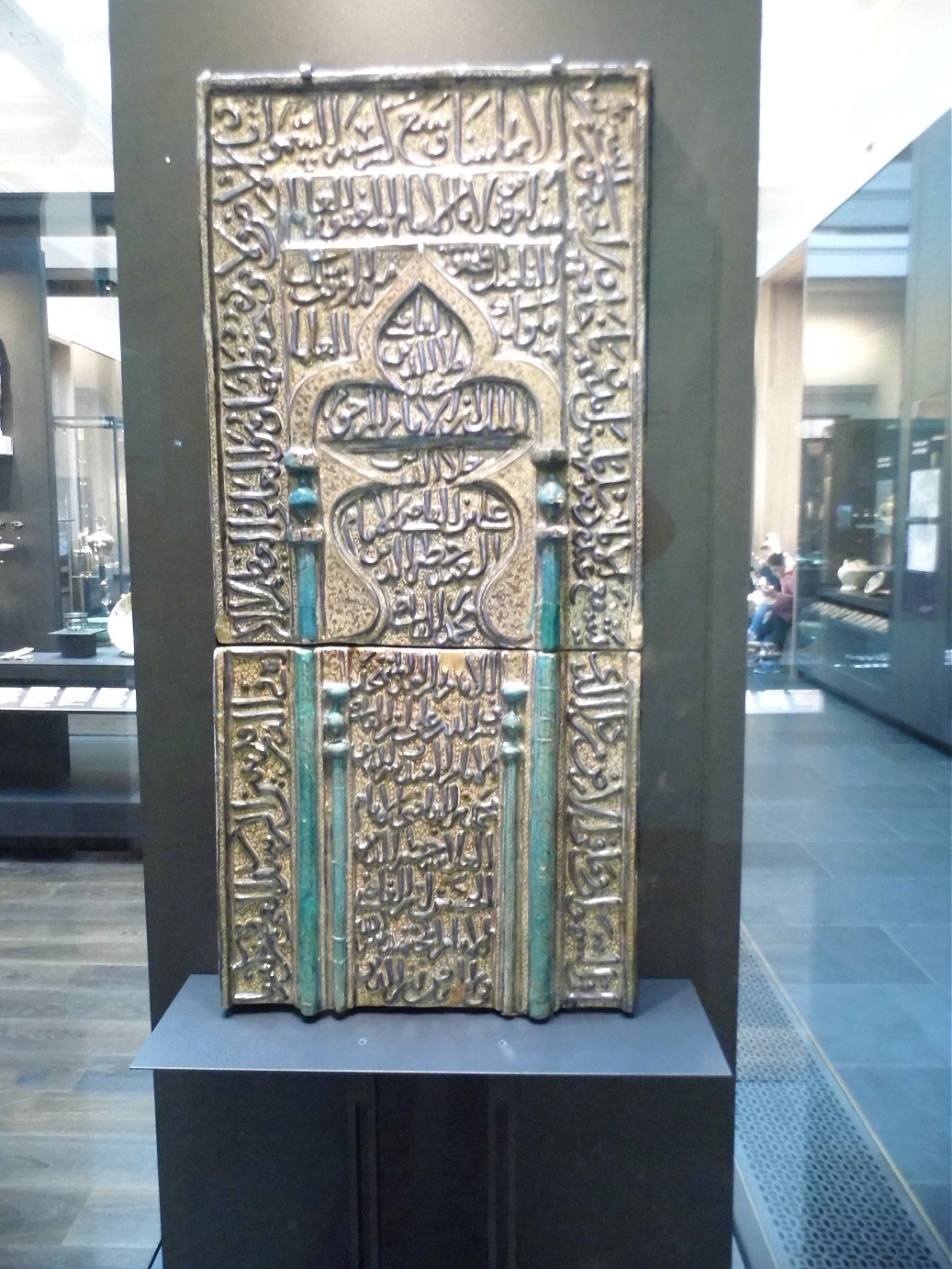
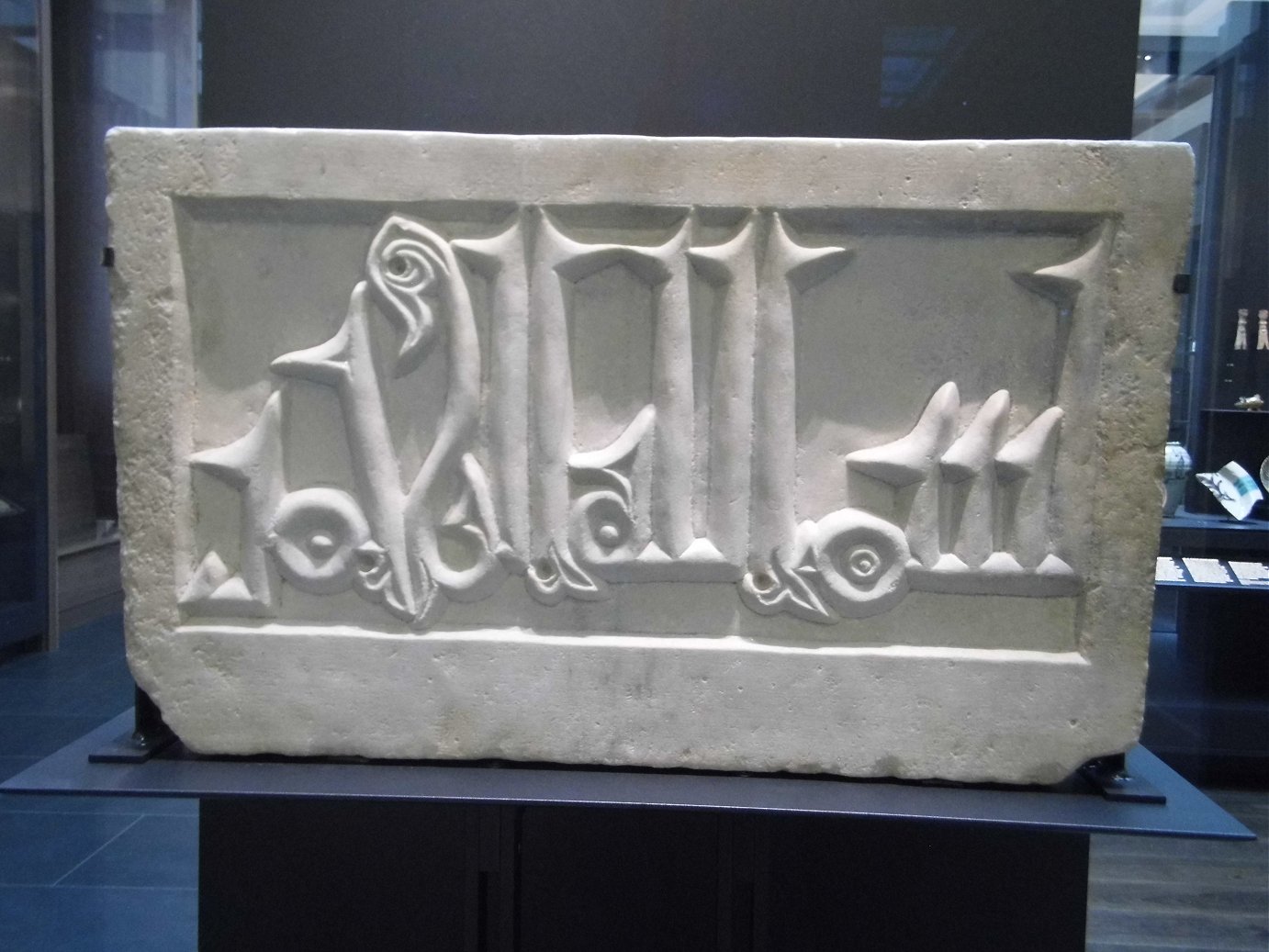
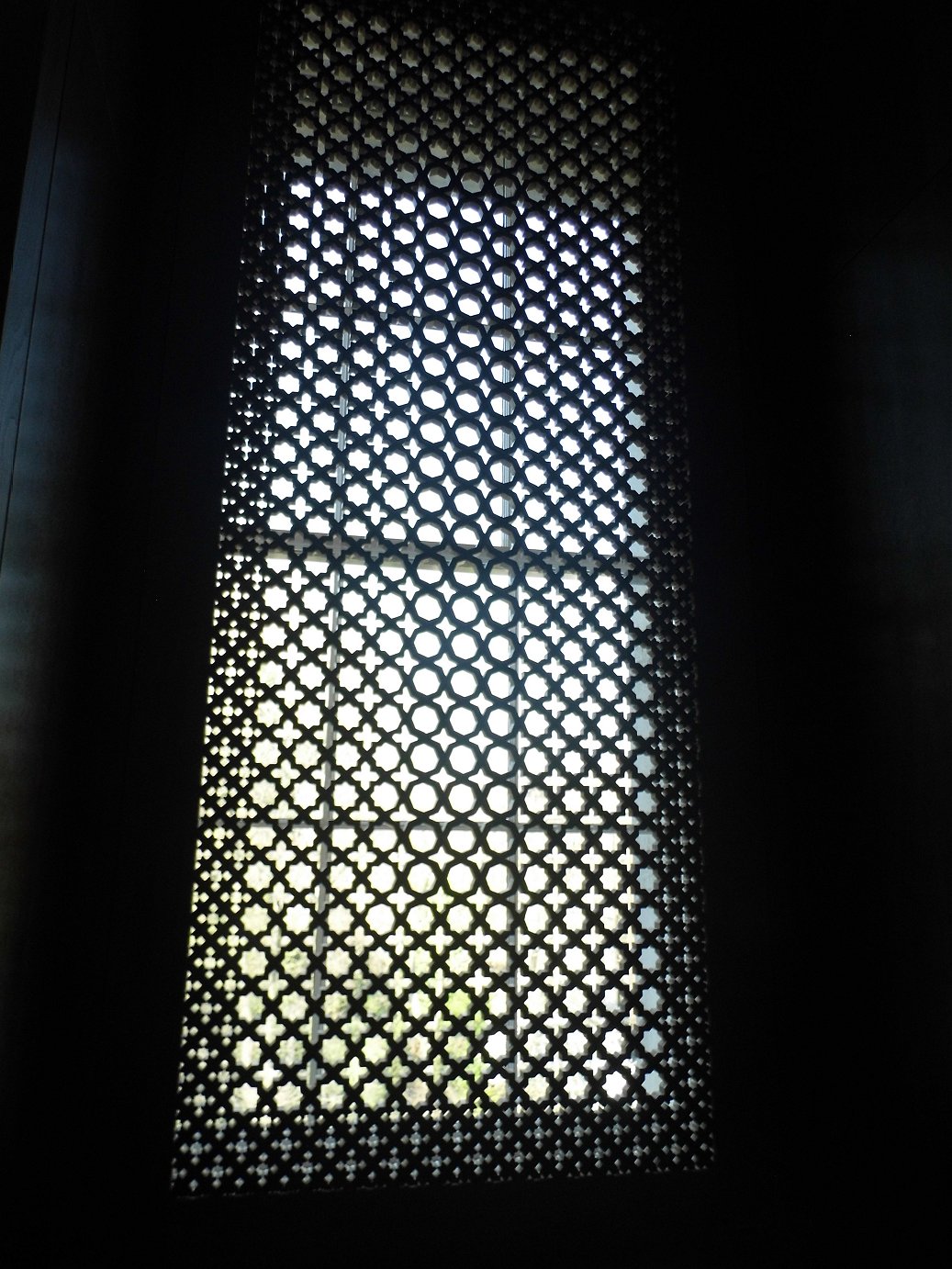
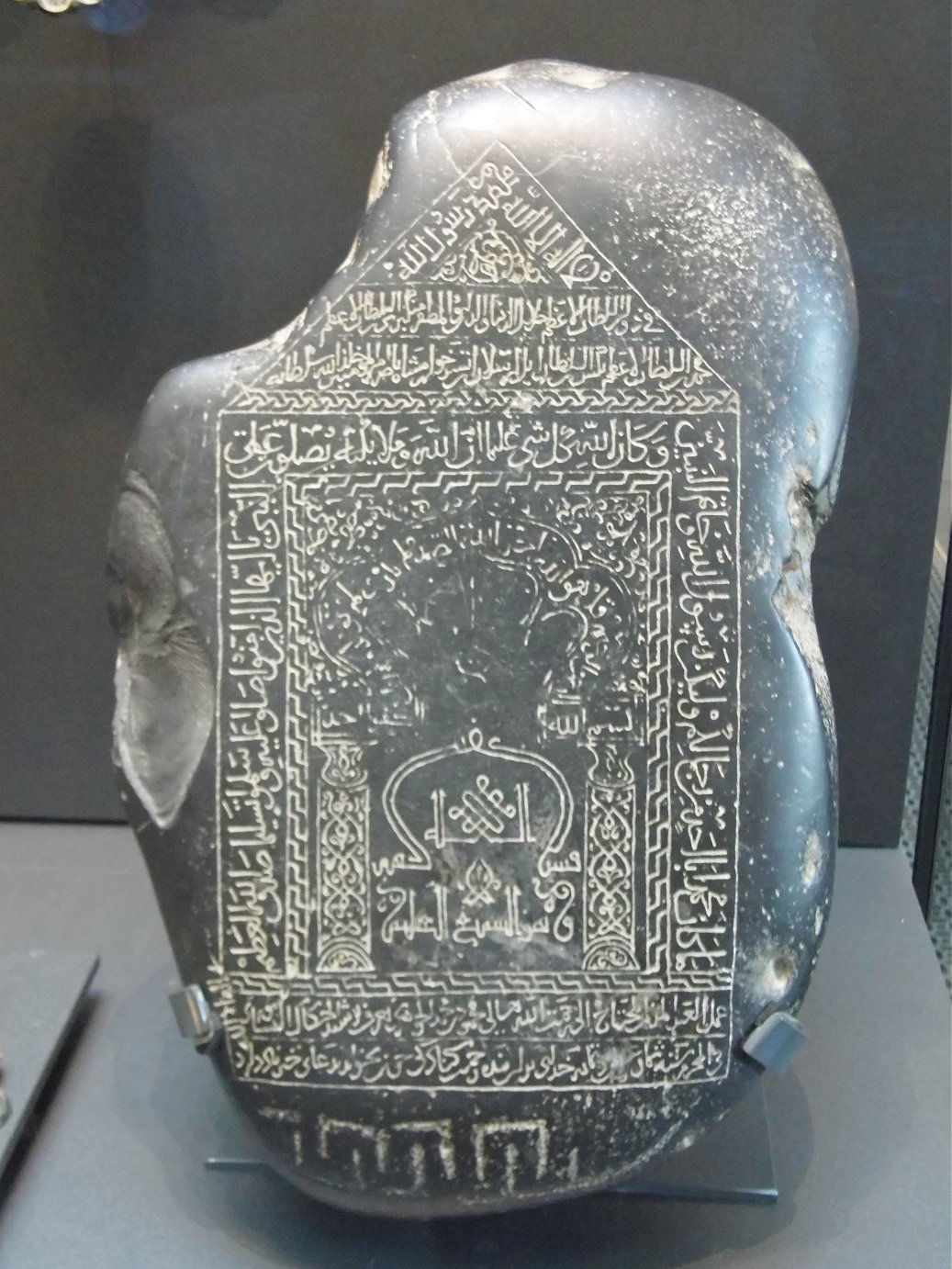
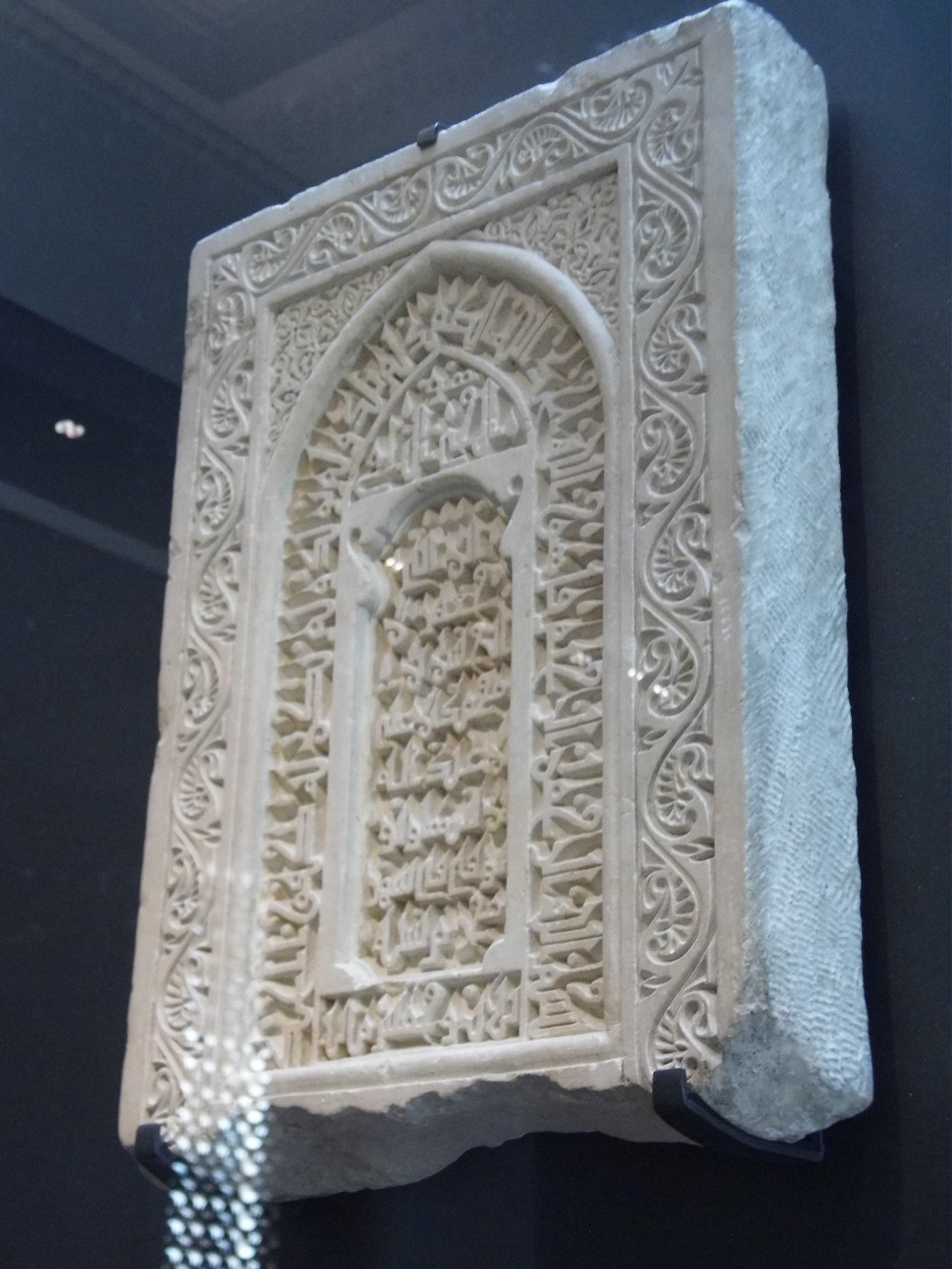
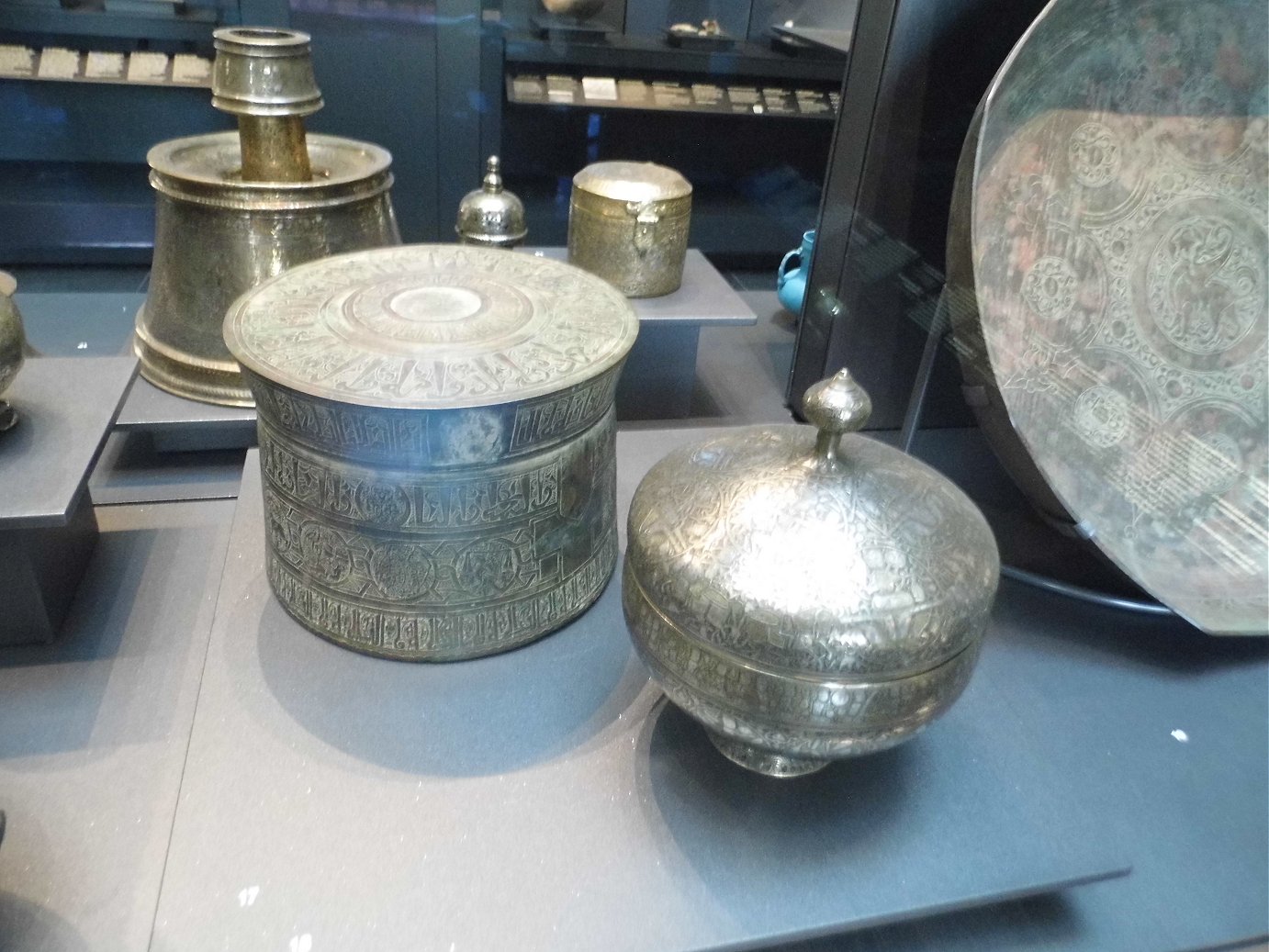
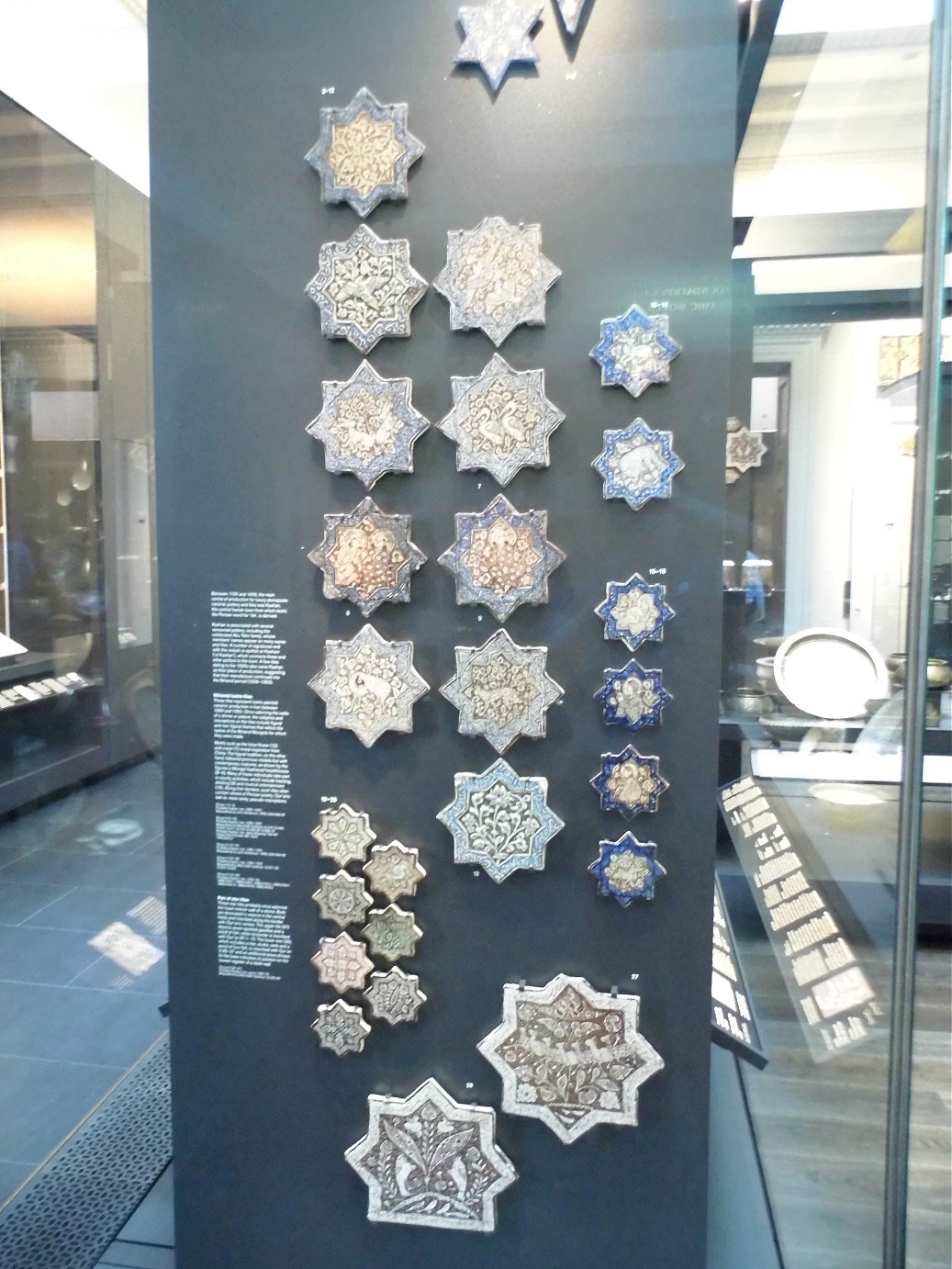
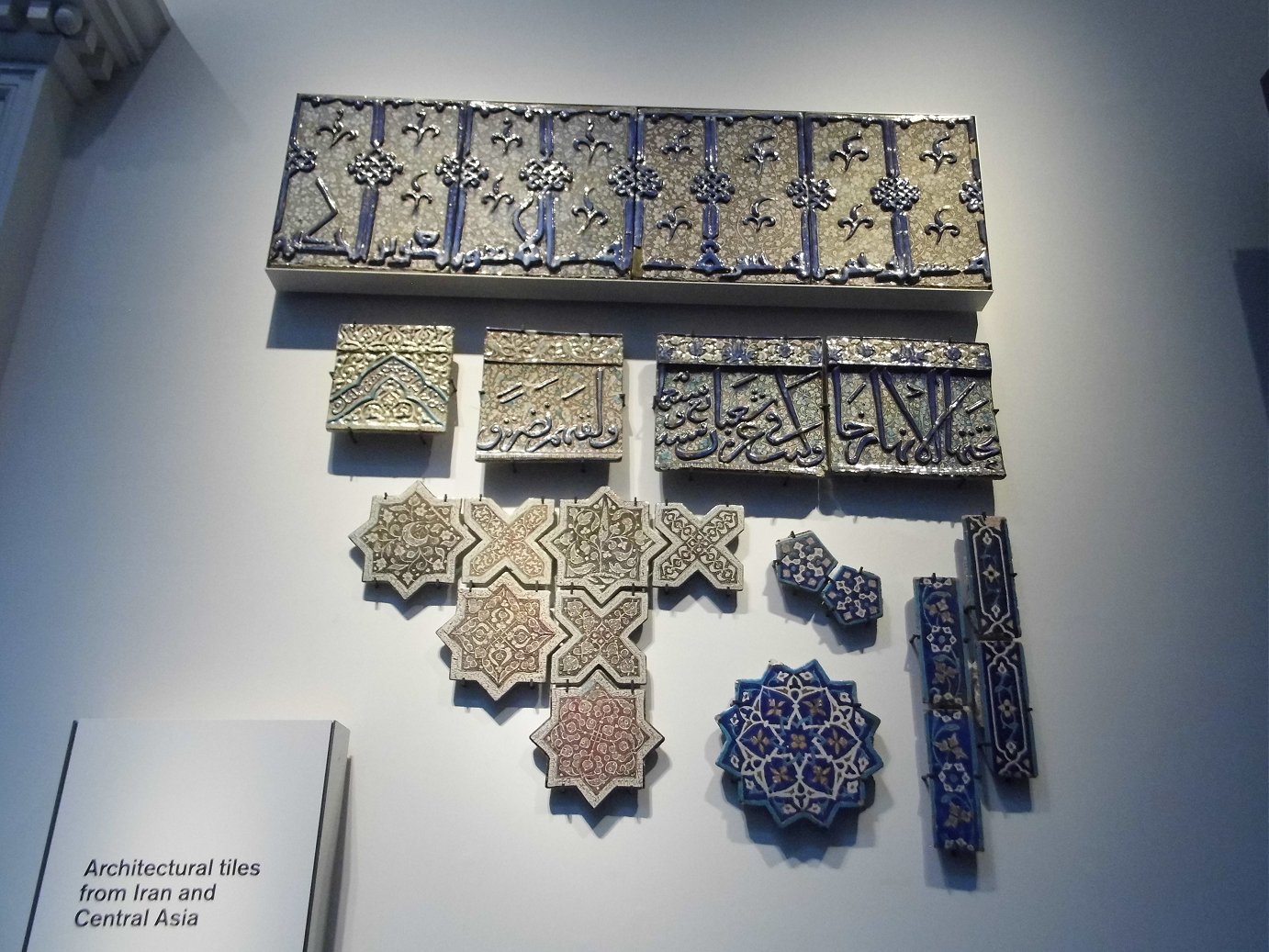
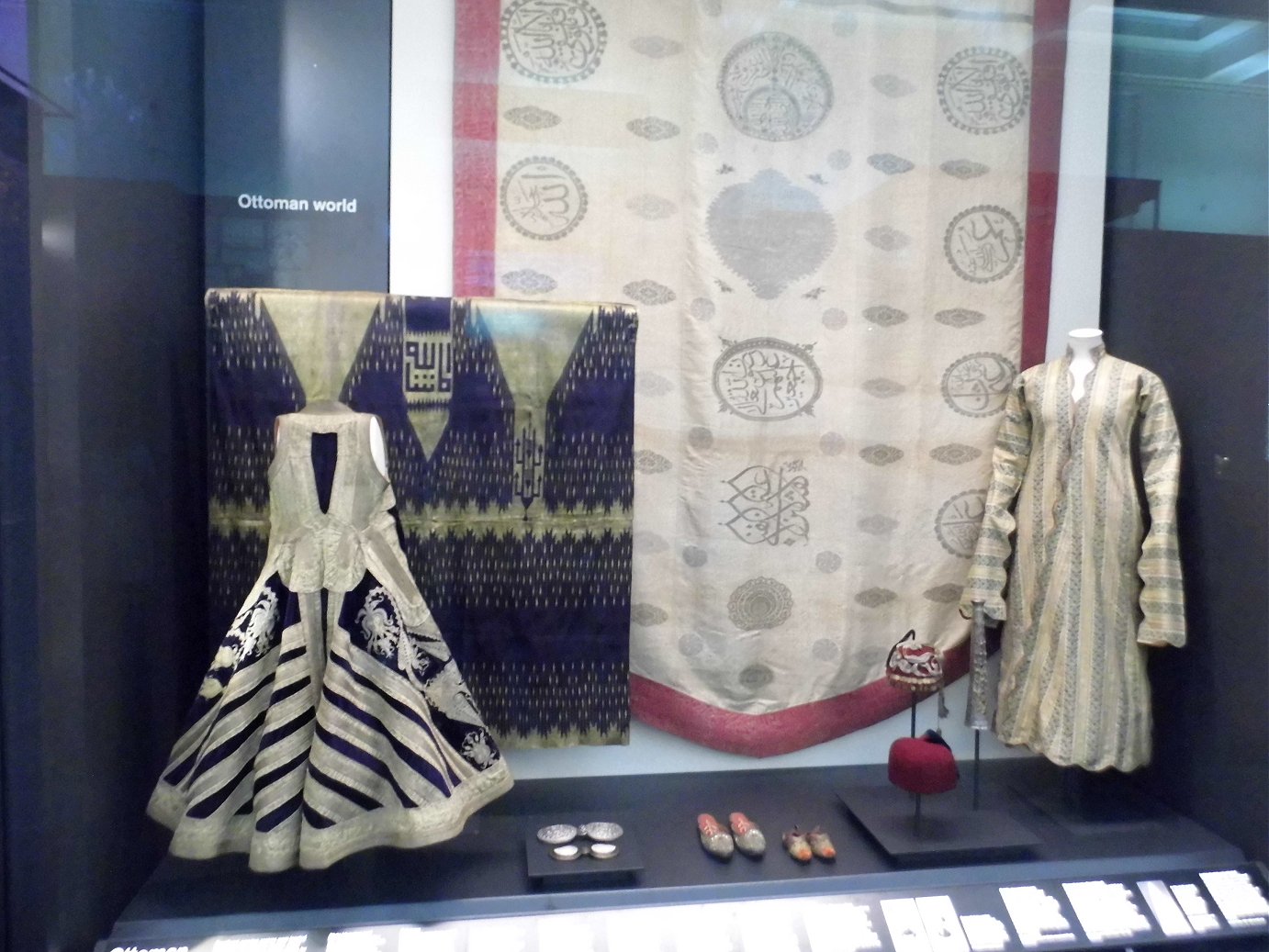
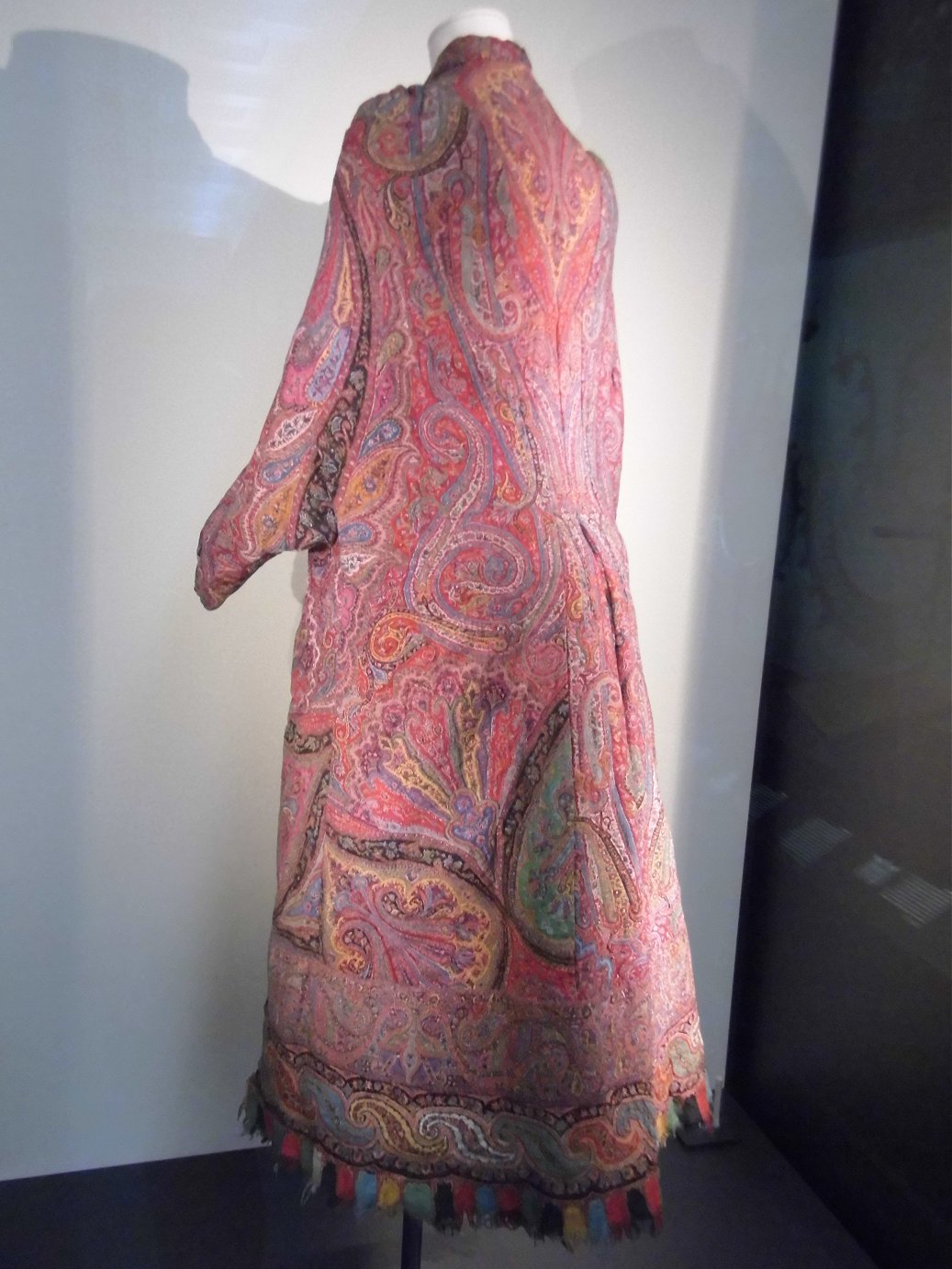
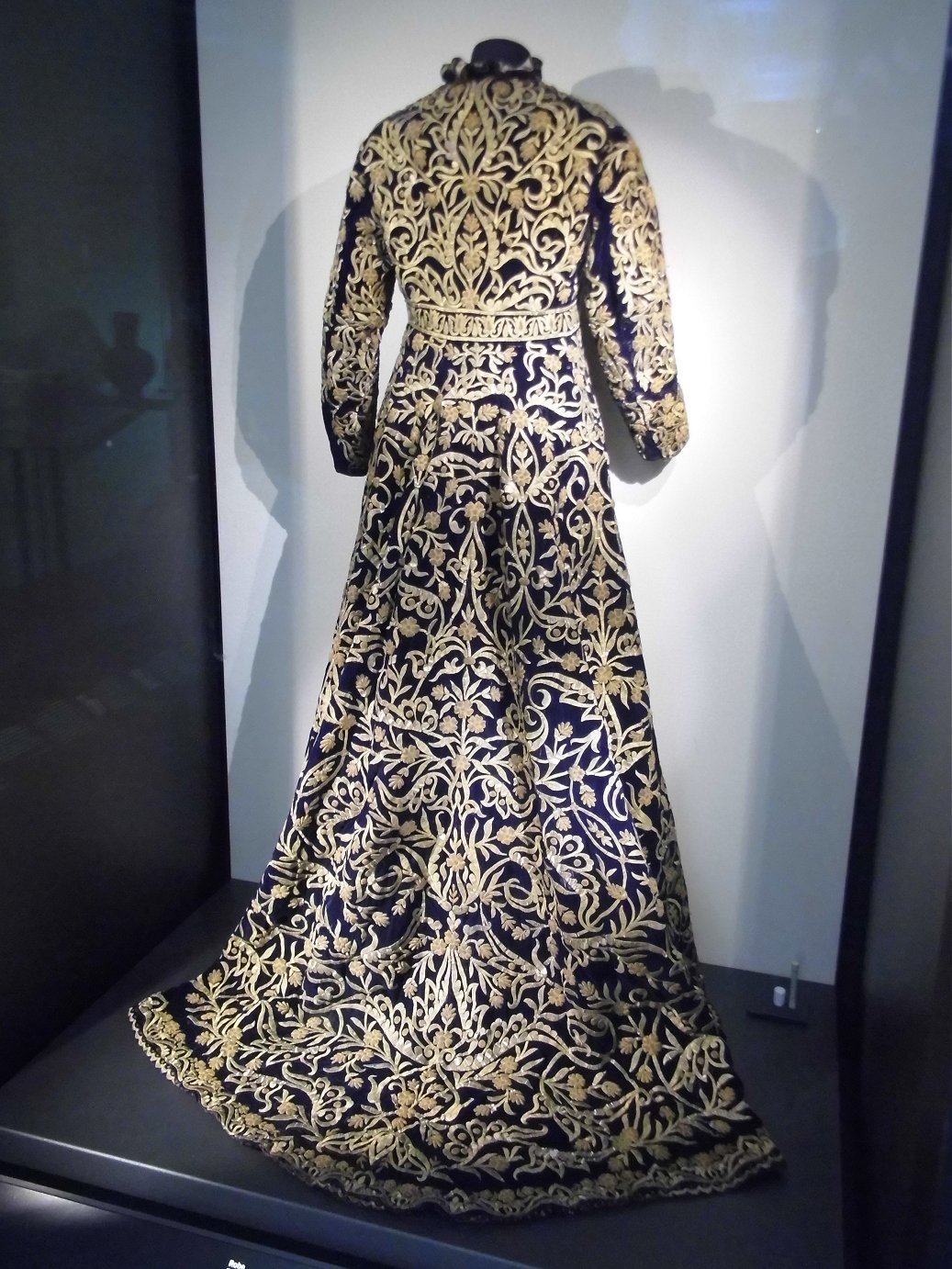
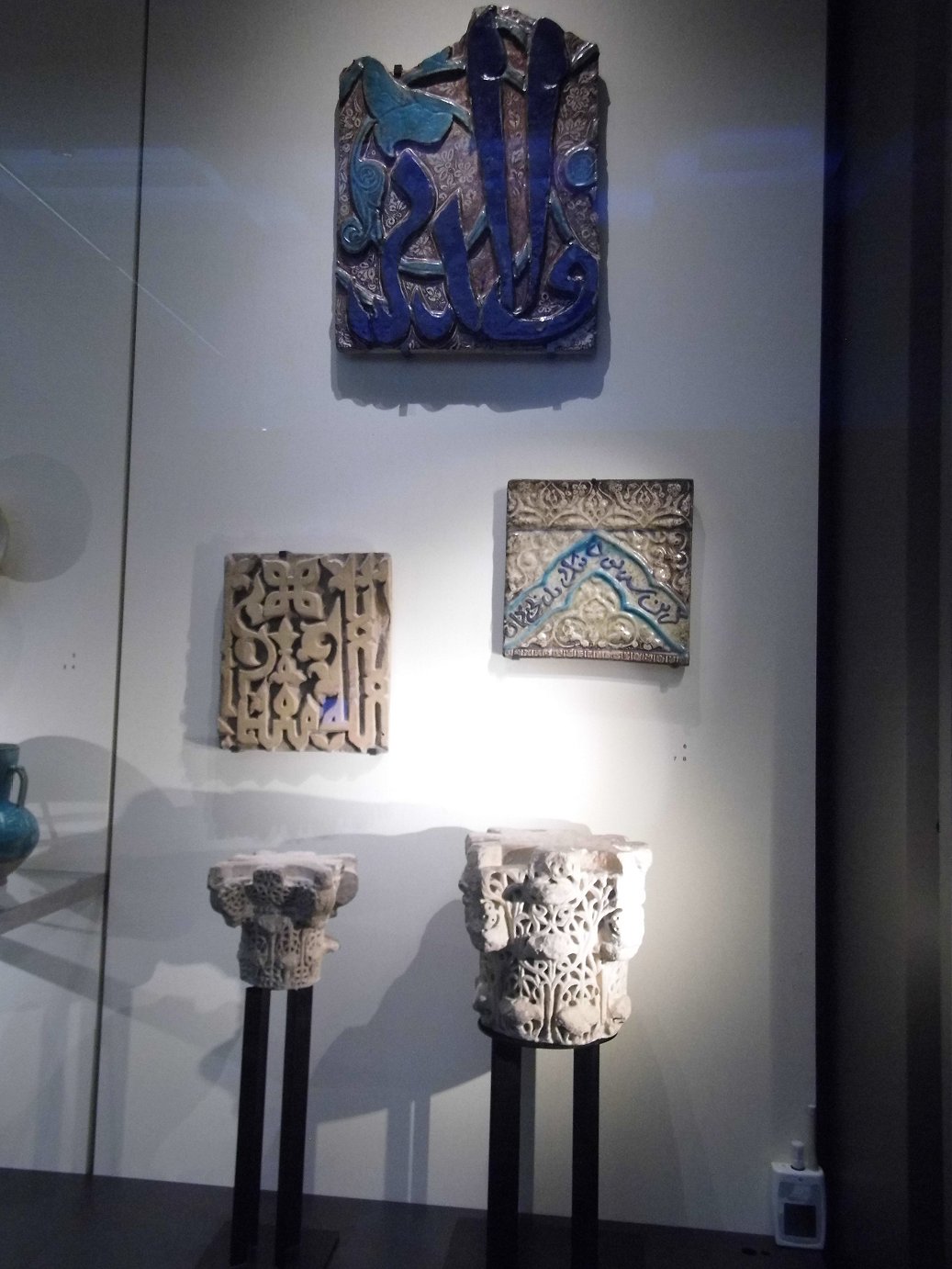
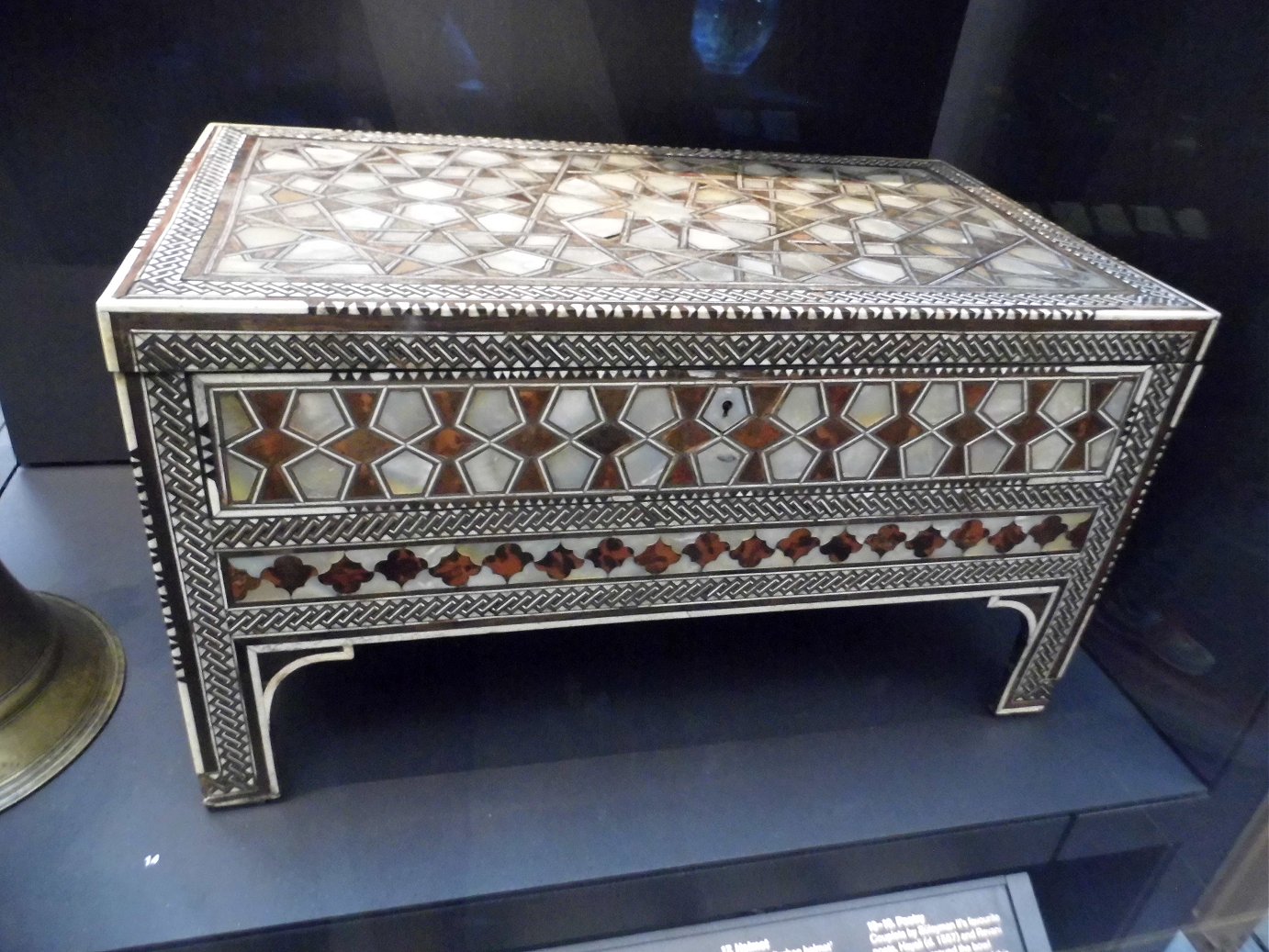
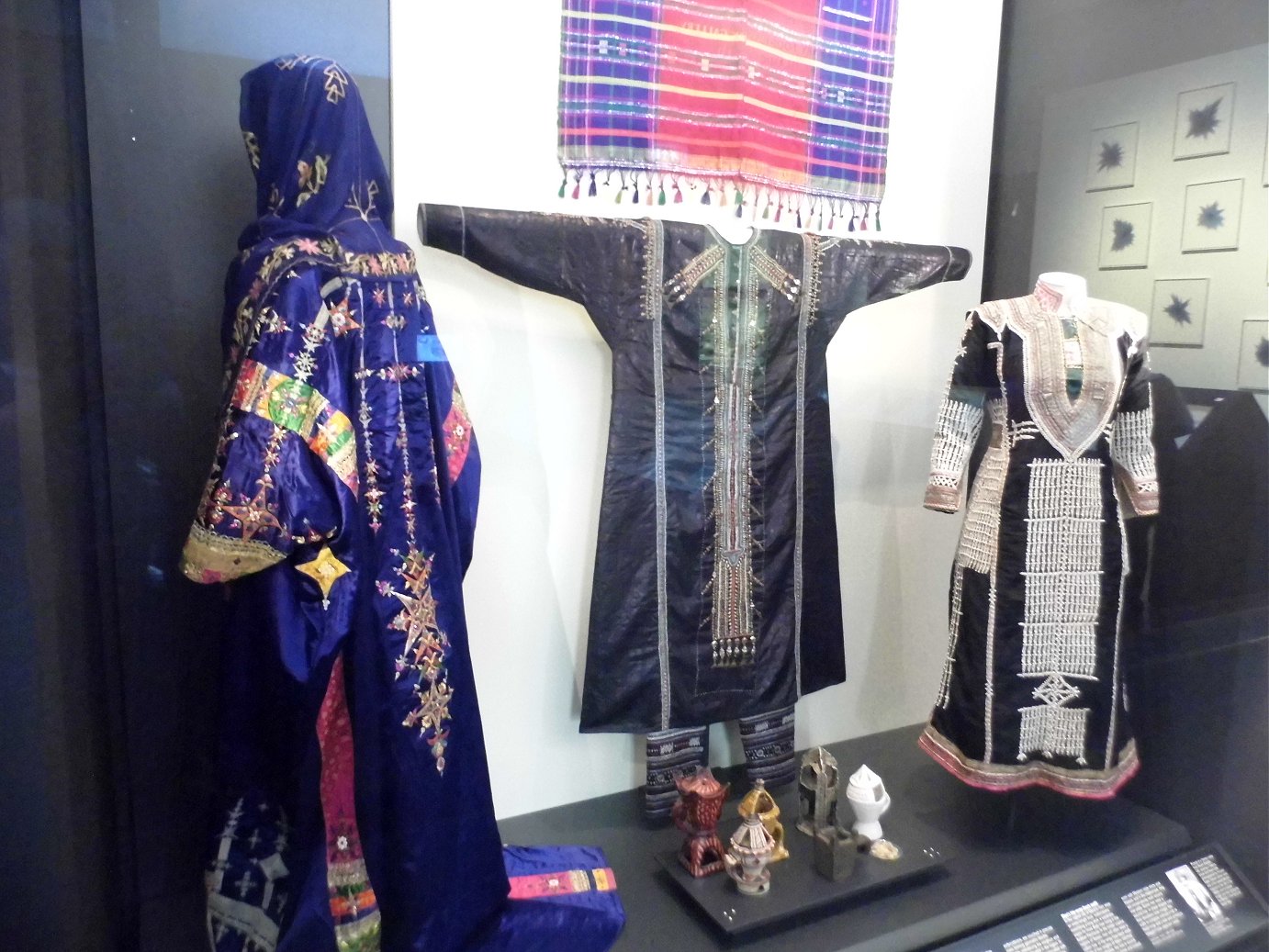
Islamic fashion and culture are influences for the Vulcans. See the British Museum page.
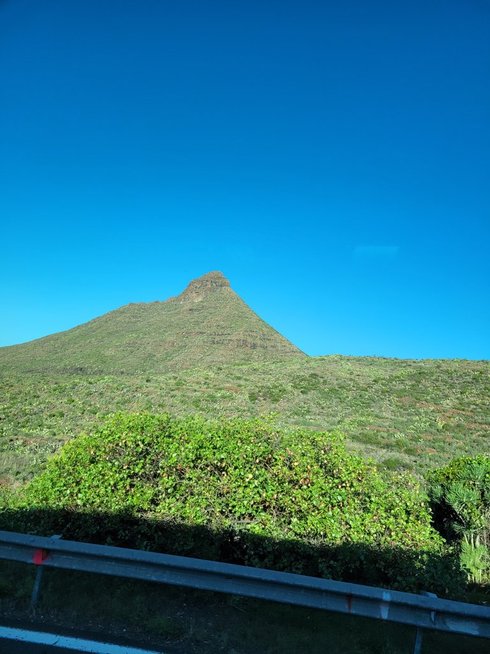
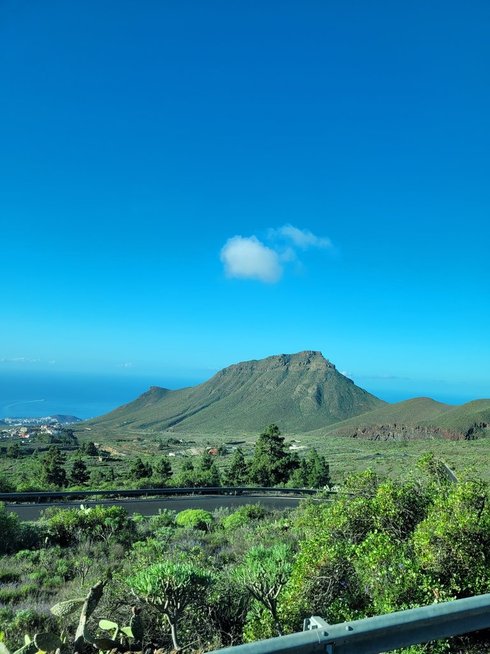
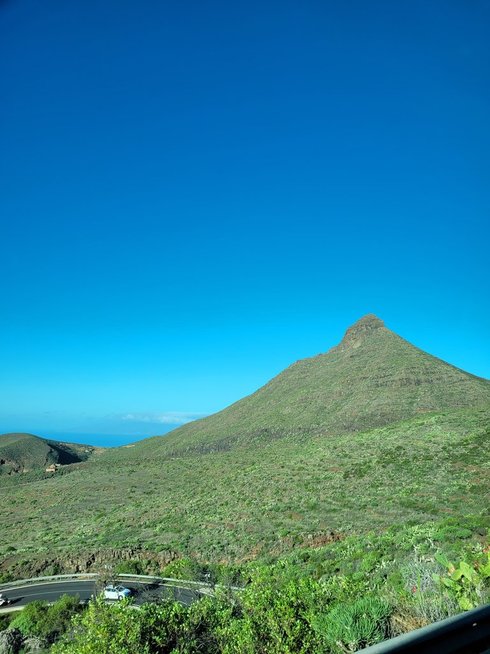
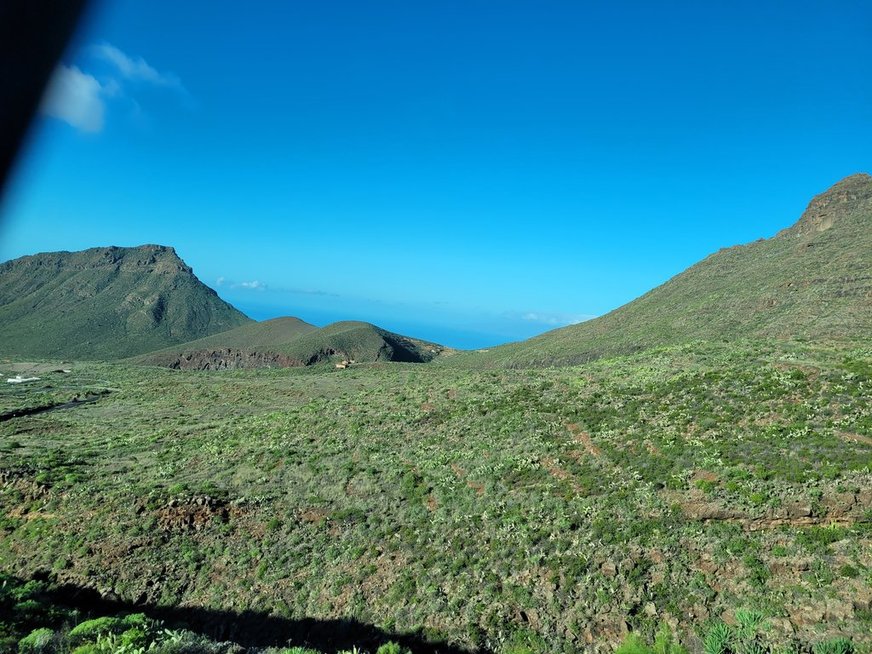
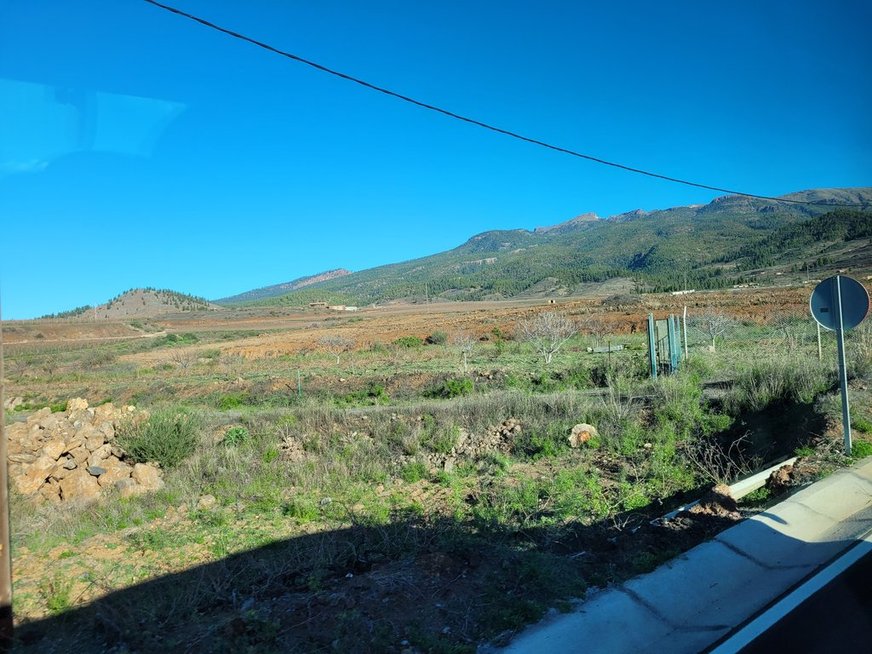
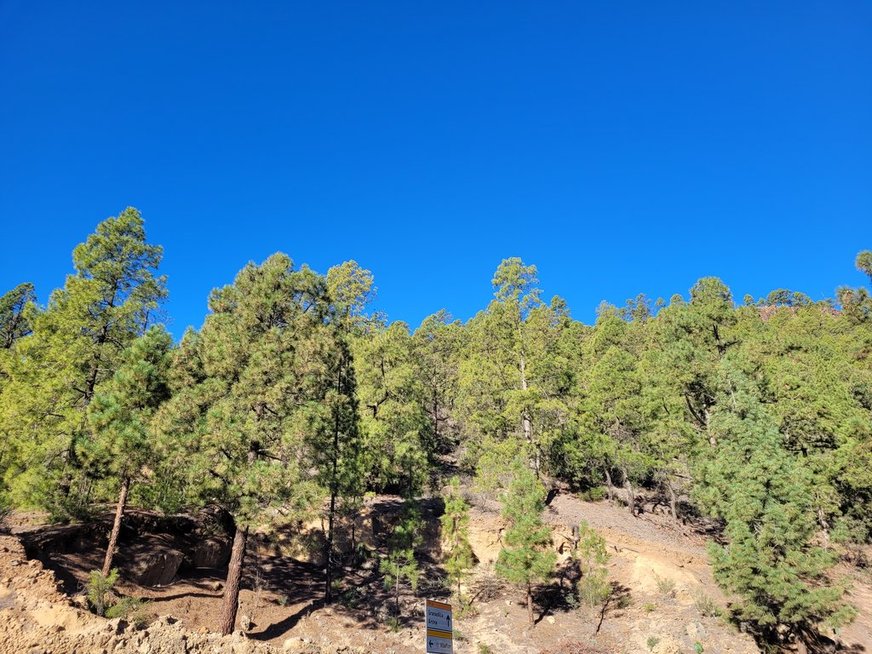
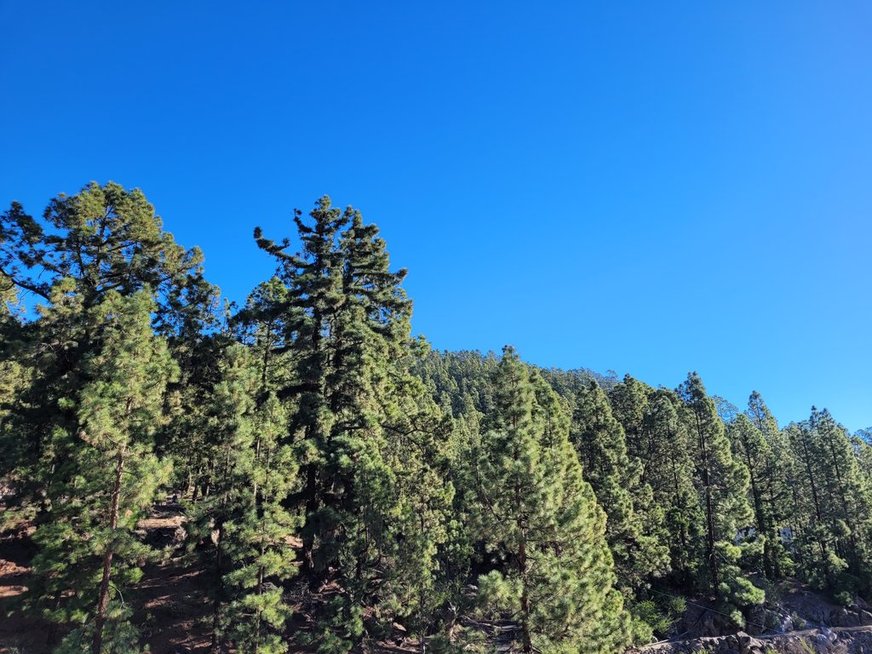
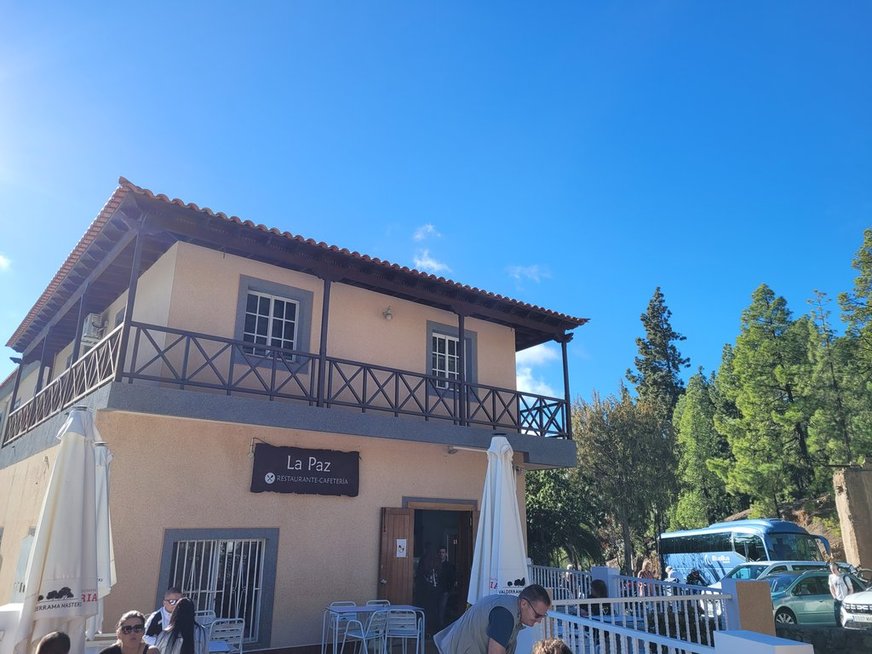
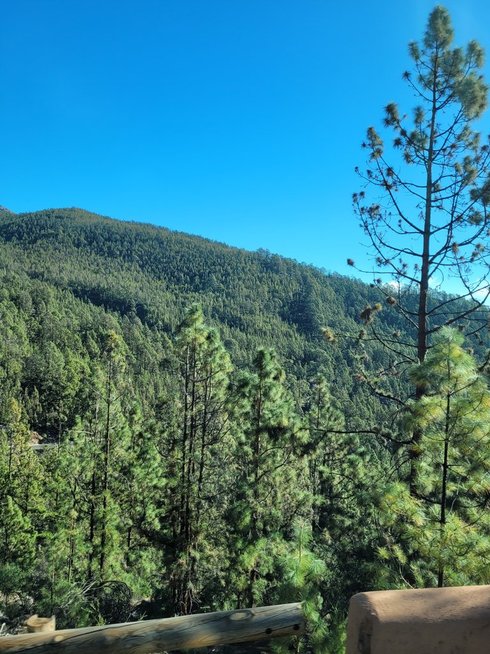
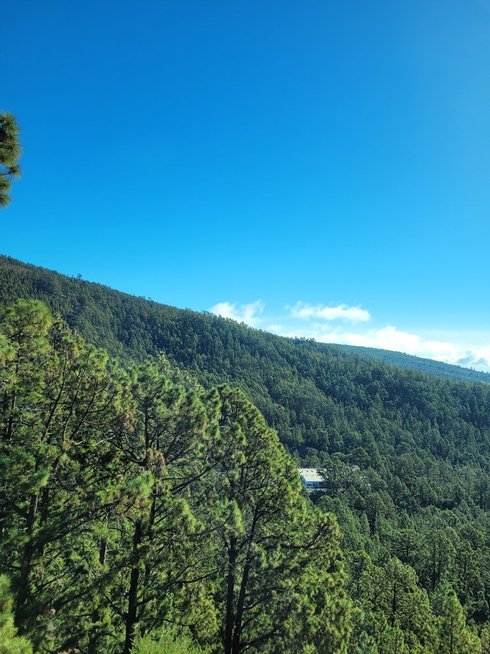
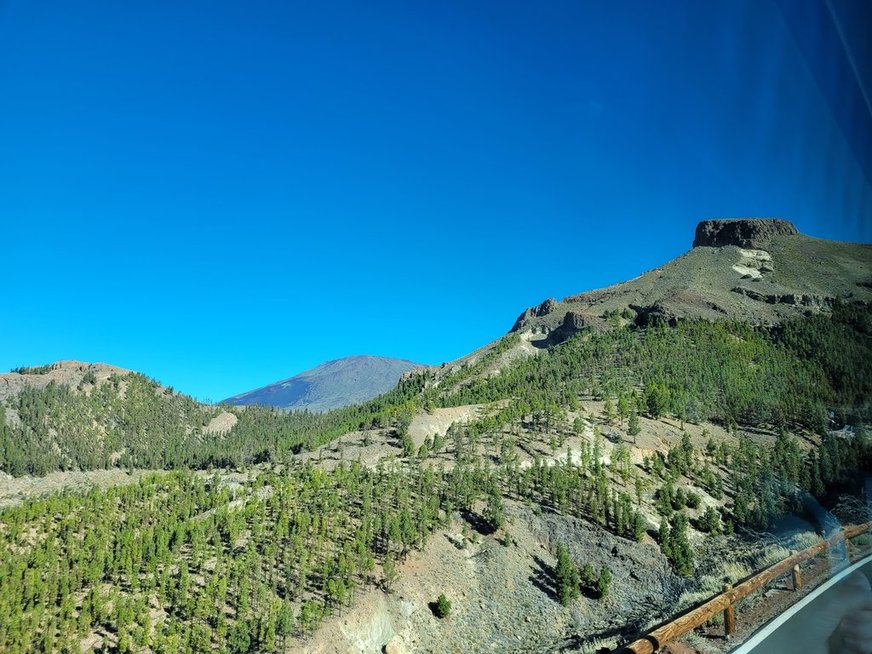
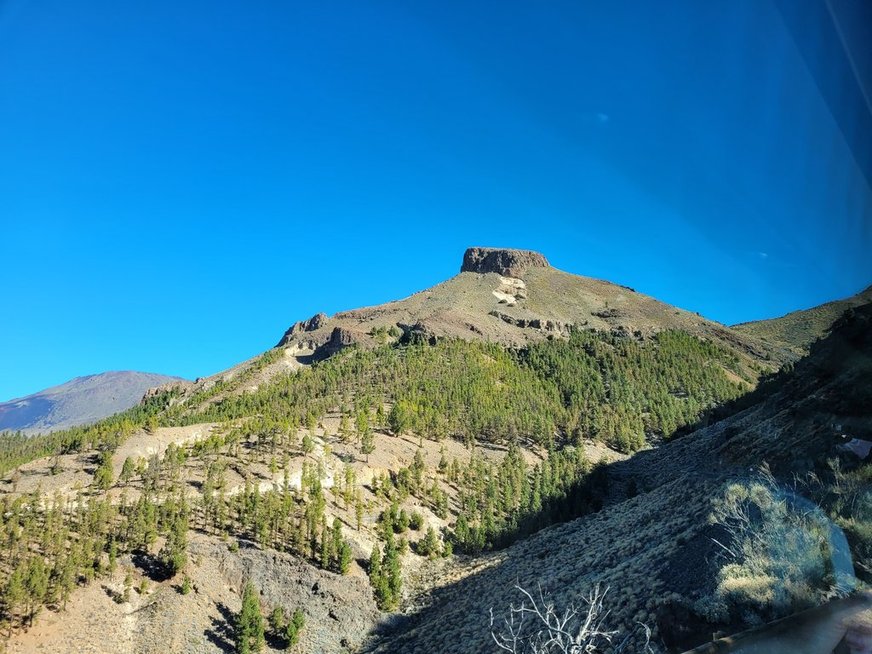
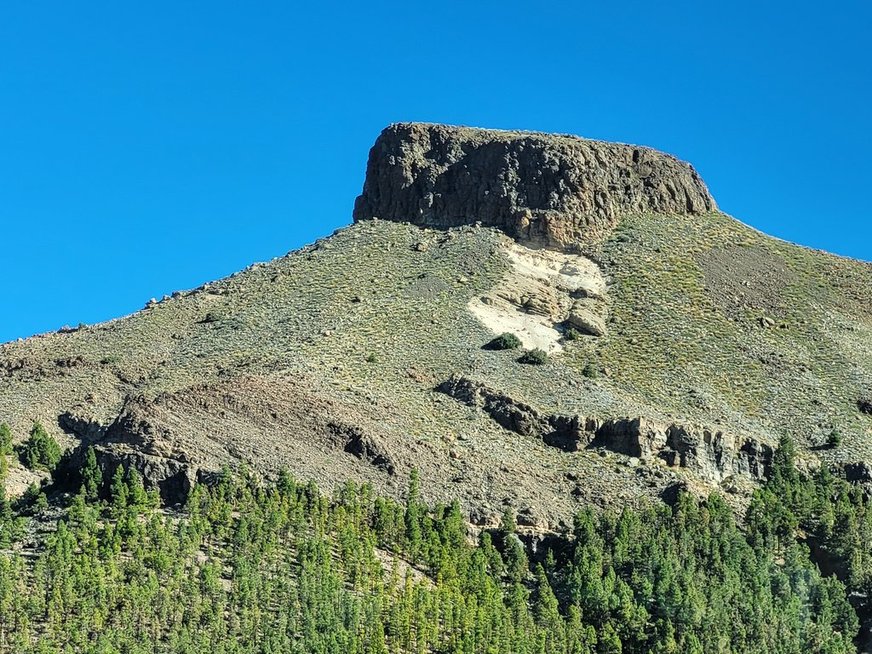
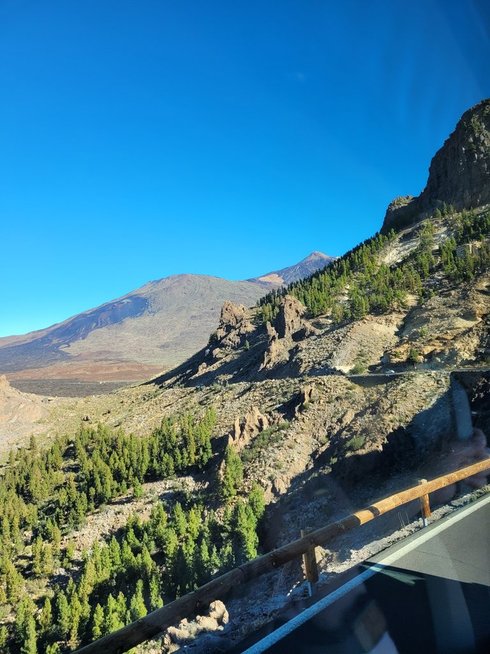
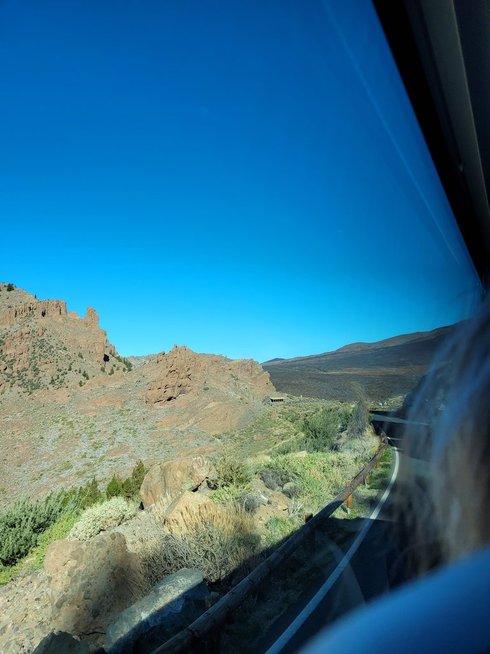
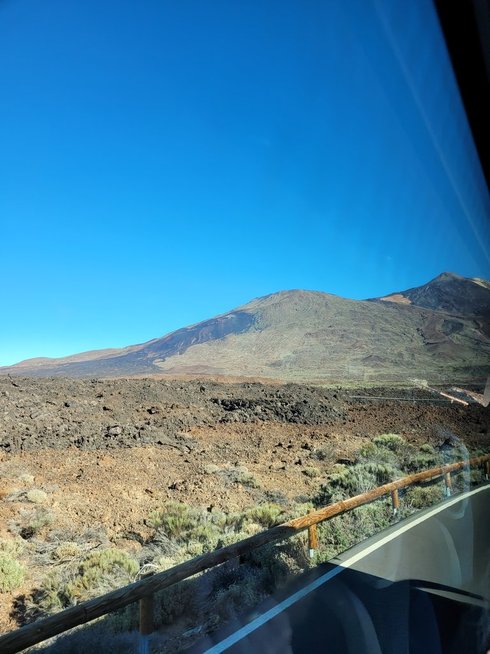
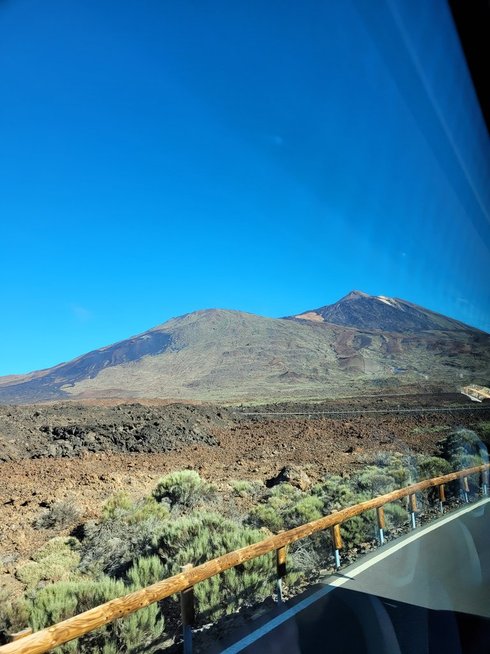
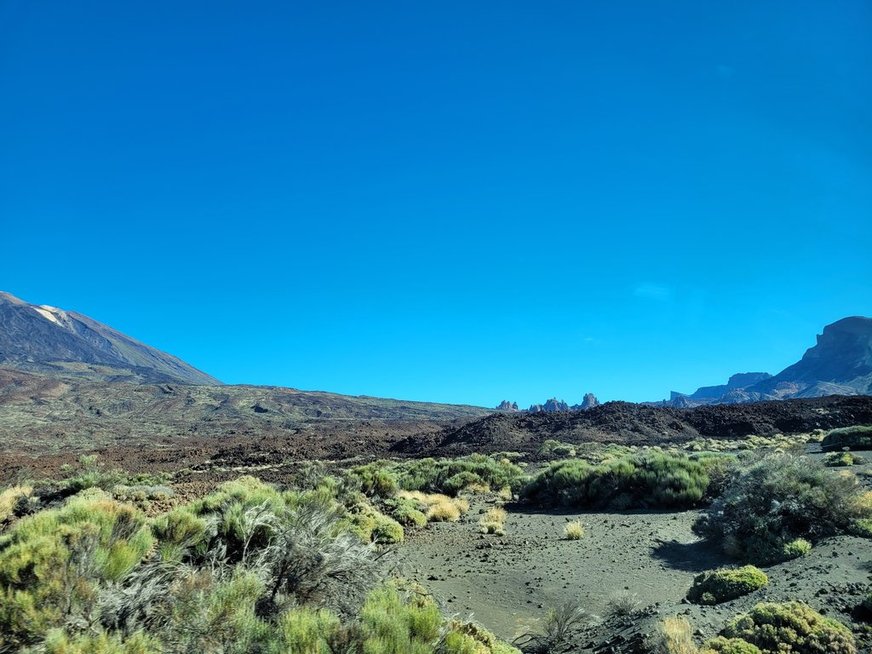
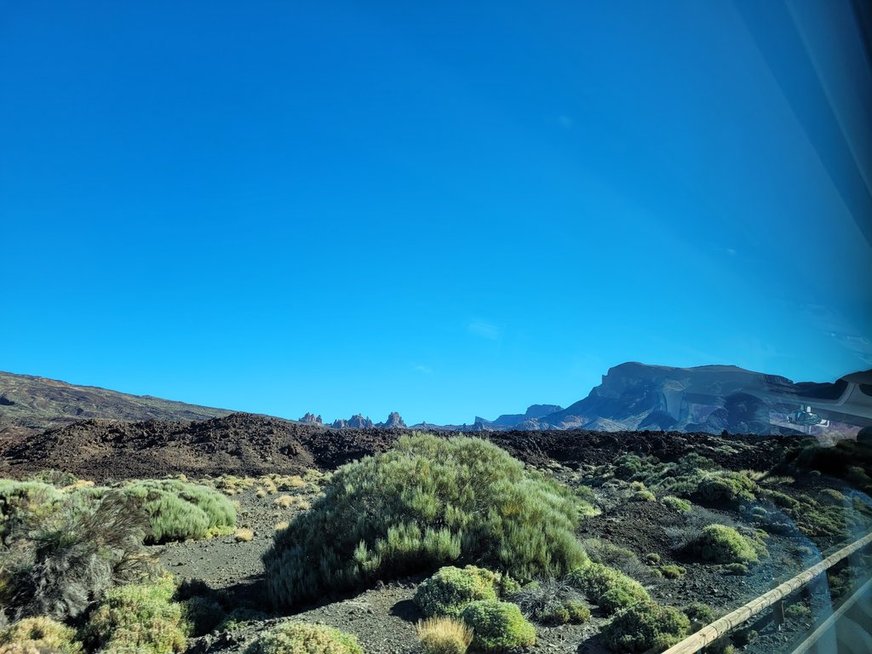
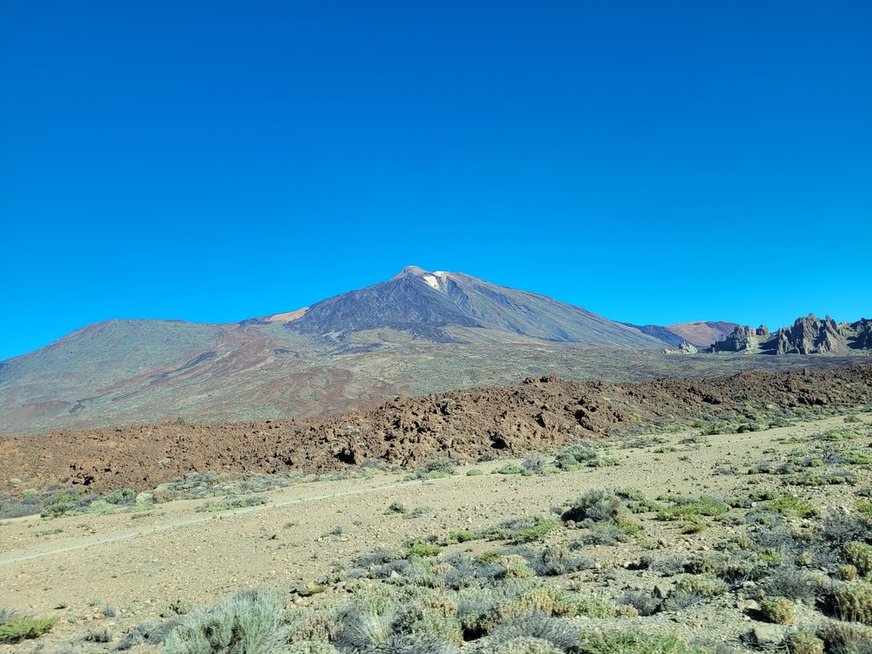
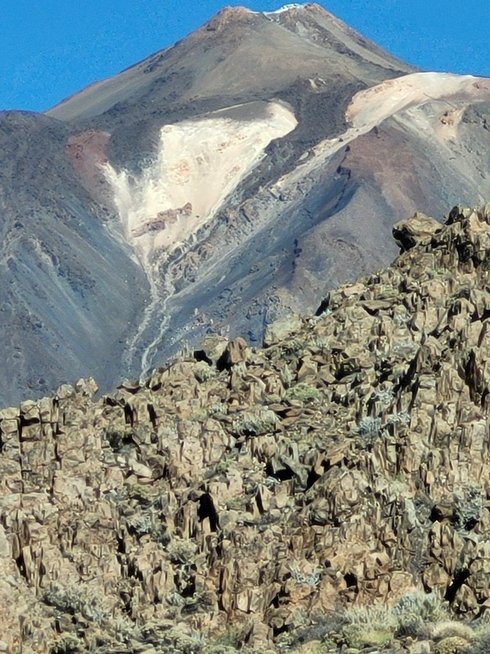
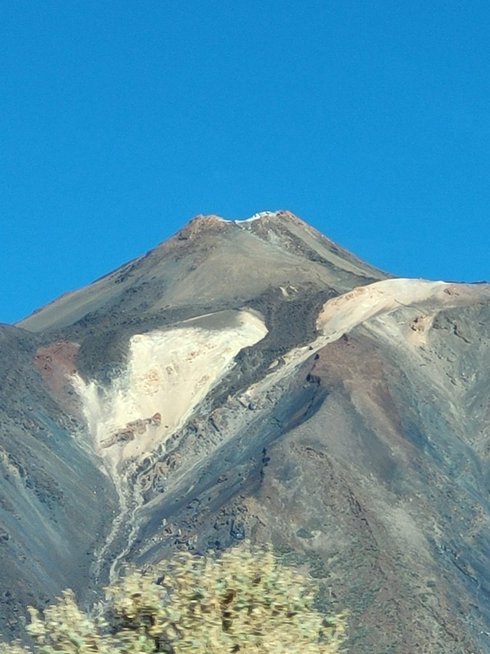
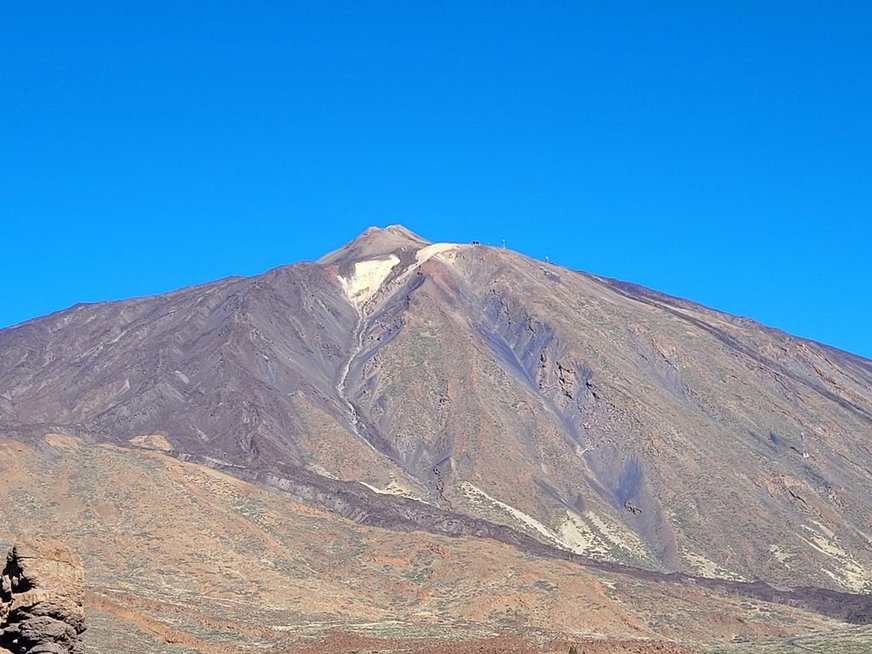
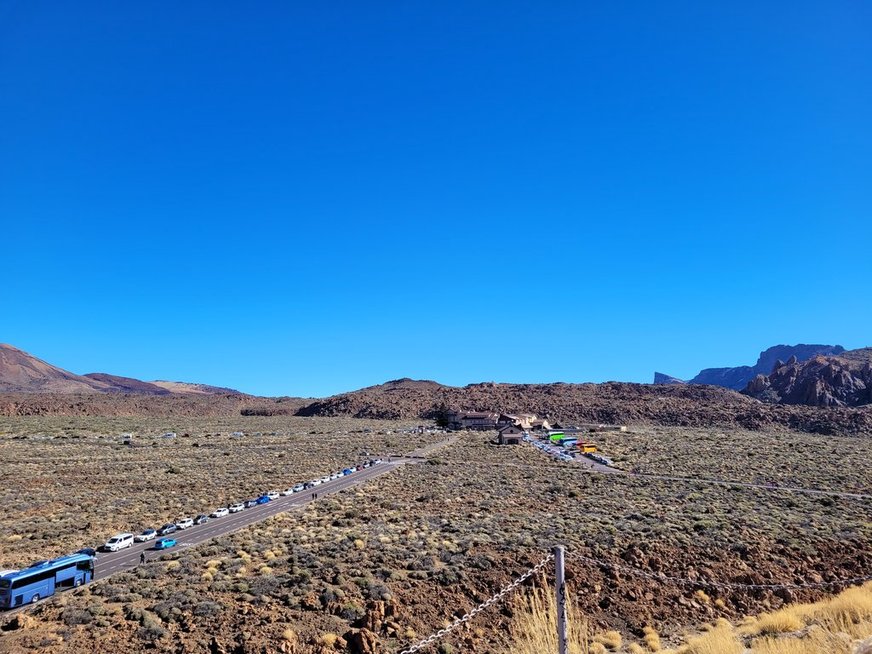
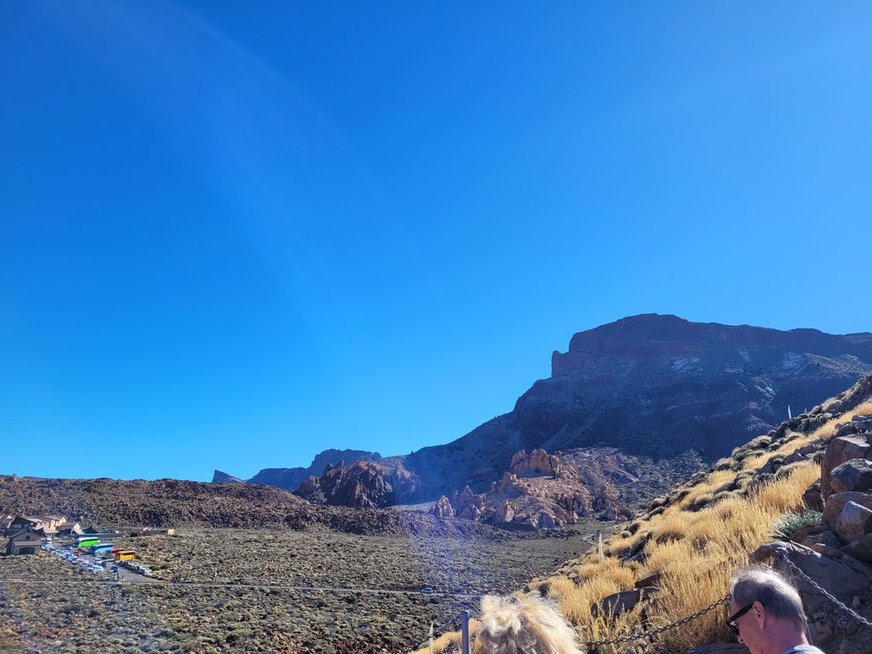
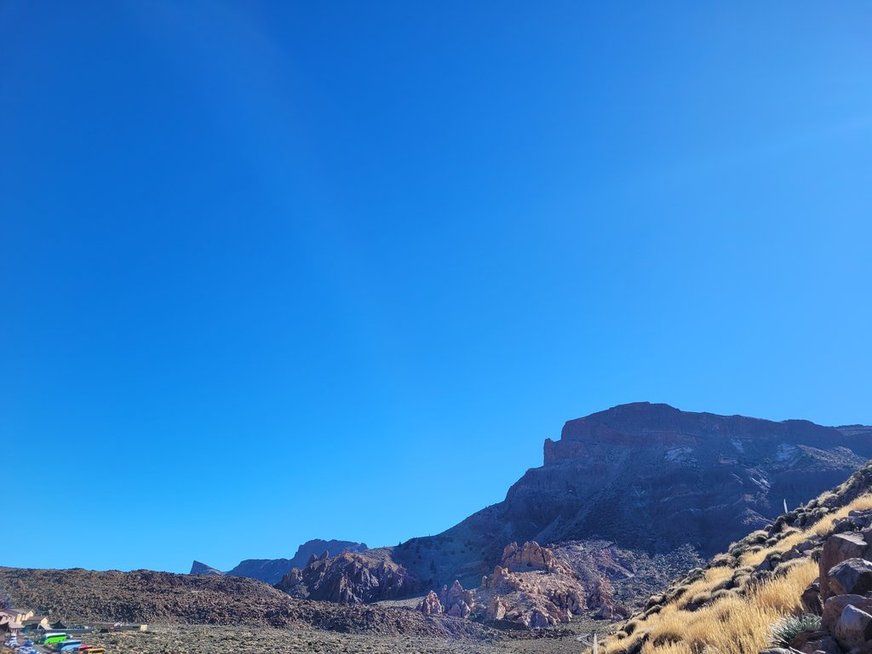
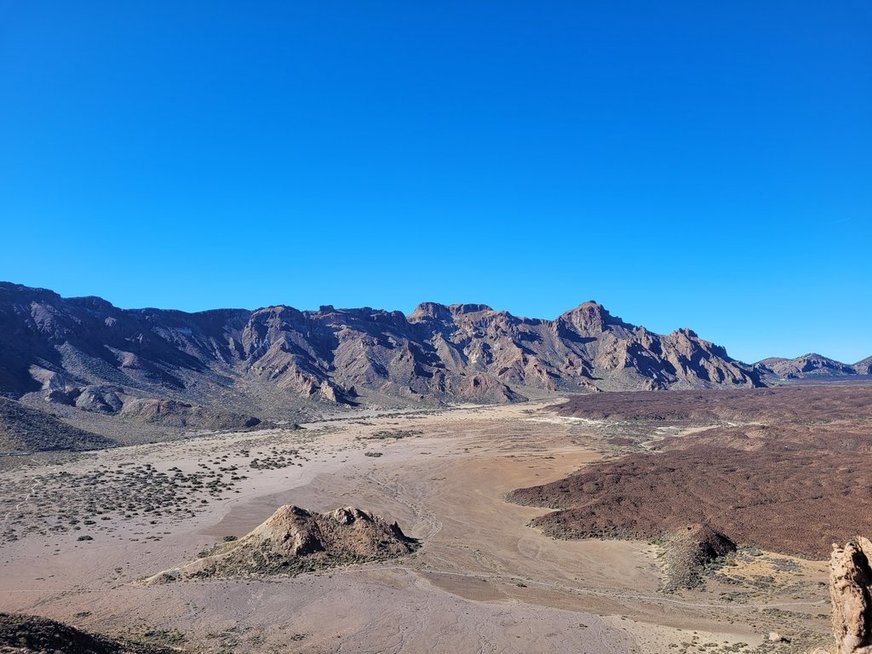
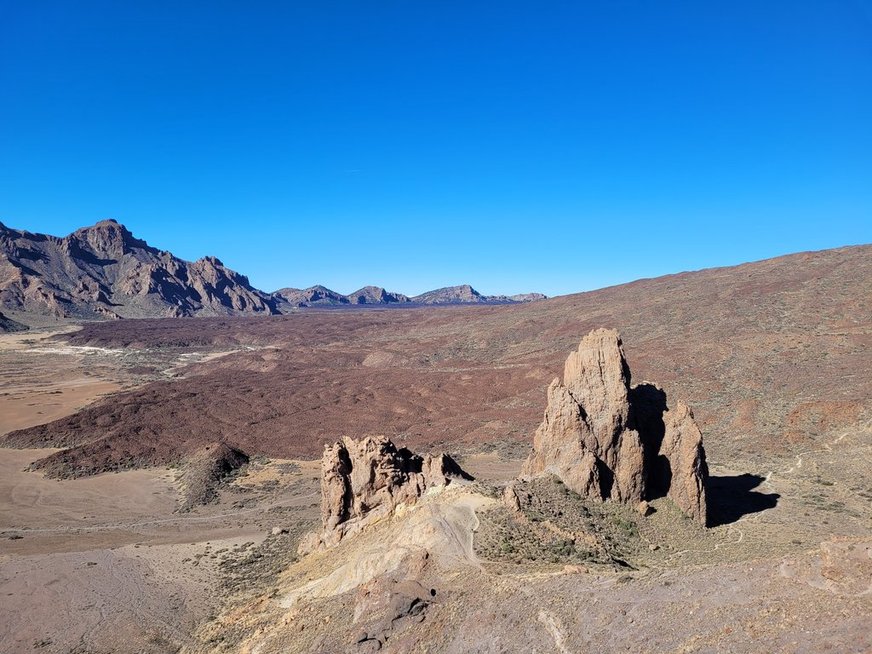
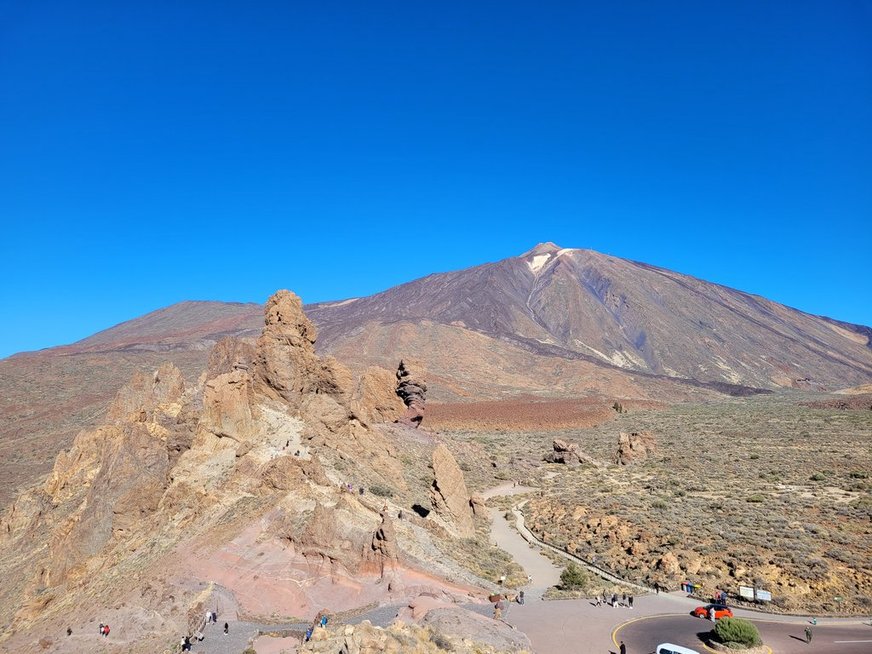
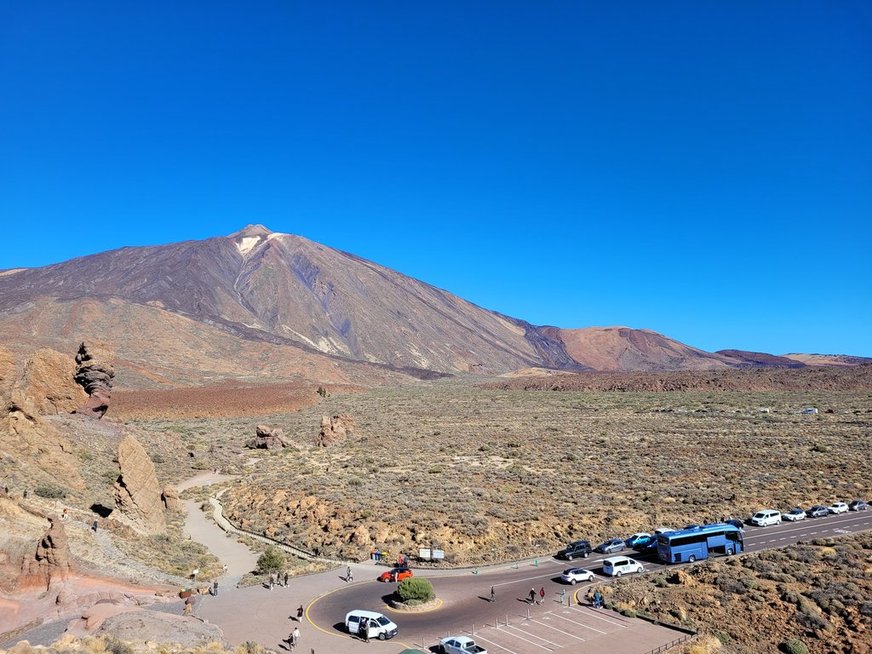
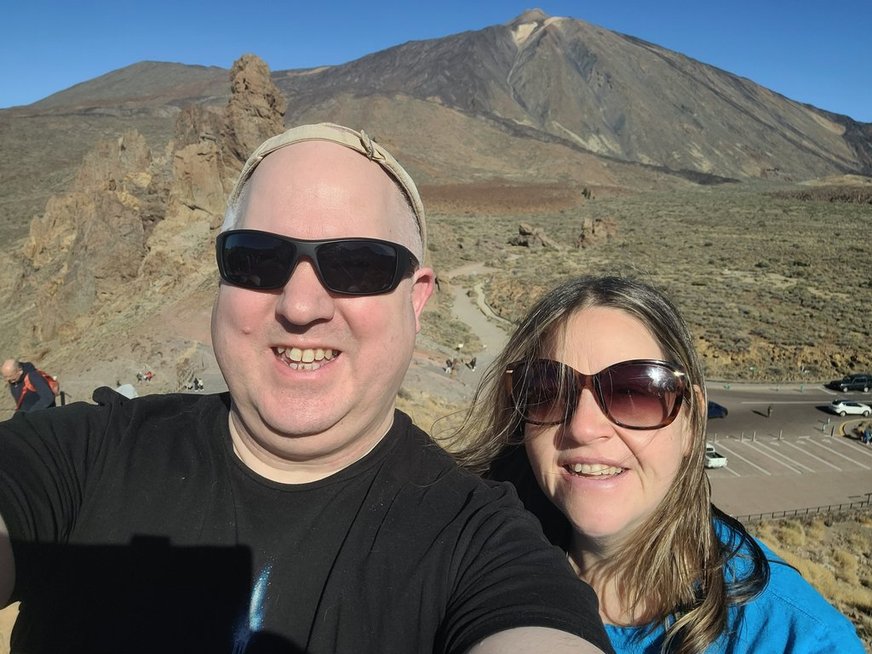
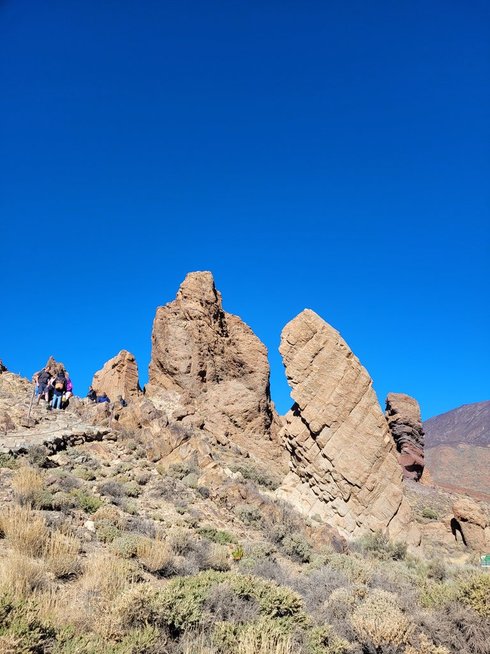
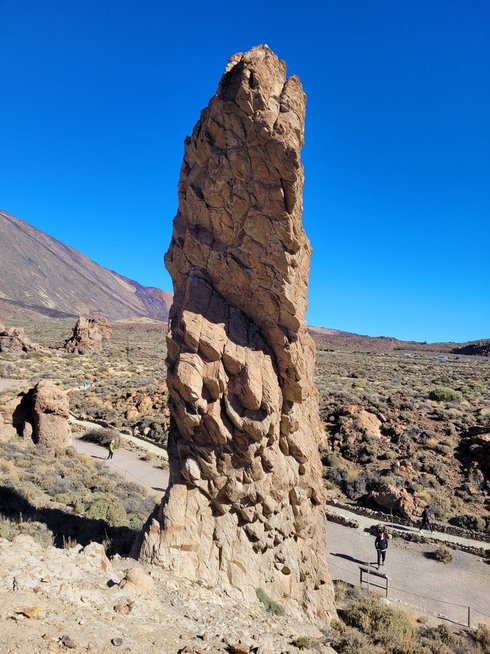
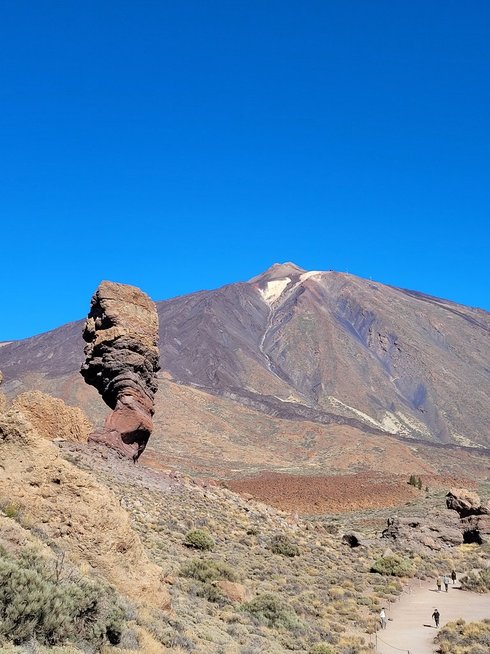
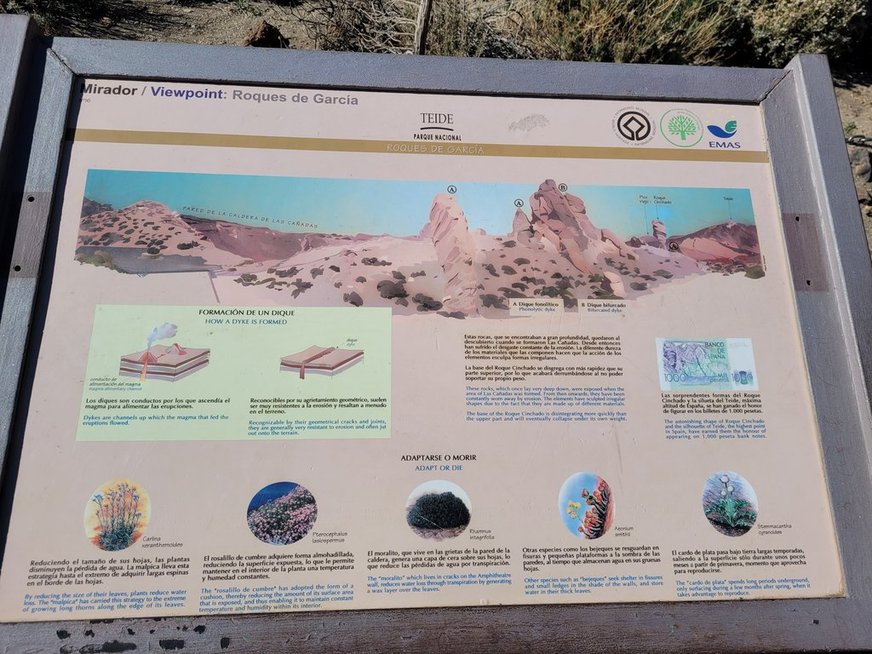
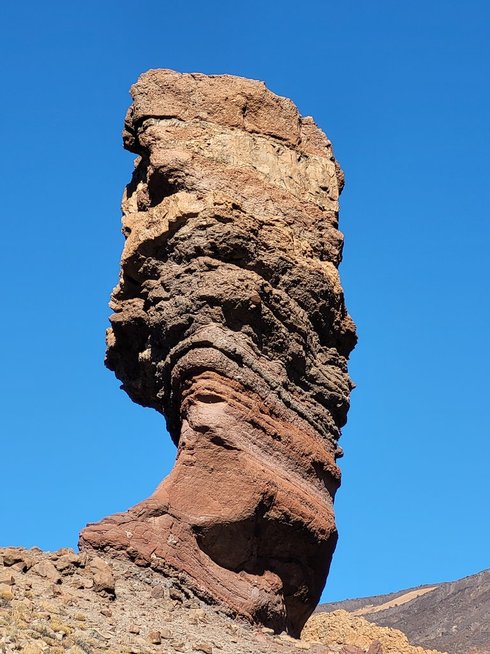
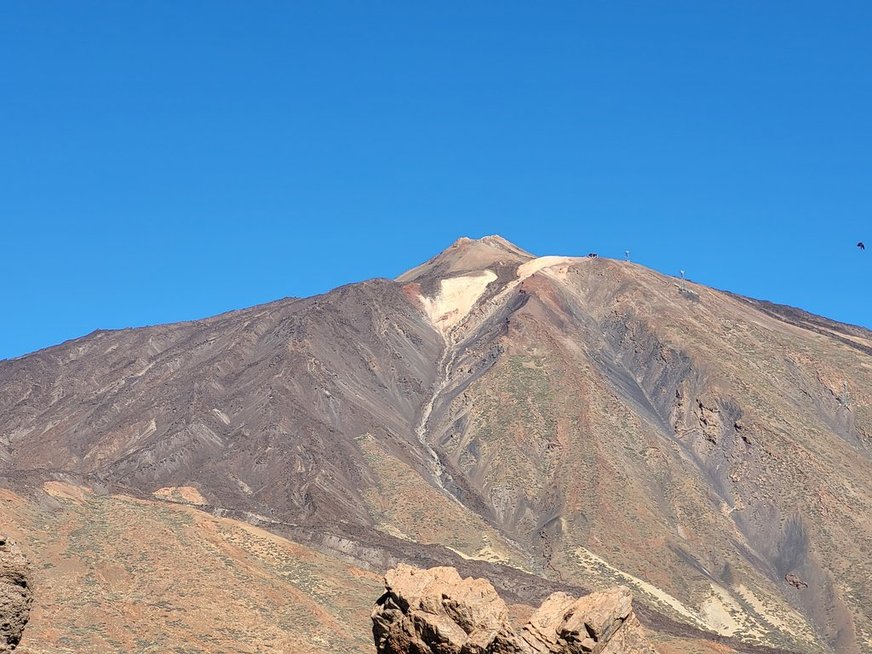
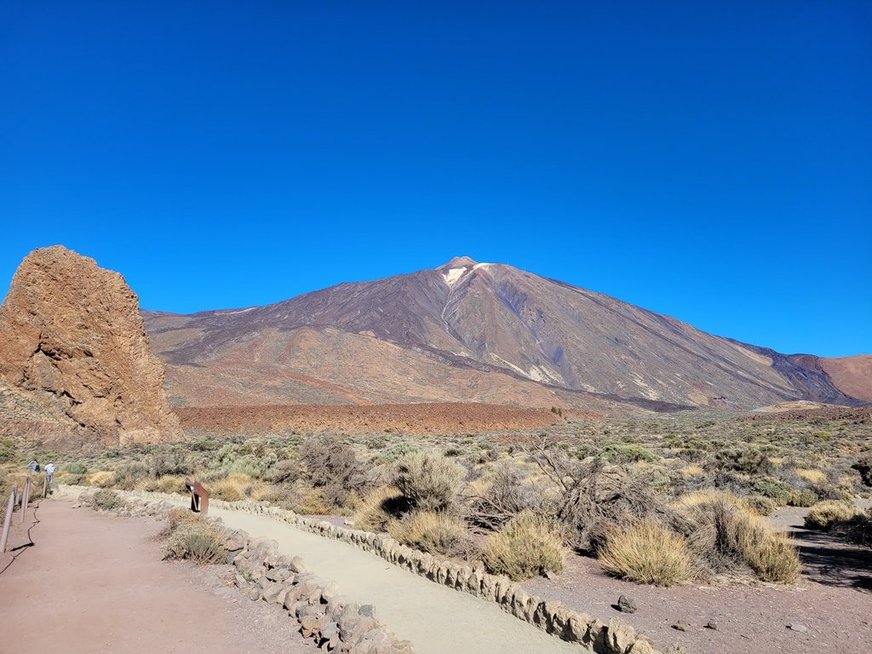
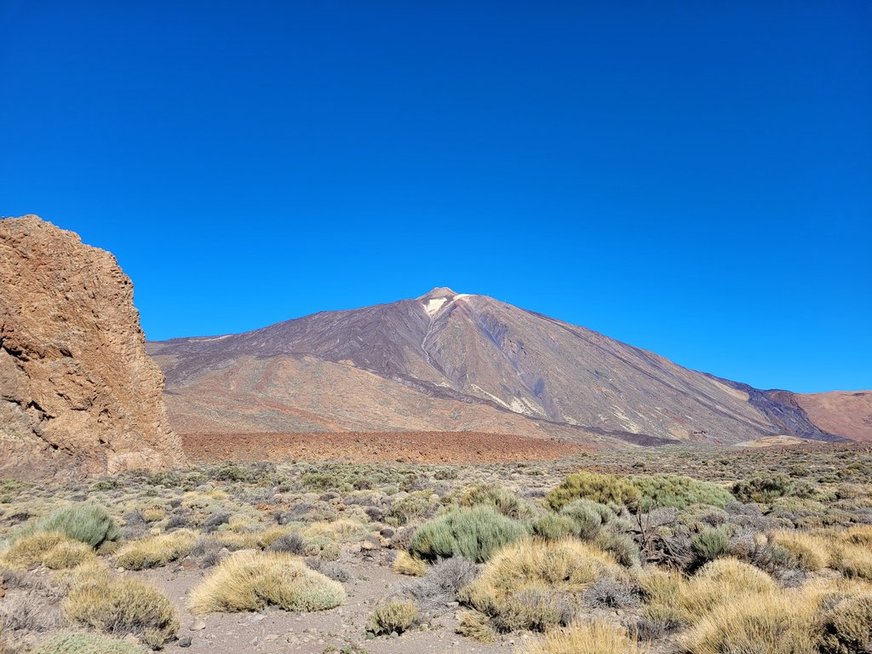
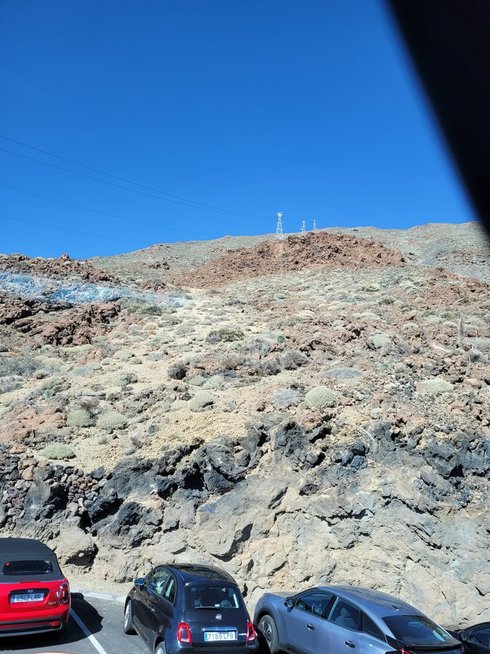
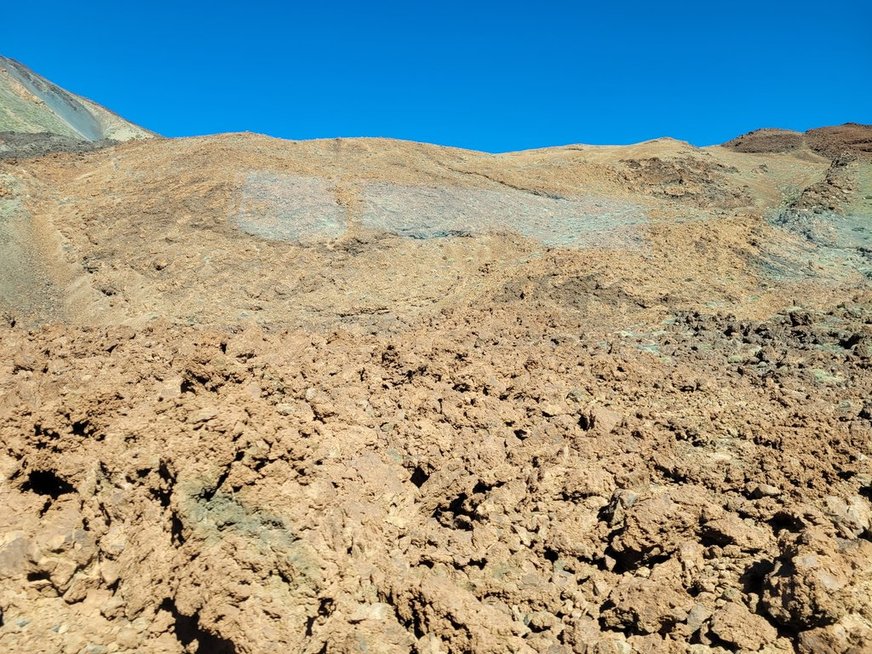
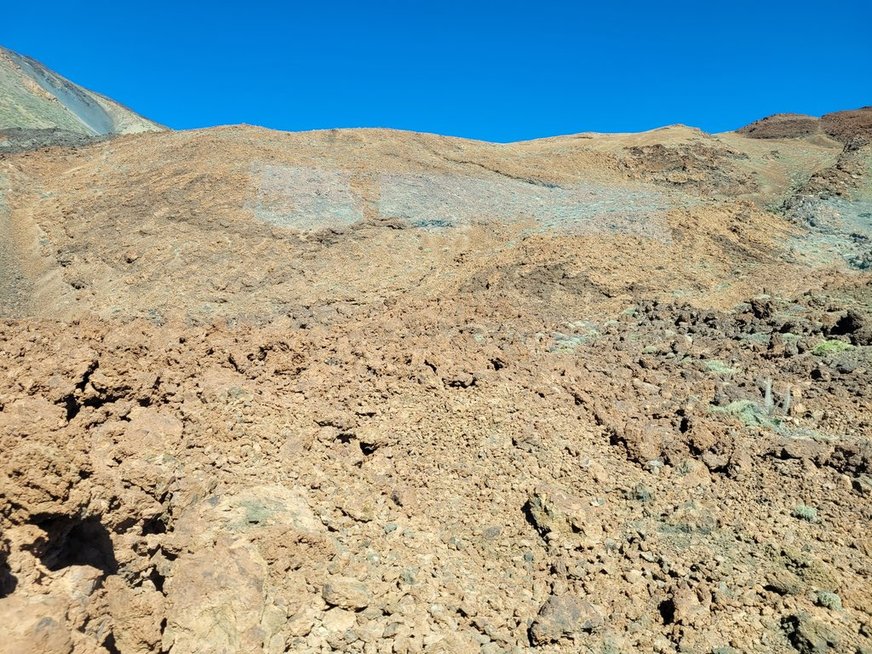
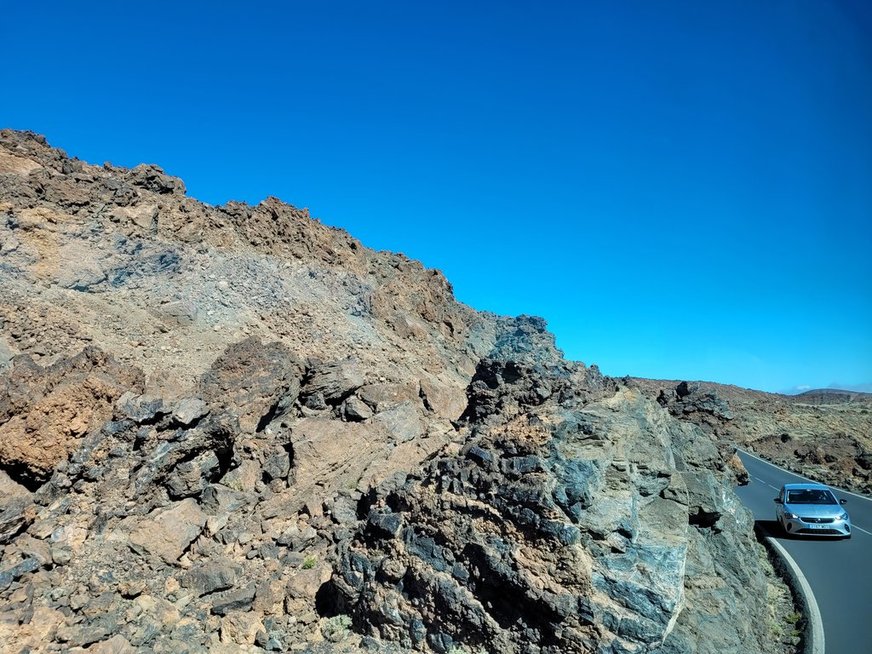
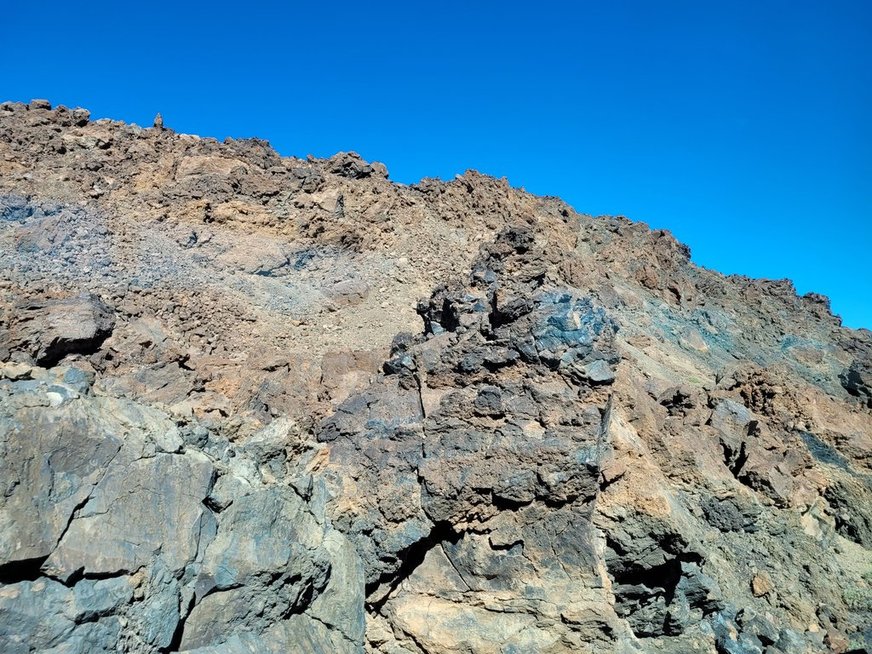
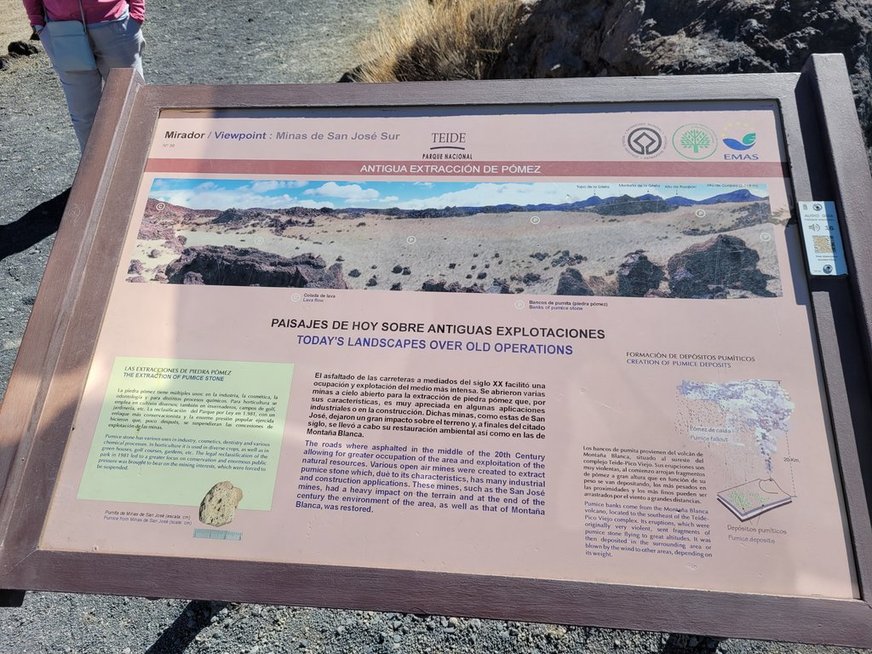
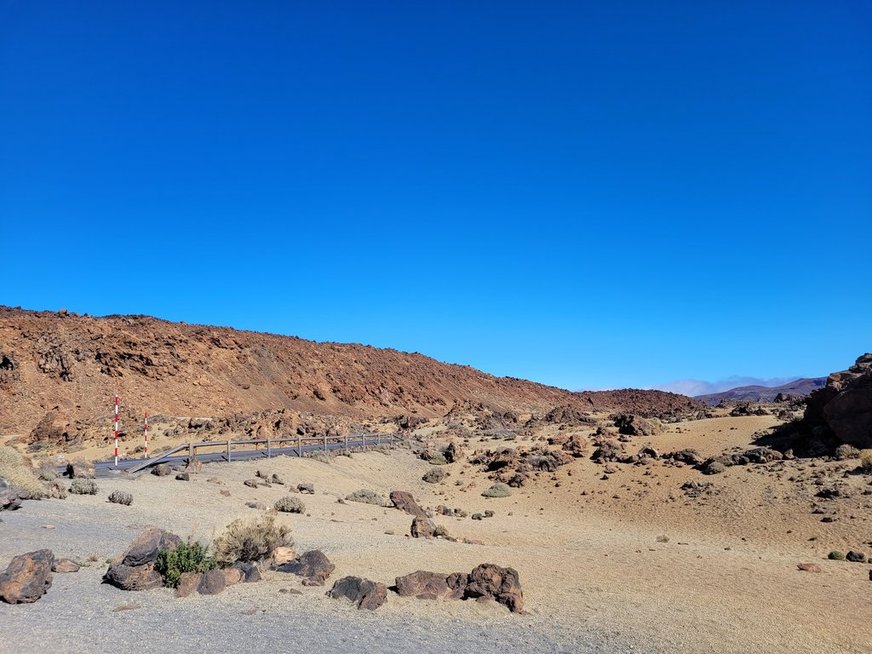
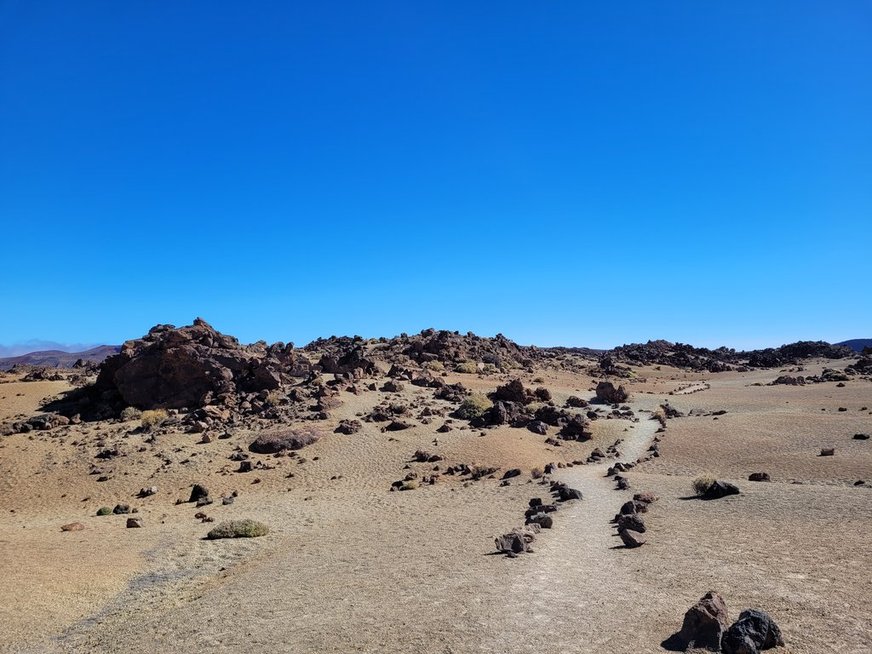
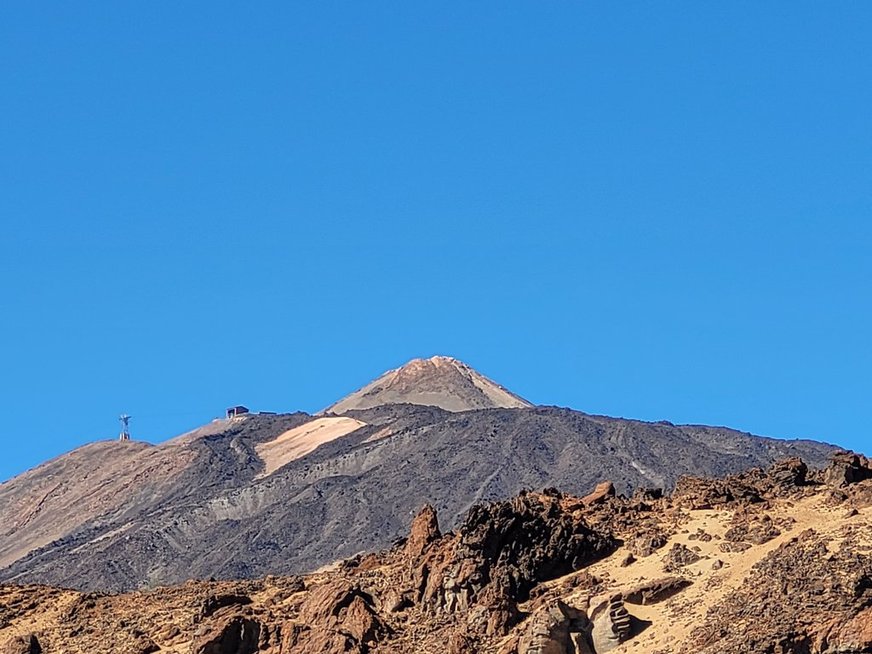
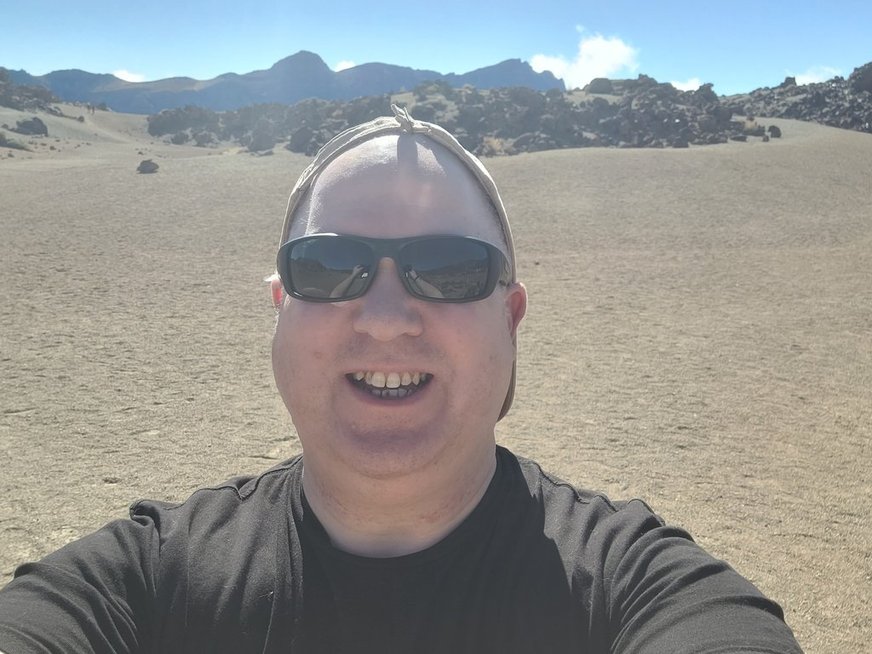
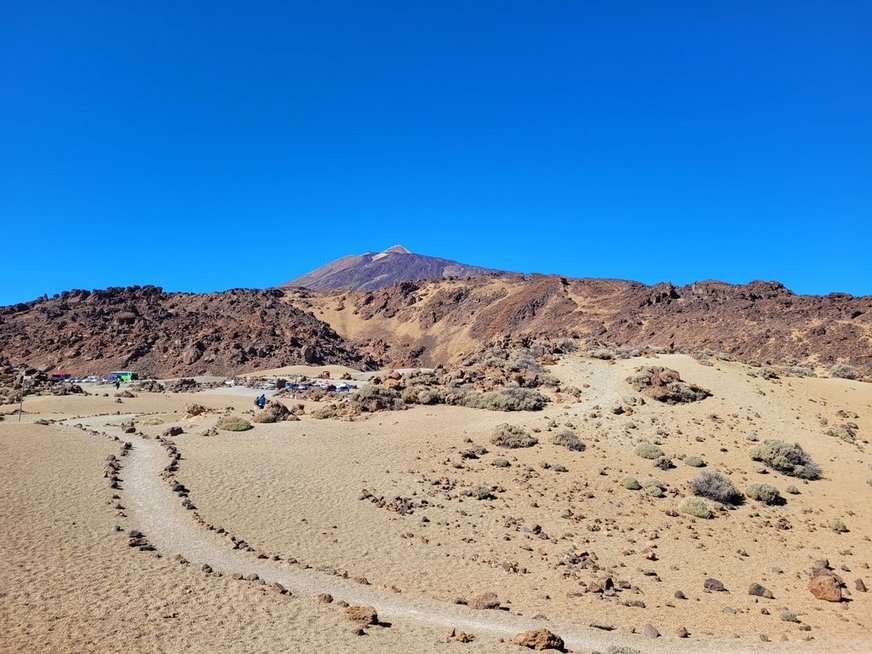
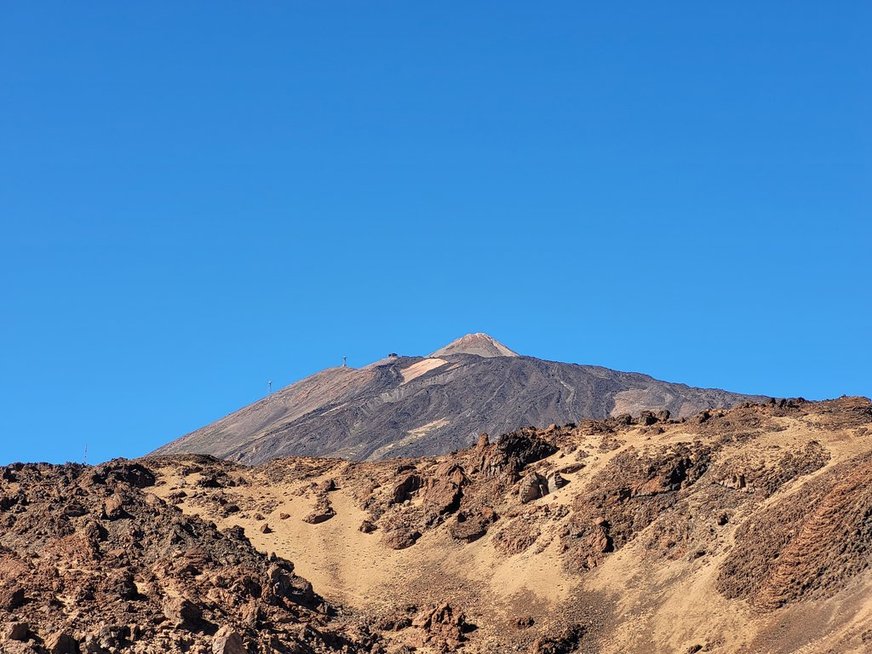
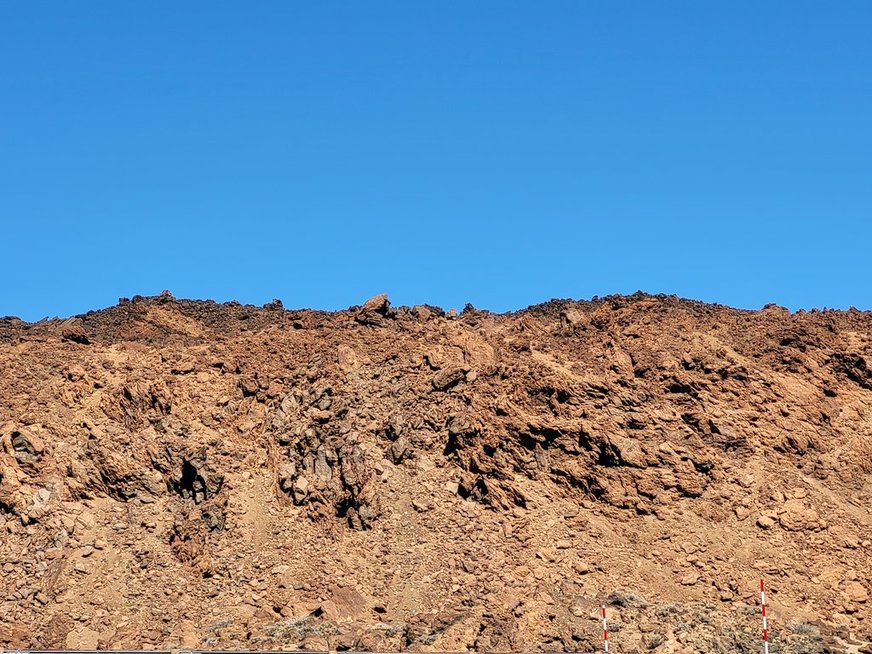
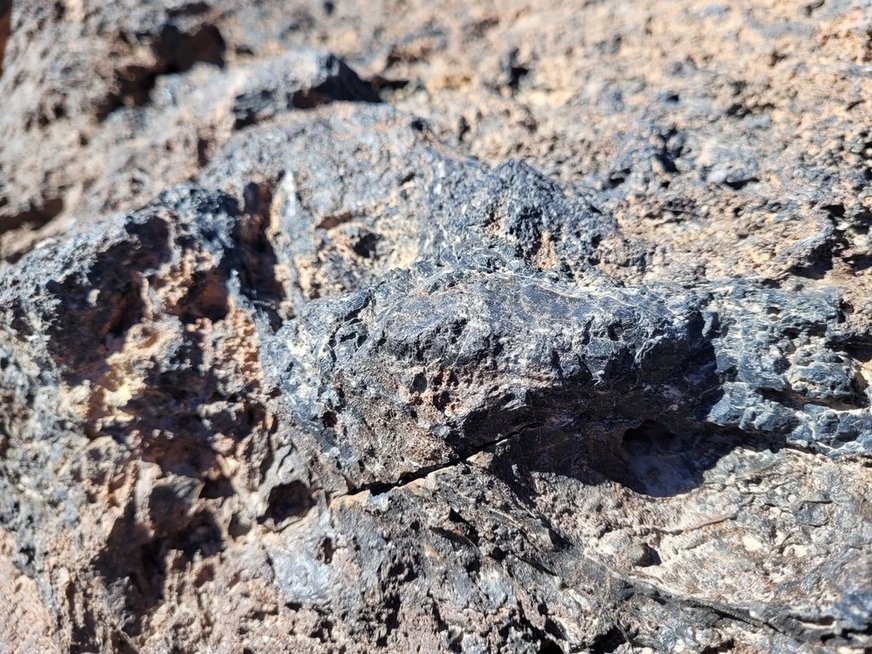
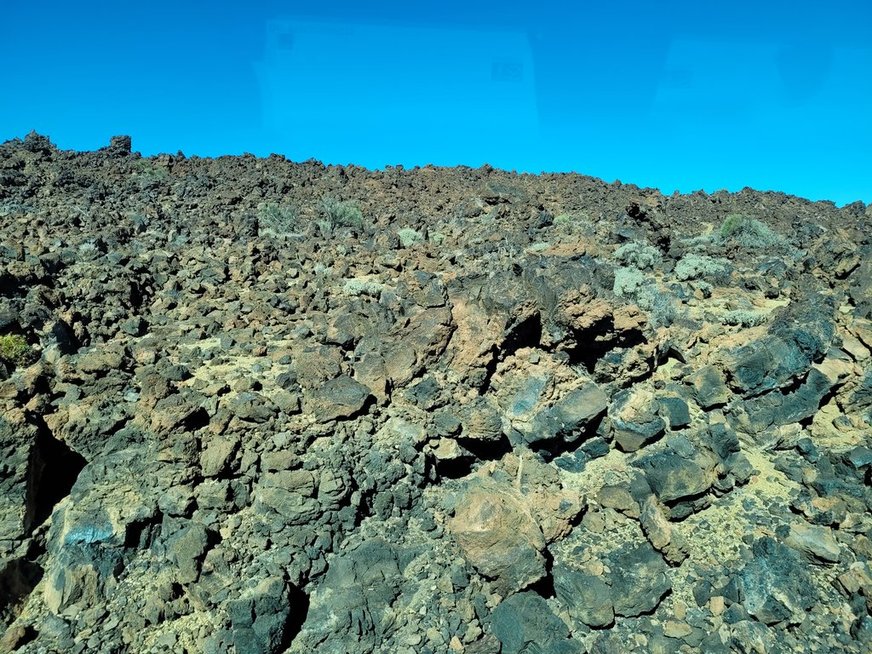
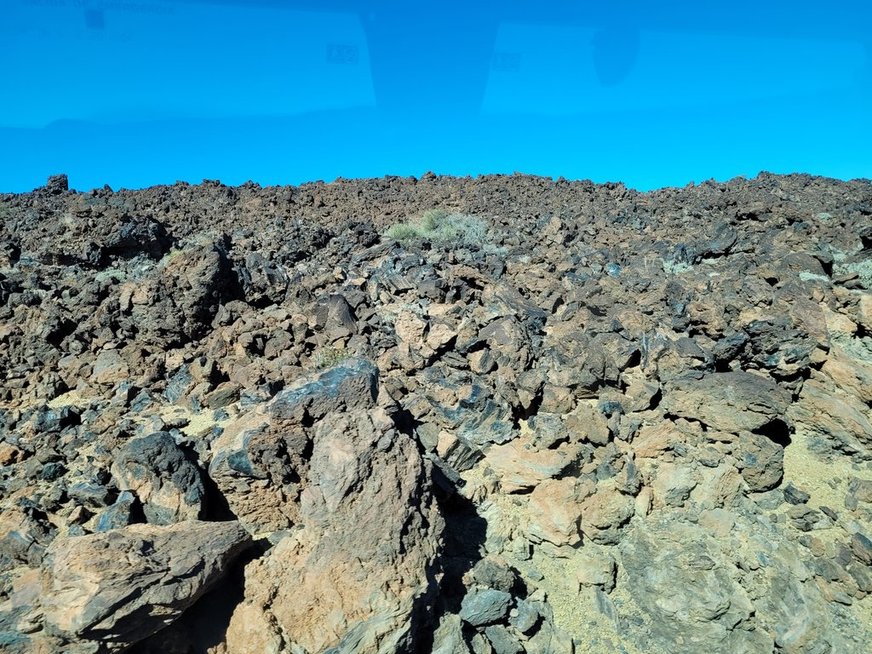
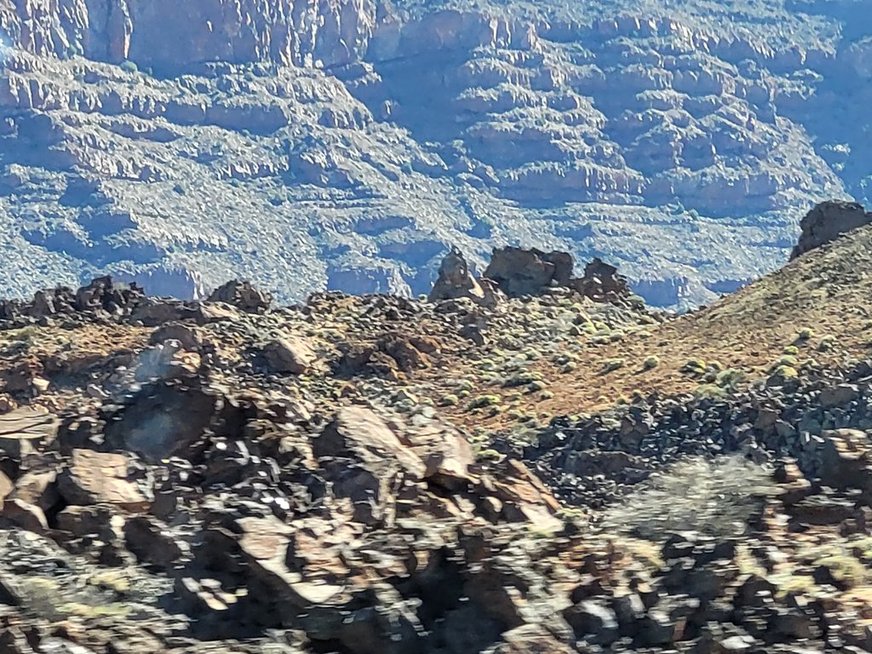
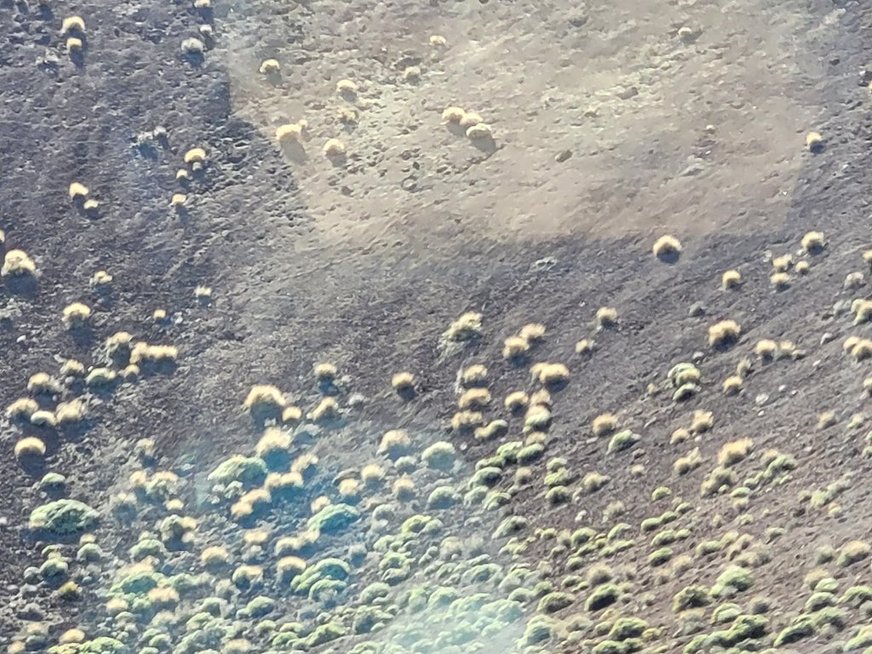
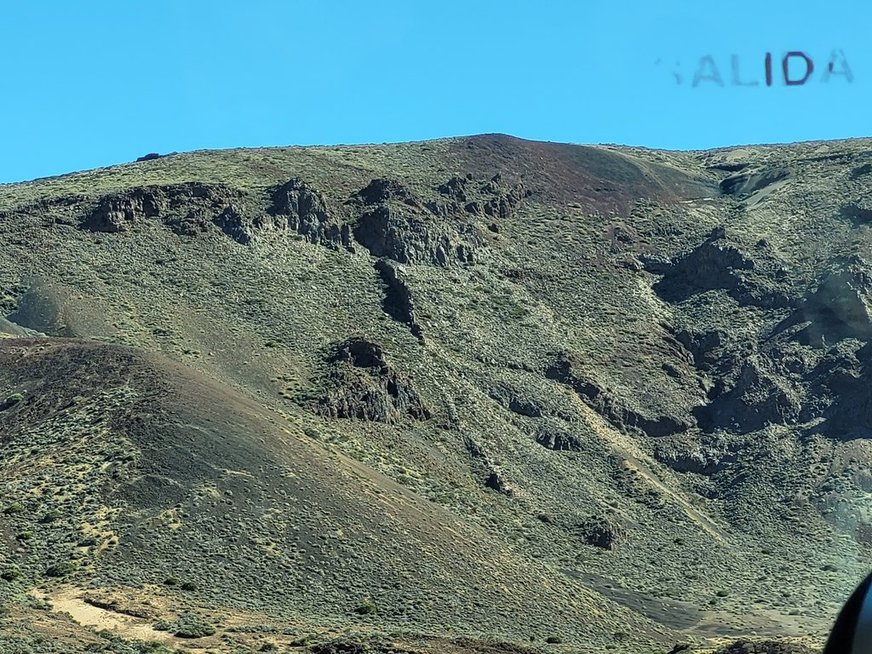
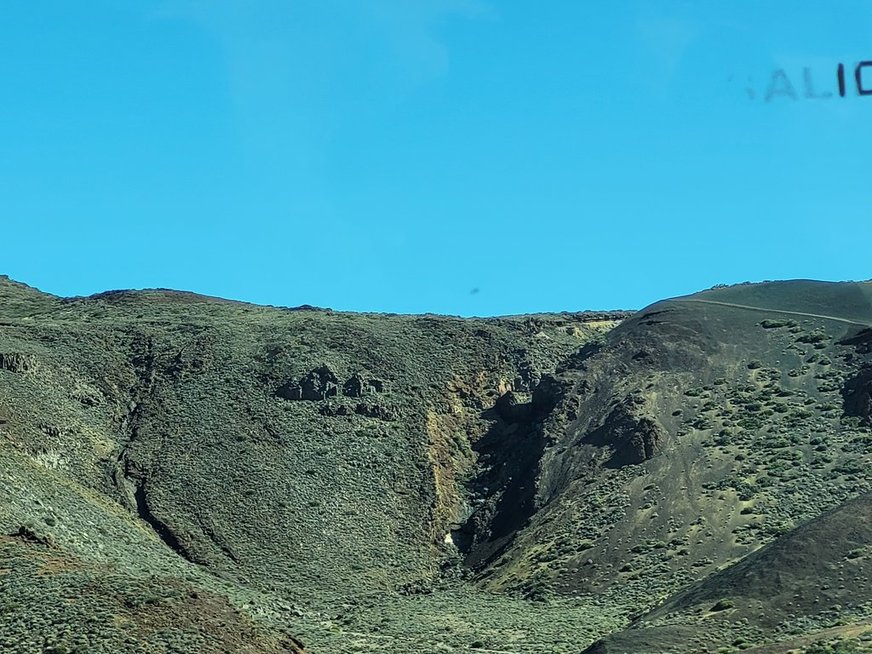
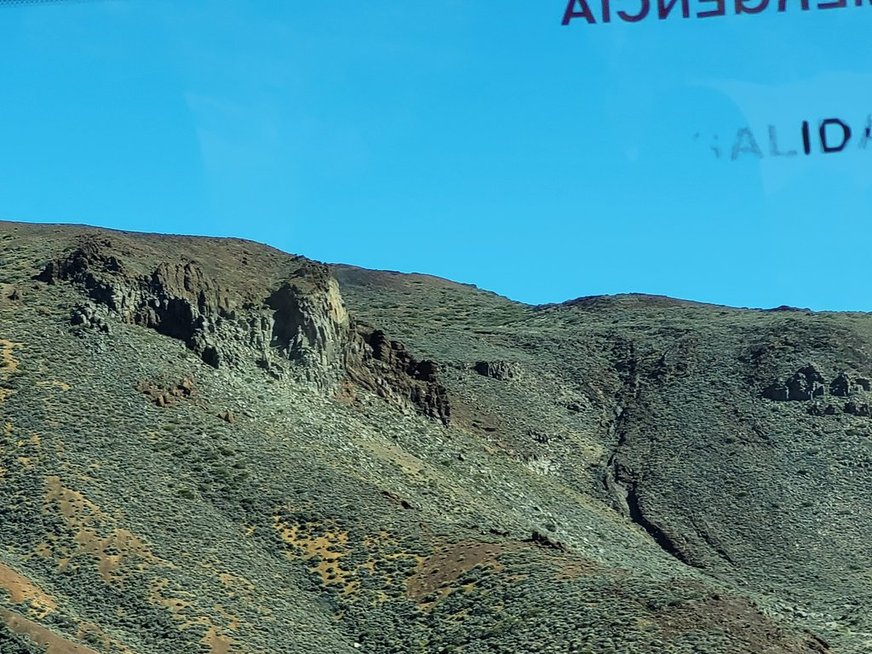
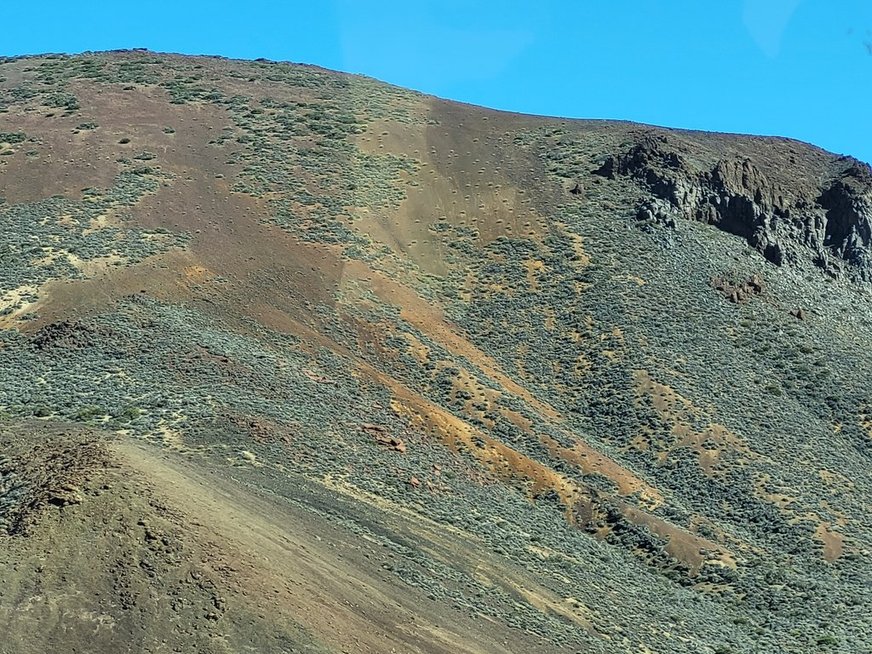
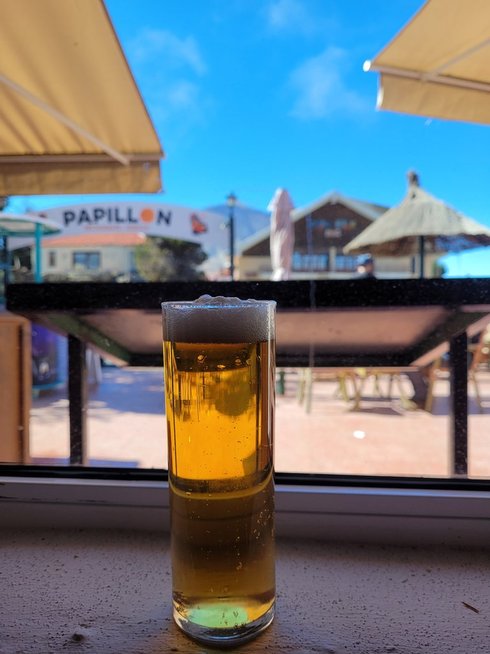
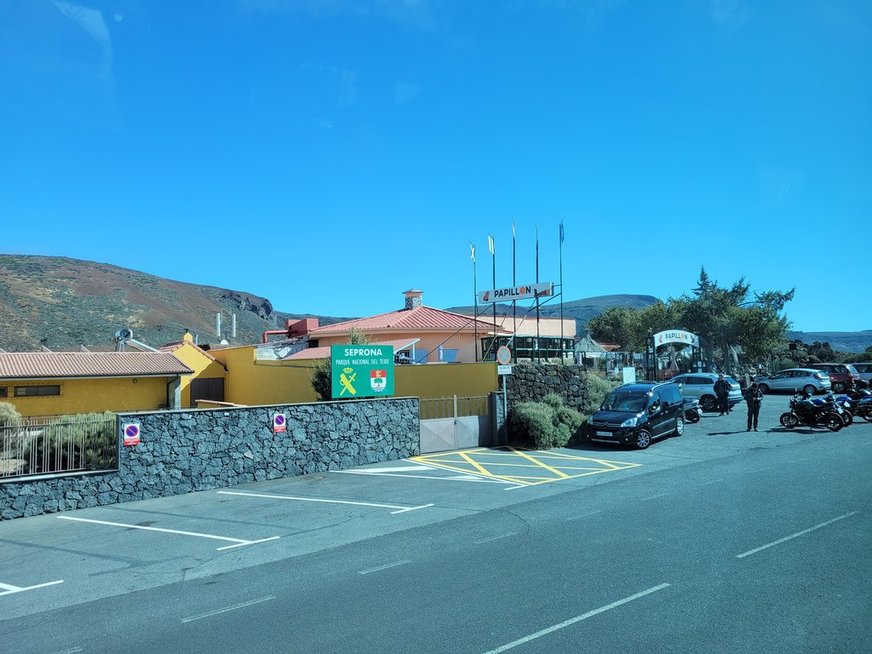
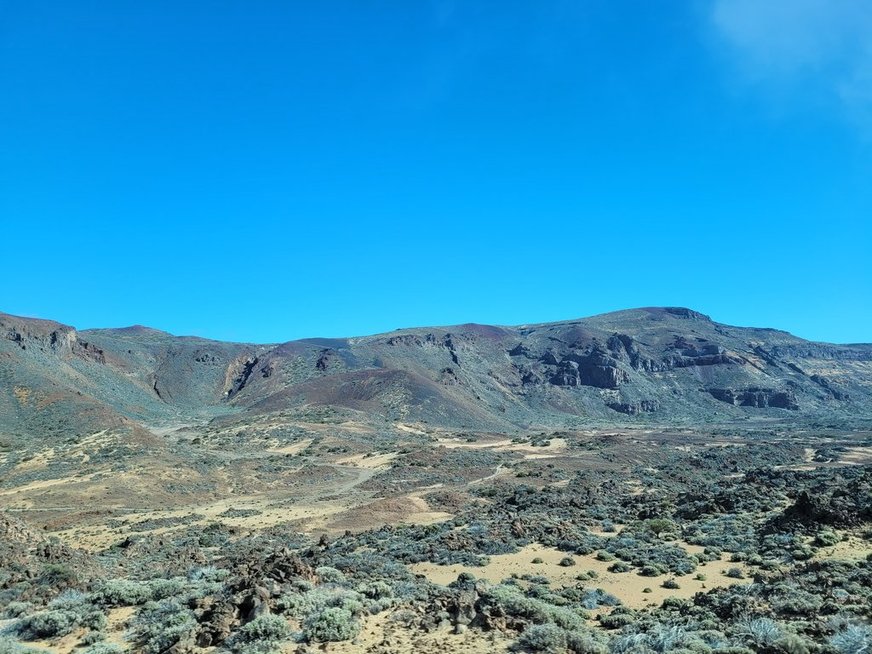
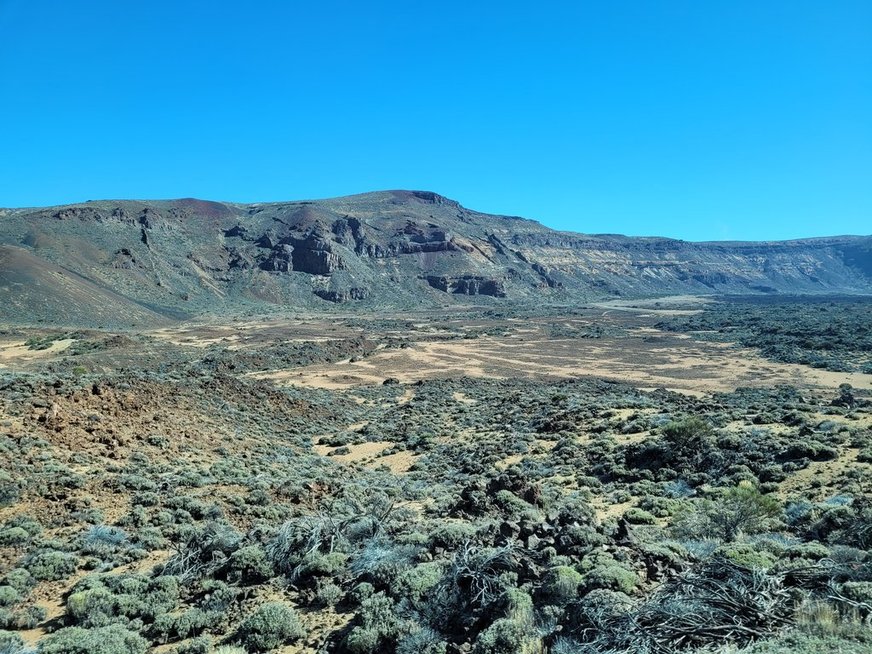
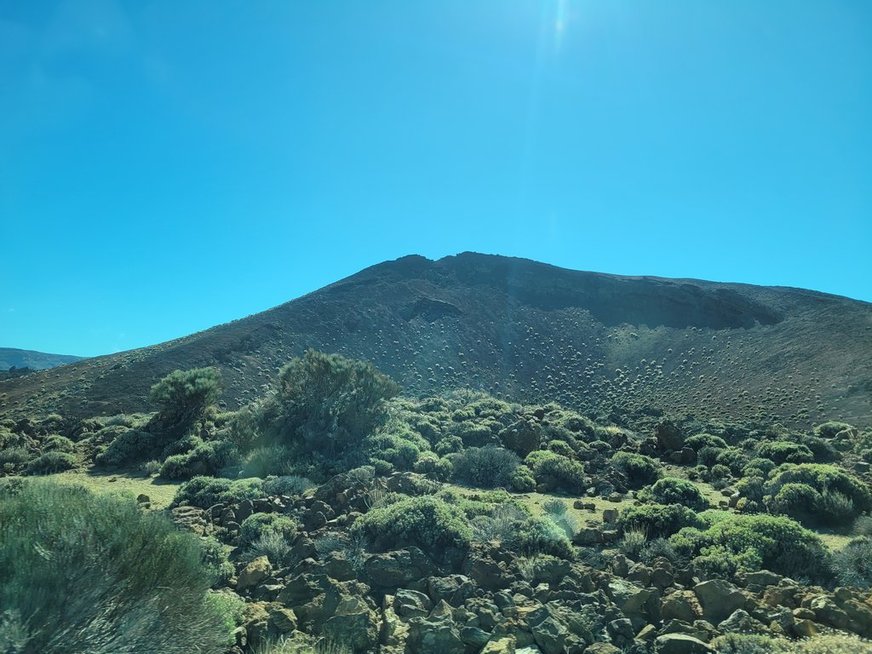
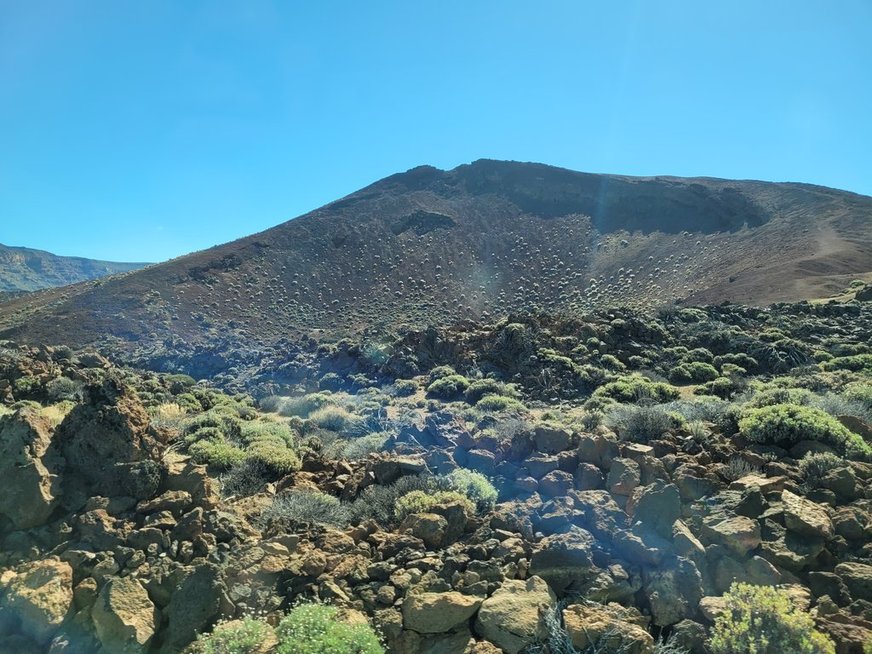
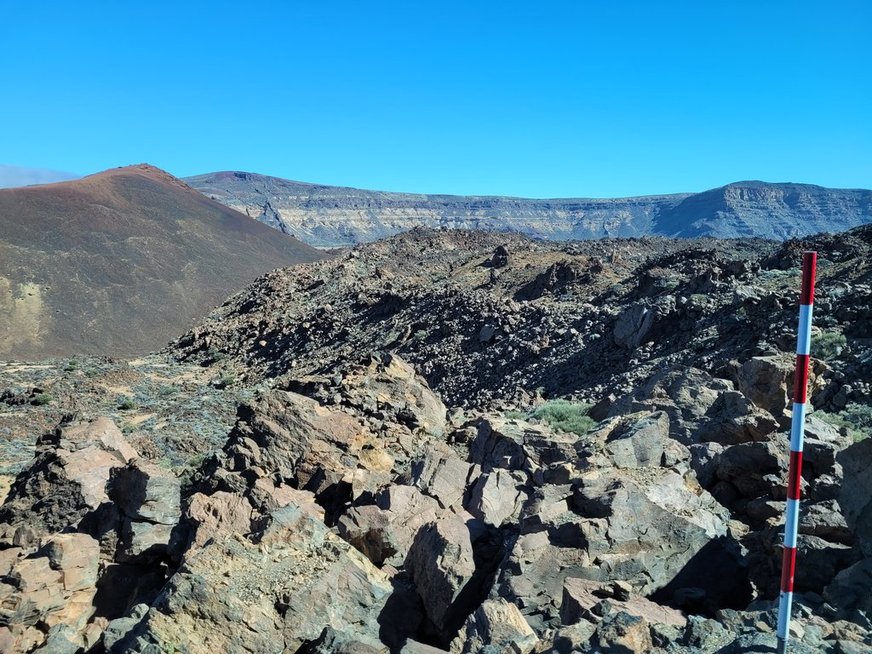
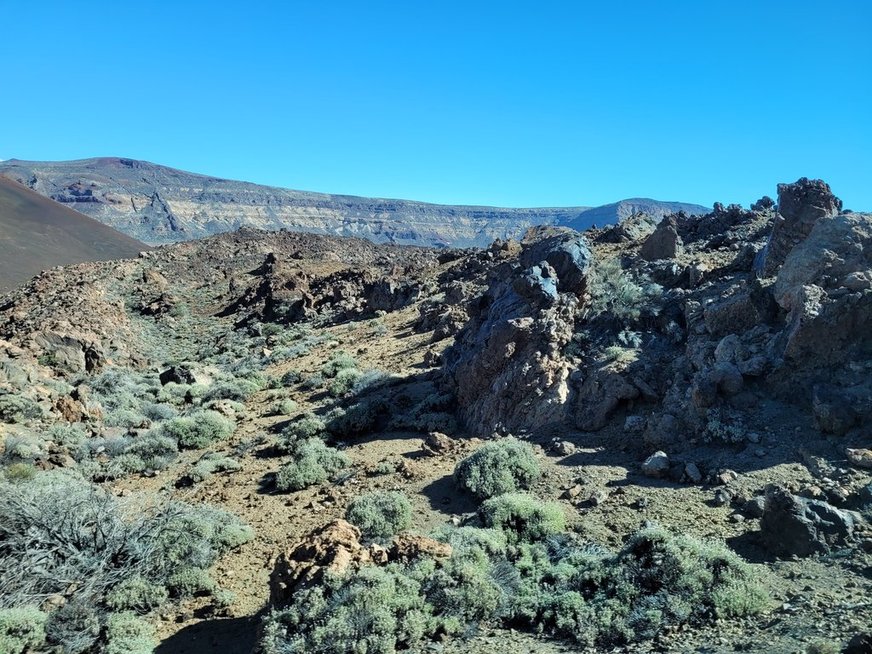
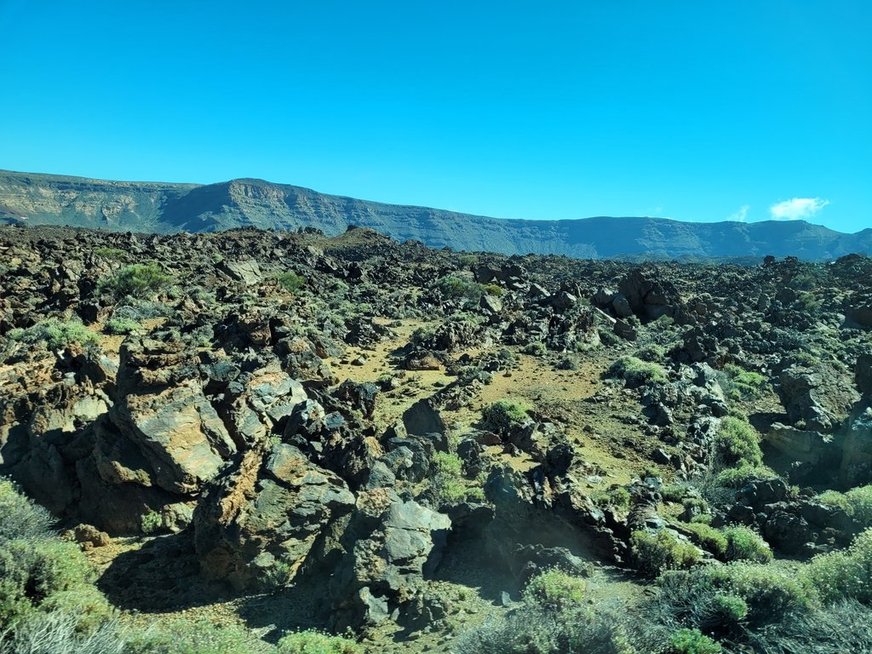
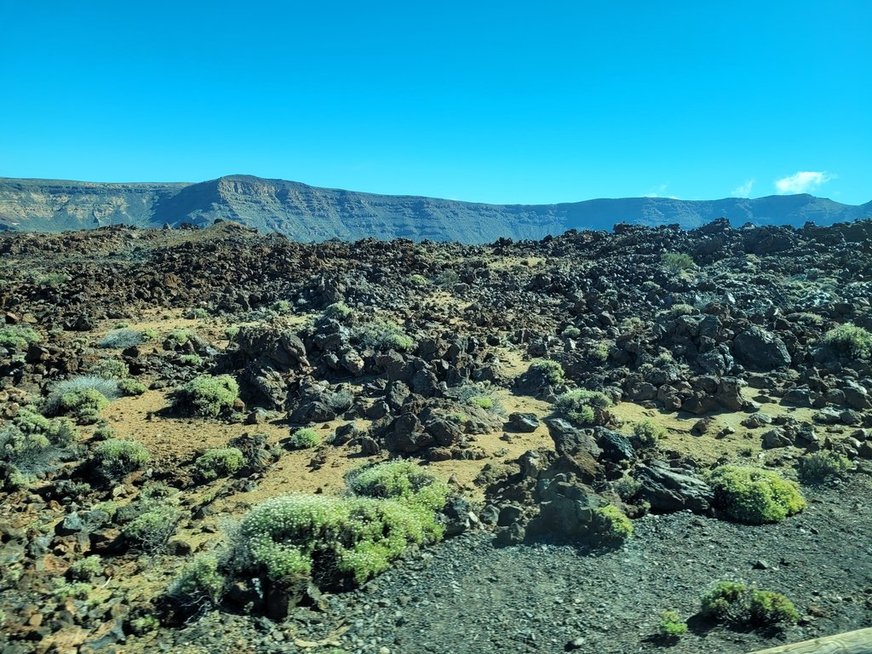
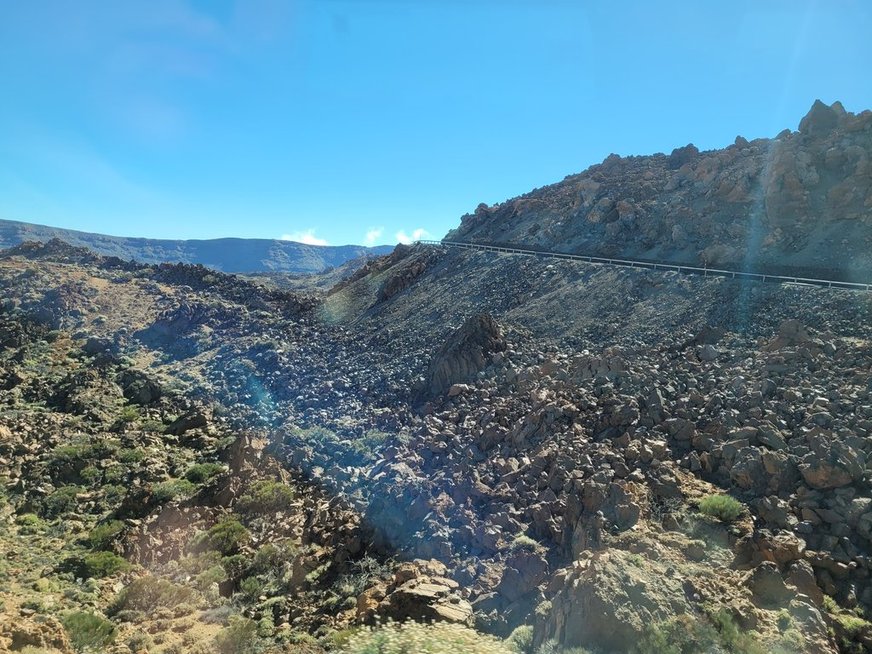
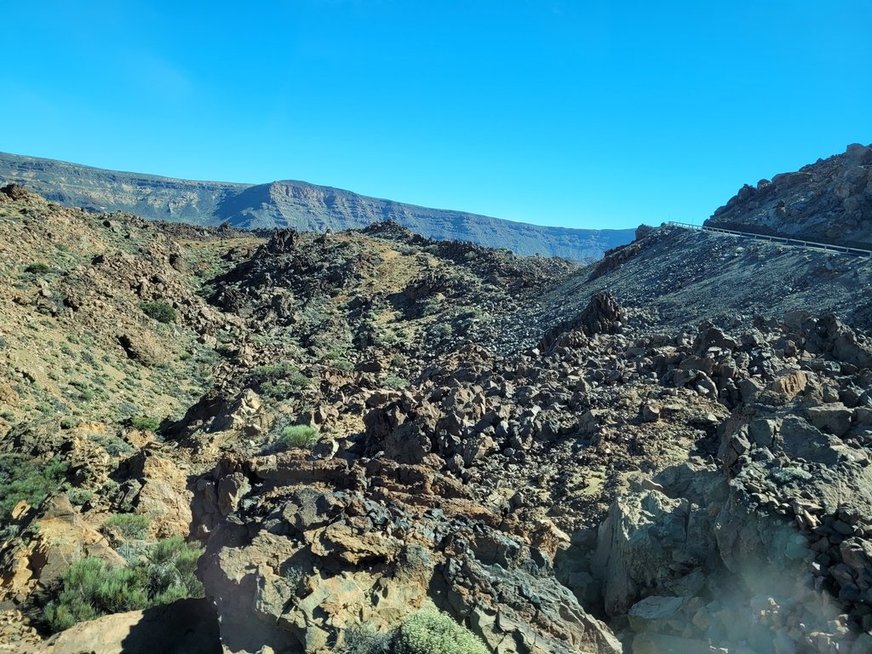
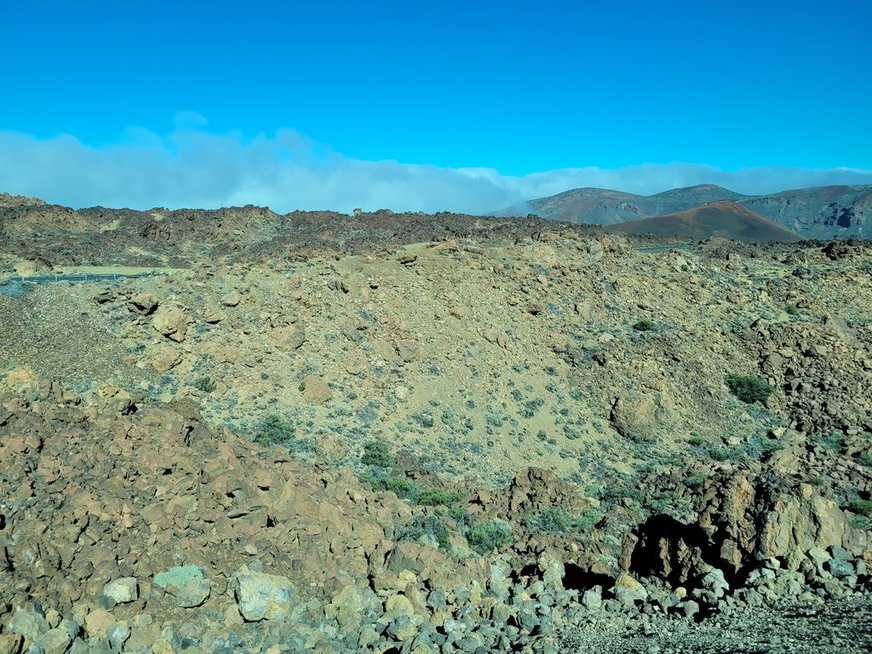
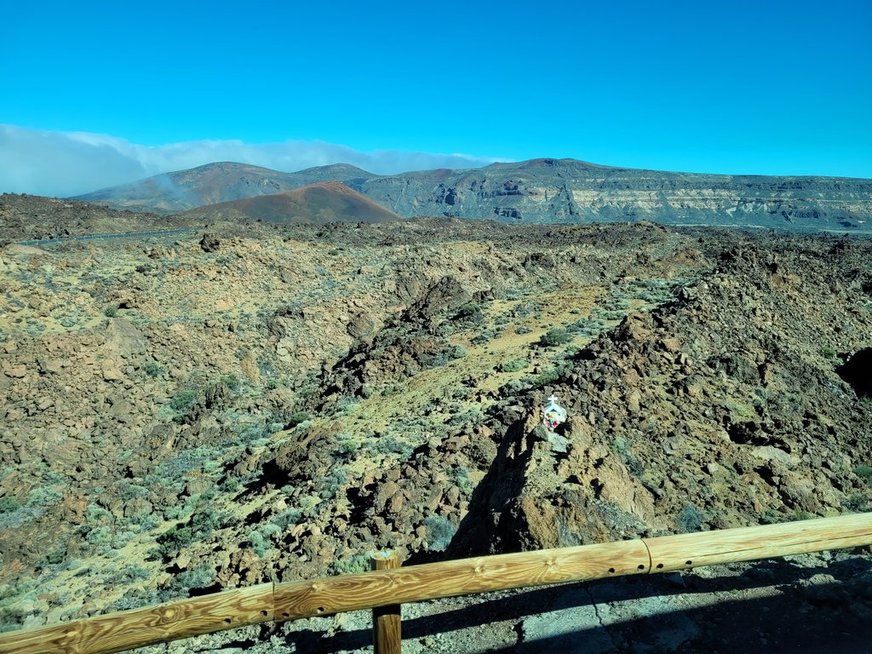
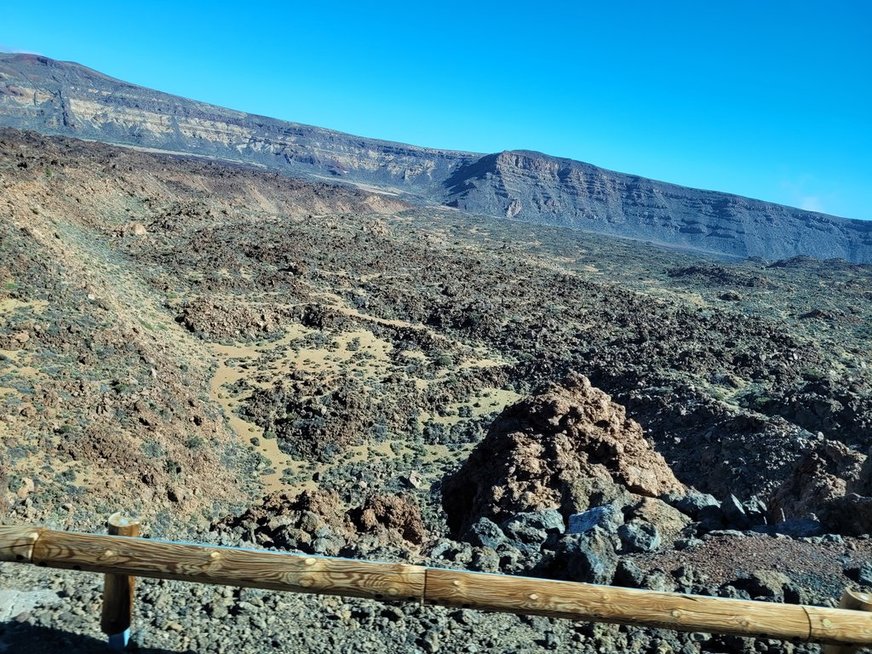
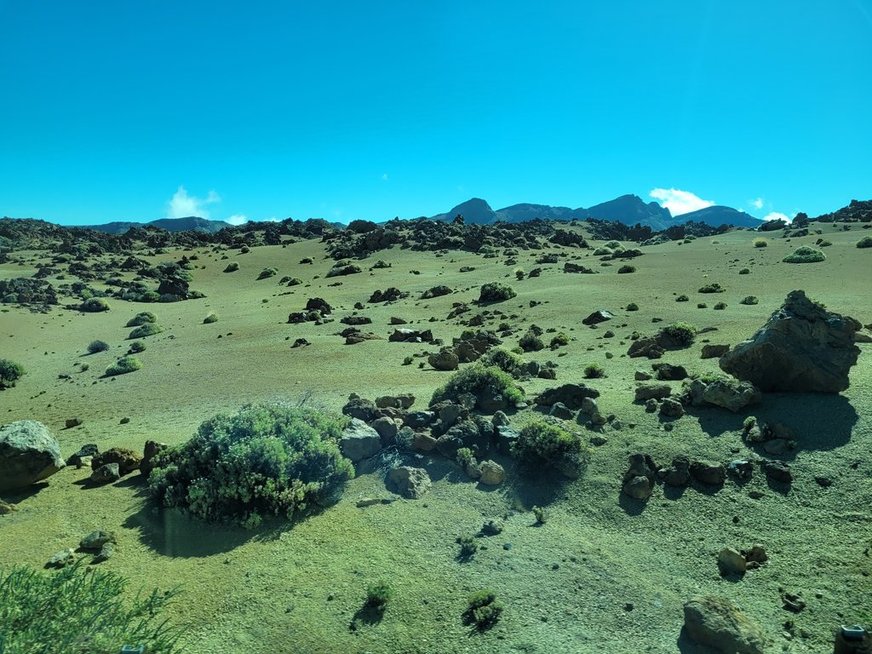
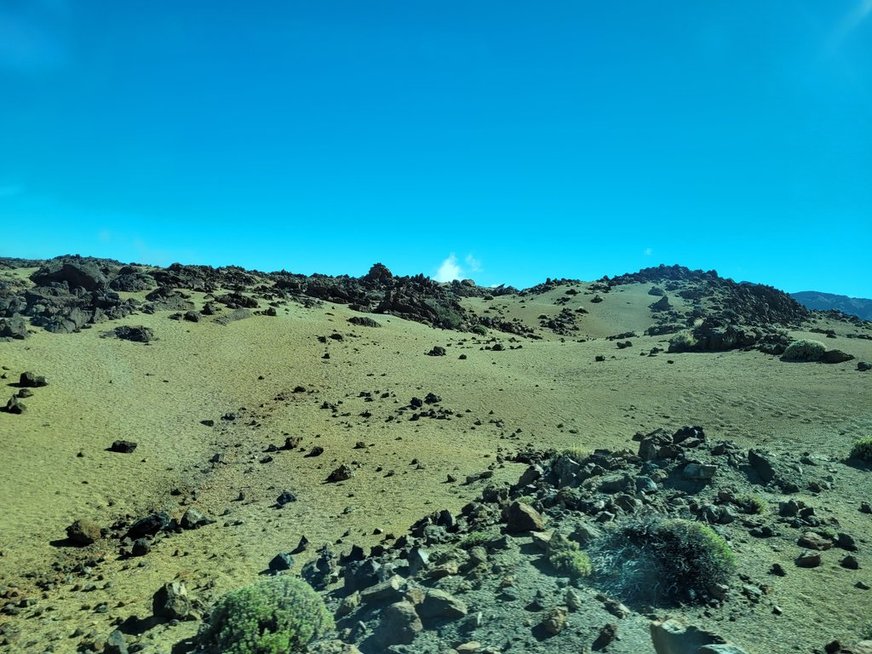
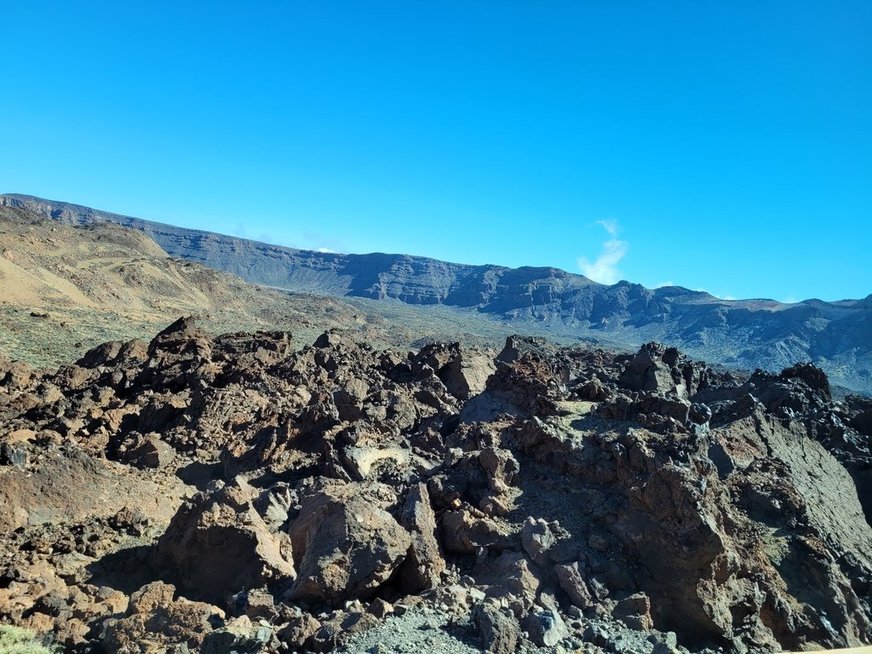
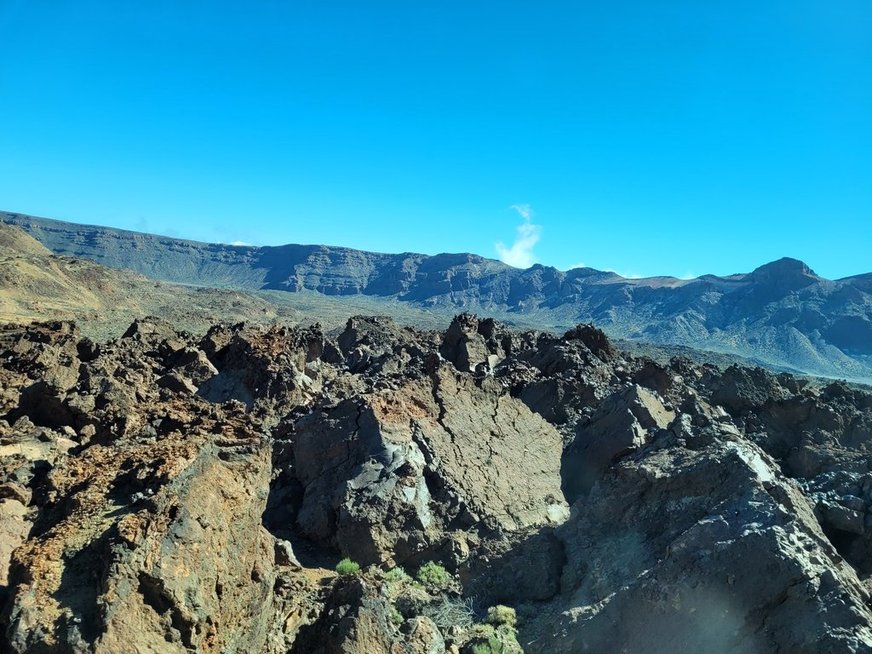
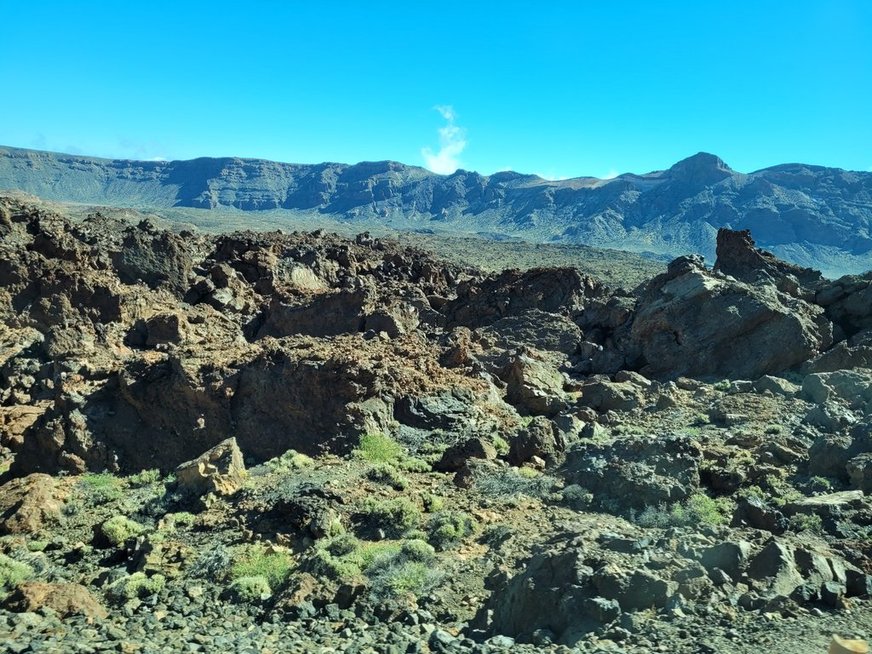
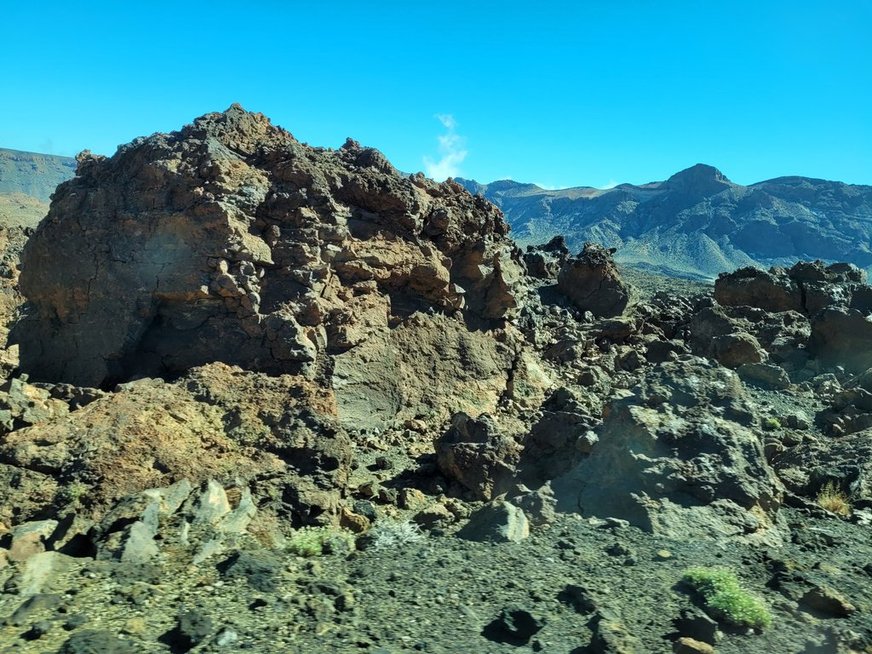
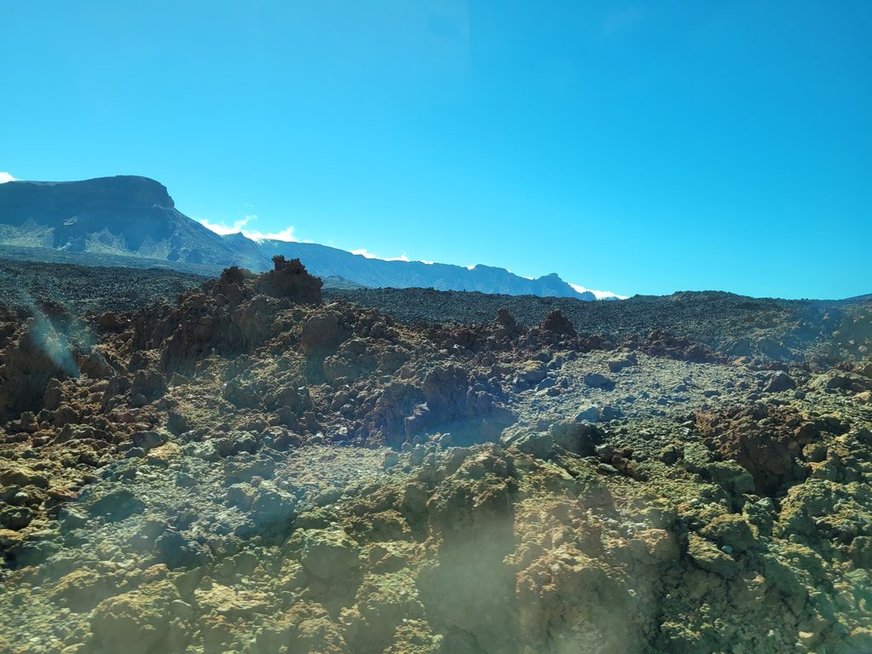
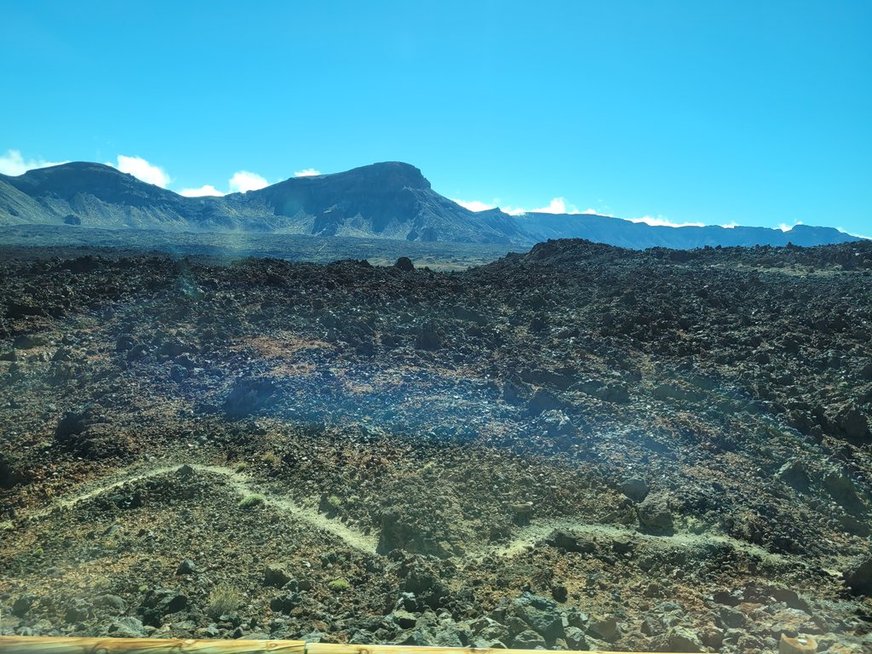
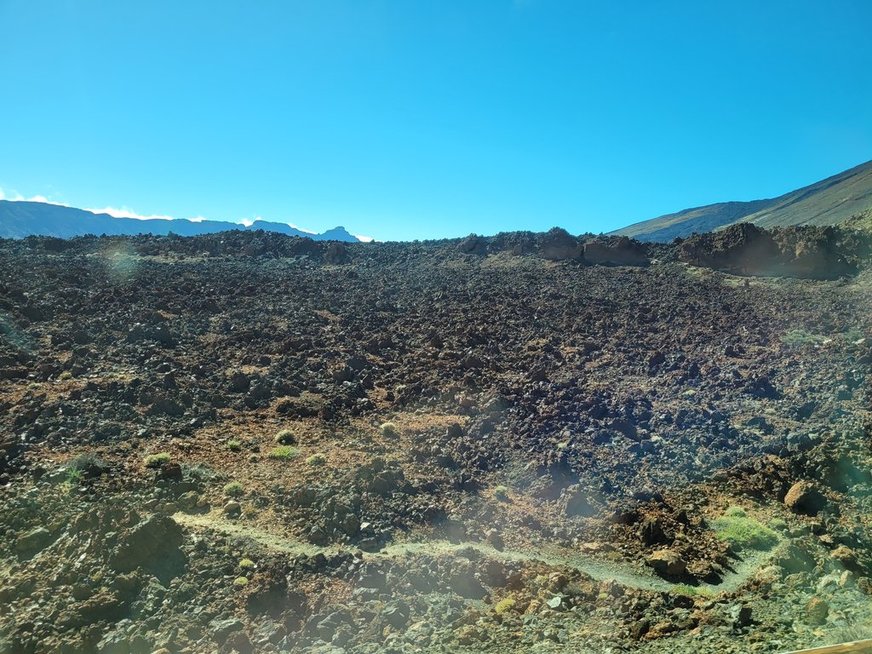
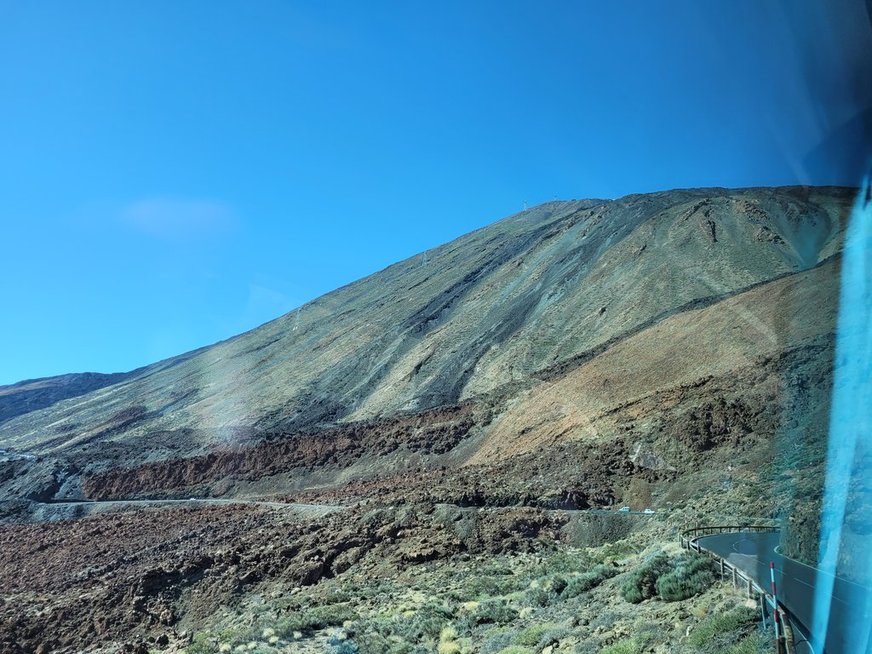
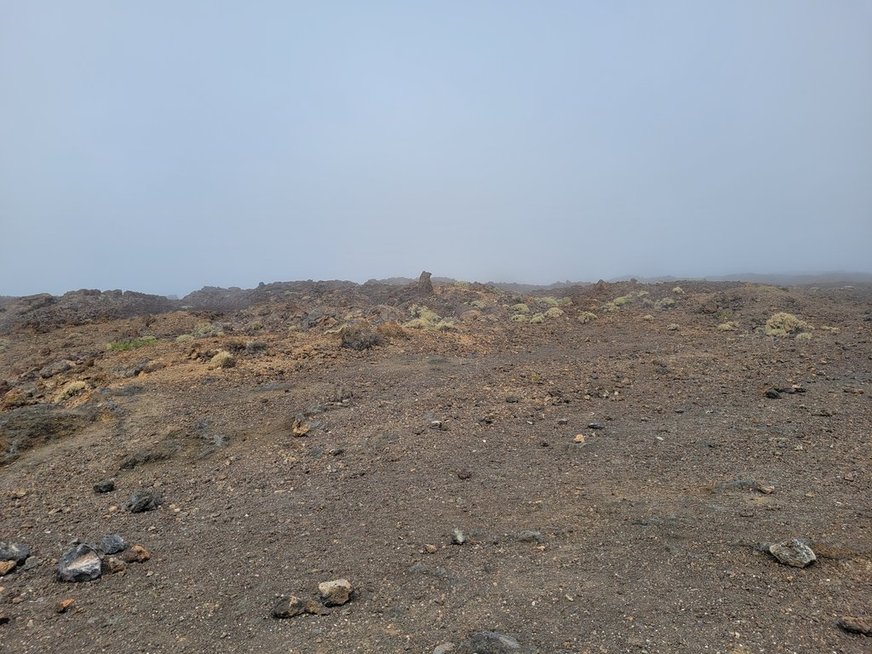
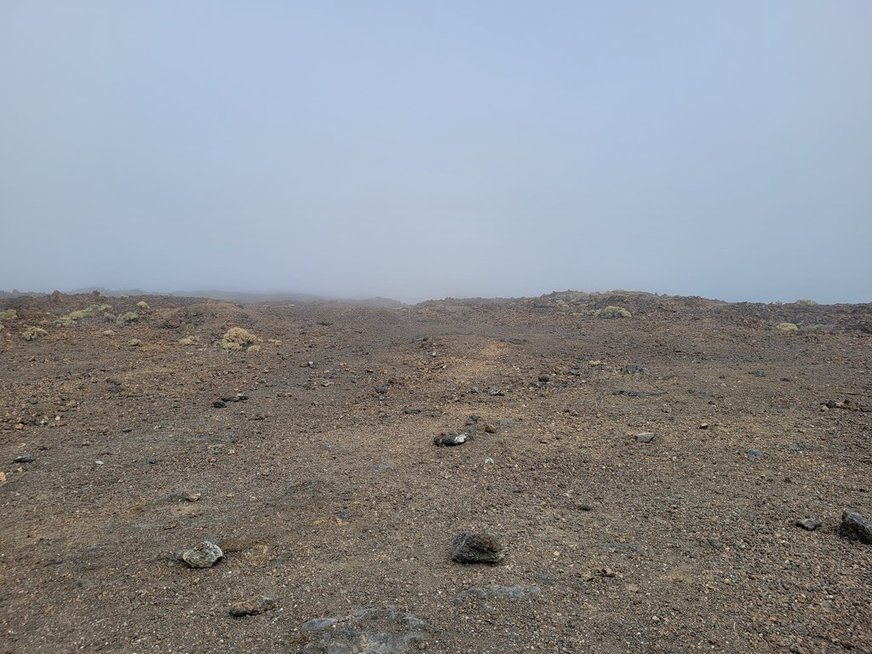
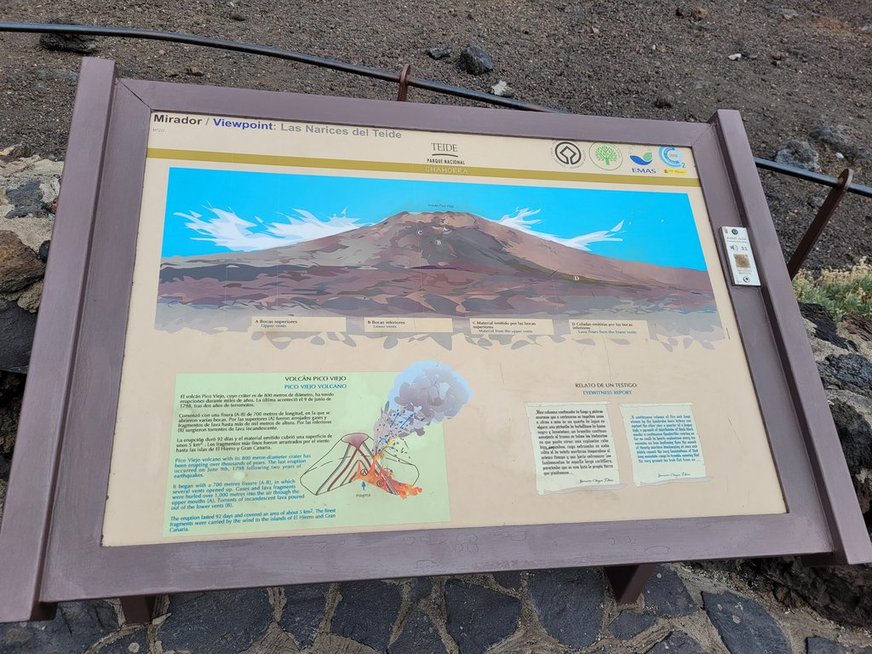
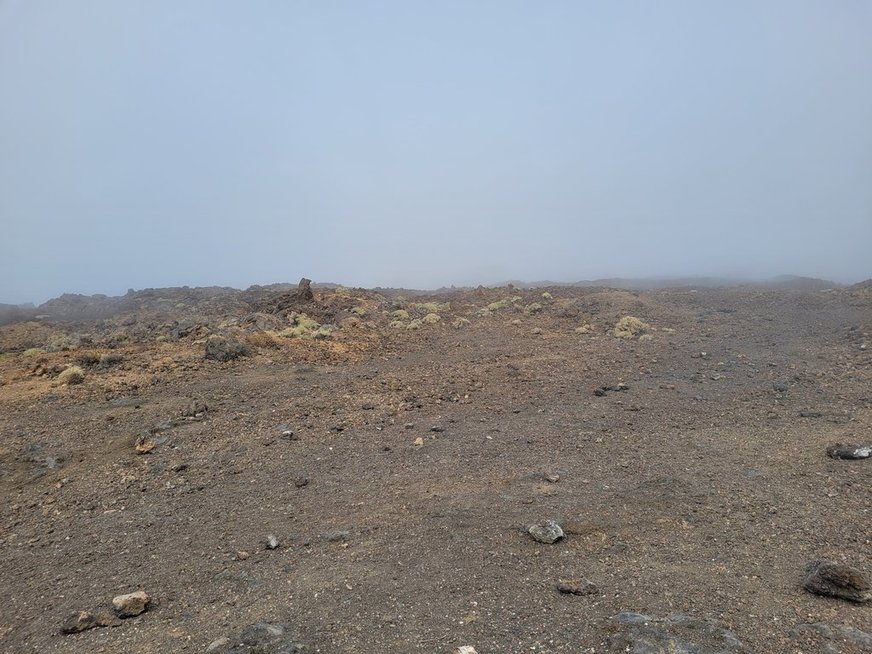
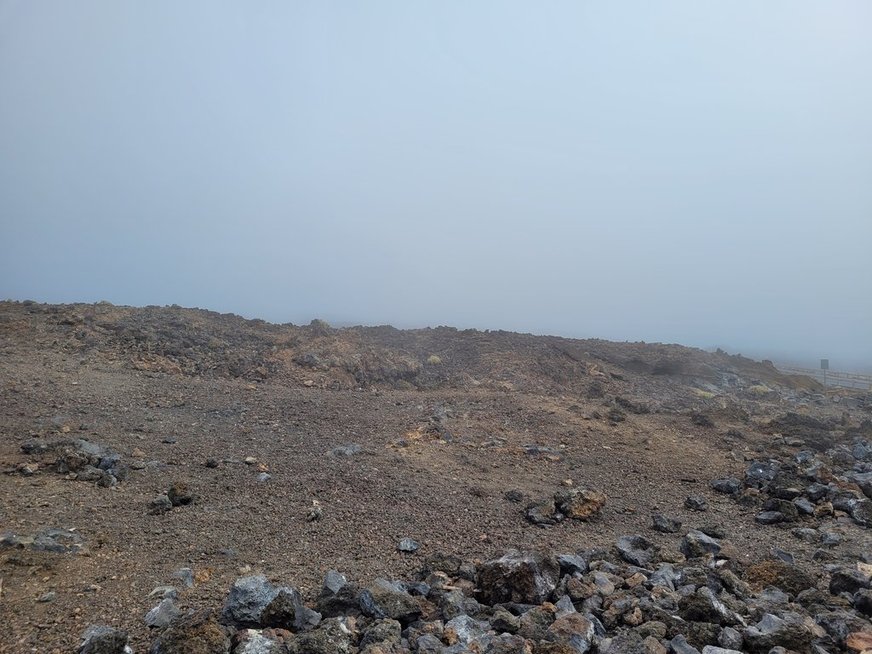
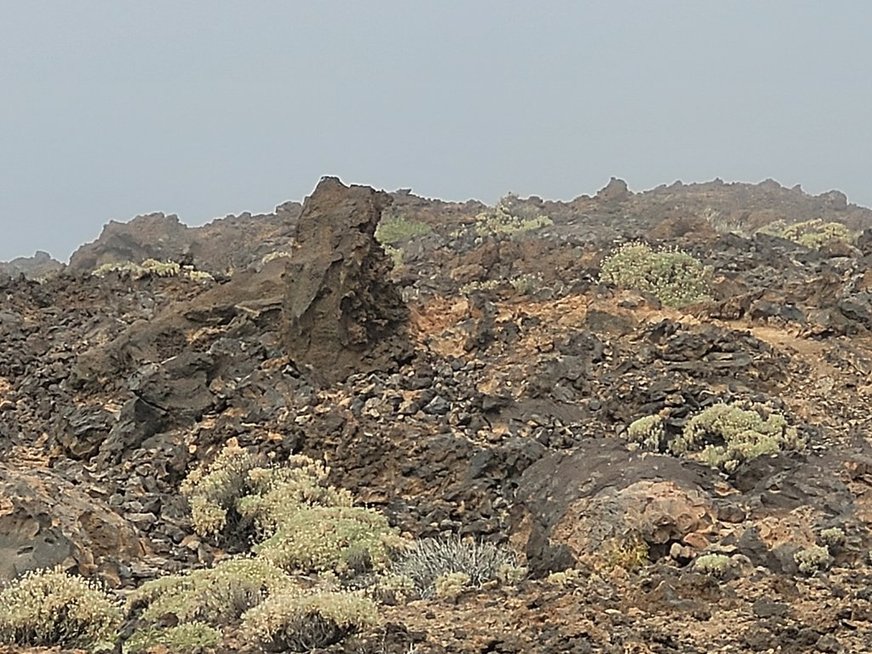
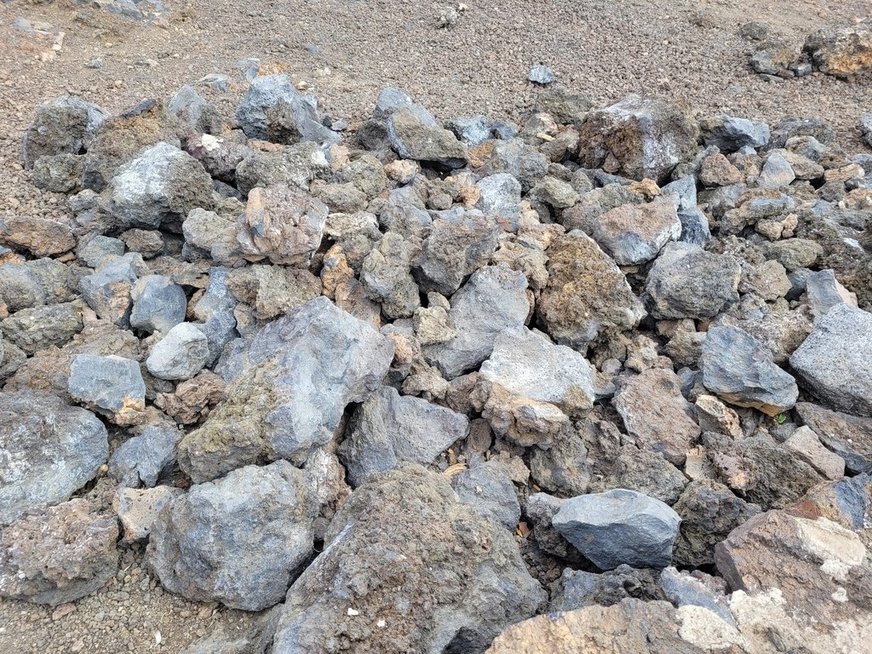
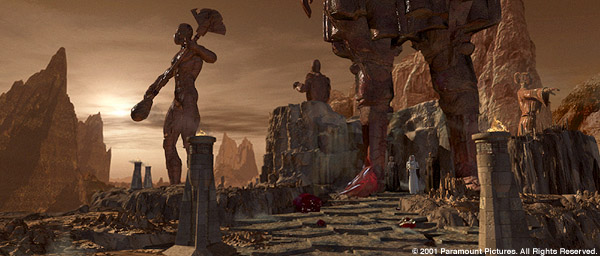
Author's Notes: Mount Teide National Park on Tenerife, as seen on Saturday January 20th 2024, is a good example of some of the terrain on Vulcan.

 "Vulcan - like going to a monastery or Abbey; a punishment of silence and emotional repression that surfaces every seven years. Vulcan itself? Irrepressibly hot; full of clones that repress their emotions. The deserts are beautiful and the architecture impressive. The people are just too afraid of their passions to feel them." - Cadet Nathaniel Hawkins.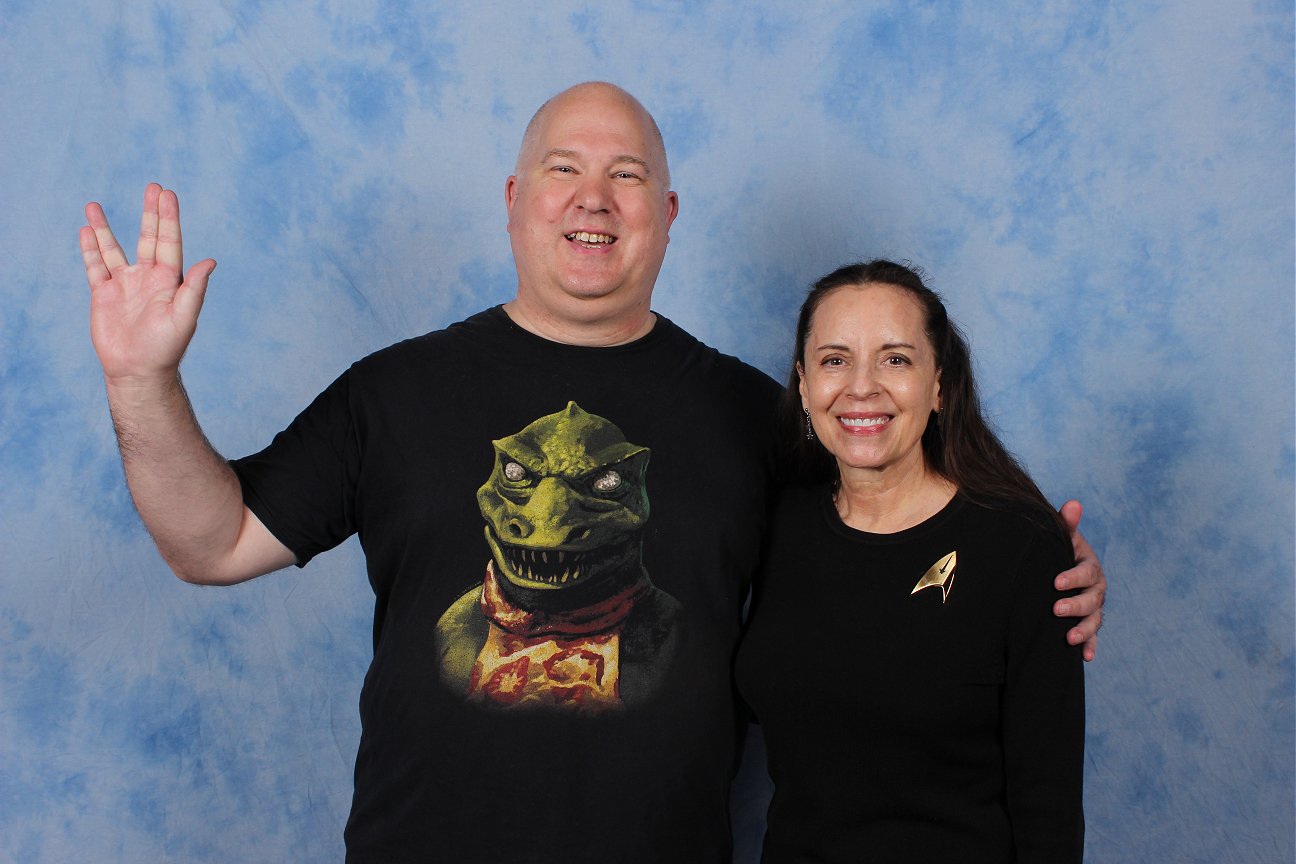
 Vulcan society is a fascinating mixture of logic and ritual. Vulcans are a telepathic race, their mental skills are considered to be amongst the most powerful of the Federation races. Vulcans are physically stronger from the higher gravity of Vulcan compared to Earth. Some inform Vulcans of a certain age practice ritual suicide. Vulcan youths are taught mental discipline by vulcan masters. These teachings ultimately give a Vulcan mental control over their emotions, trained mental skills such as mind-meld and the Vulcan Nerve Pinch as well as an almost unparalleled concentration and problem solving ability. Emotional displays are frowned upon in Vulcan society. Every seventh year of his adult life, a vulcan male must endure the fires of Pon Farr, when the mating impulse overpowers even the mental discipline of a vulcan. During this time a vulcan must mate or die. Vulcans have their mates selected for them at age seven, at this point the two are bonded telepathically: to return to be bonded later in their lives.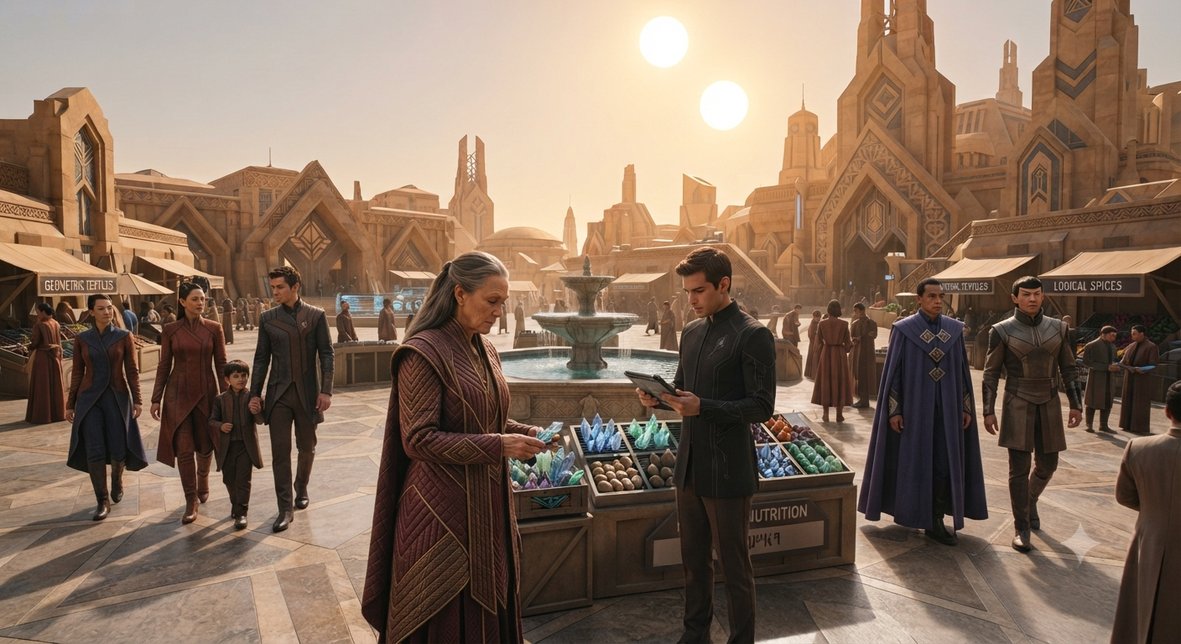

 Vulcan Farming
 4. How They Protect Agriculture From Electromagnetic Storms
 5. Electromagnetic Storm Countermeasures
 3. Canyon-Integrated Microfarms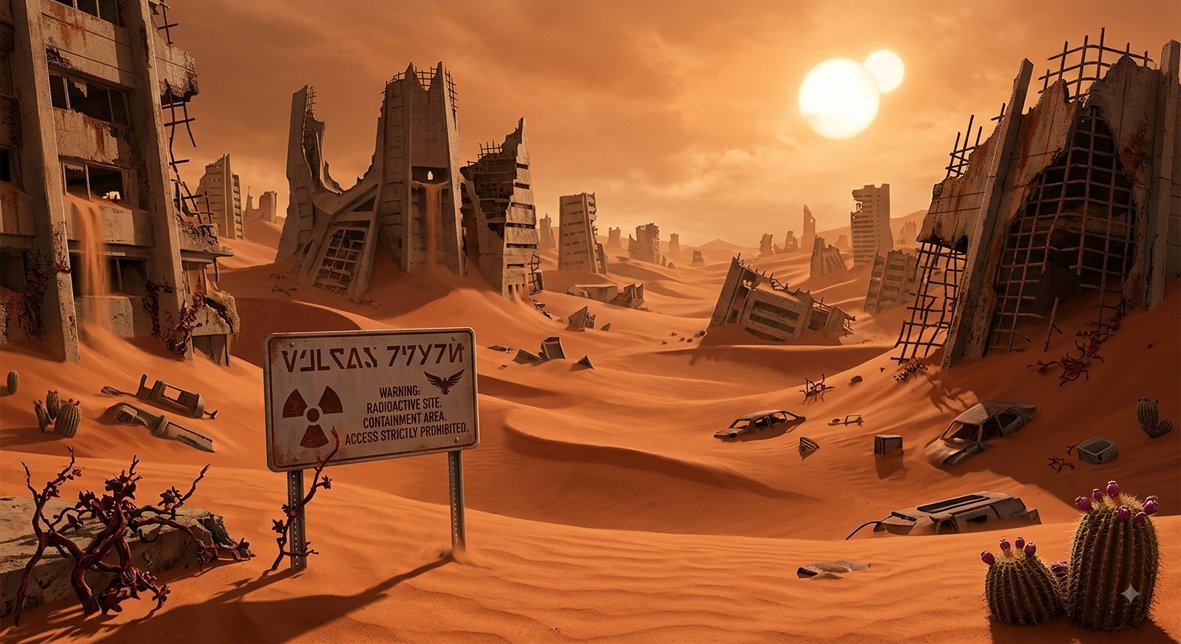

 Education
 3. Pacifism and the sanctity of life
 I — The Foundations of Logic
 V — Infinite Diversity in Infinite Combinations (IDIC)
 Chapter II — The Nature of Emotion
 Chapter VII — The Katra and Continuity of Consciousness
 Origins and Philosophy
 Philosophical Meaning
 6 — Katra as Communal Continuity vs. Rare Spiritual Practice
 Vulcan Factions and Their Interpretations of Surak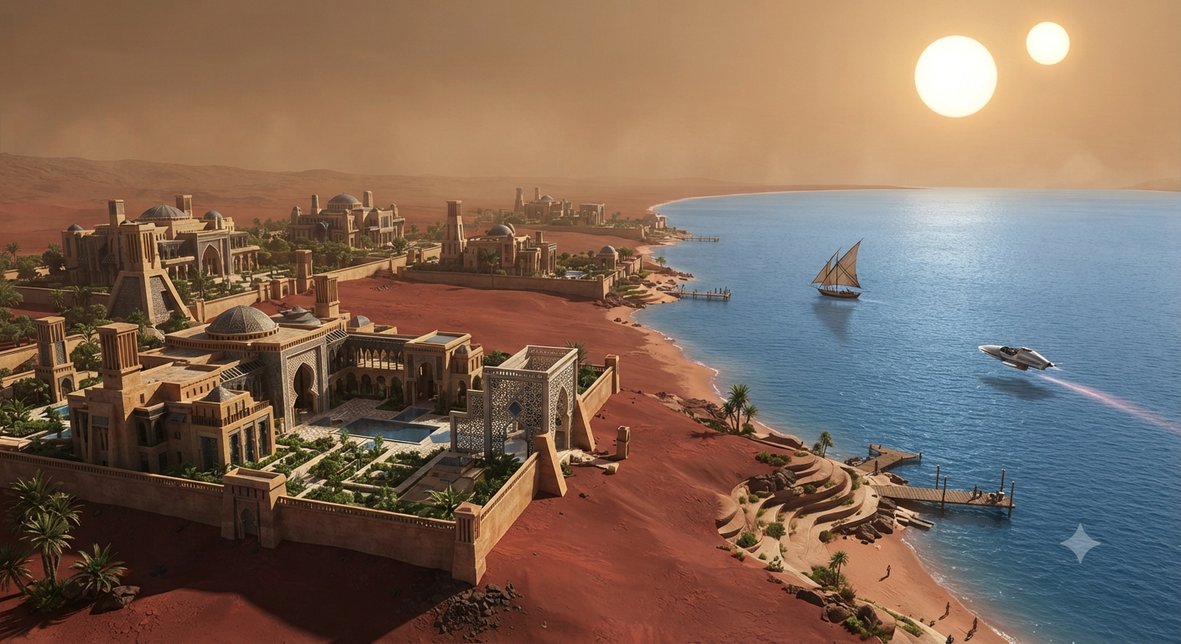
 Mind melds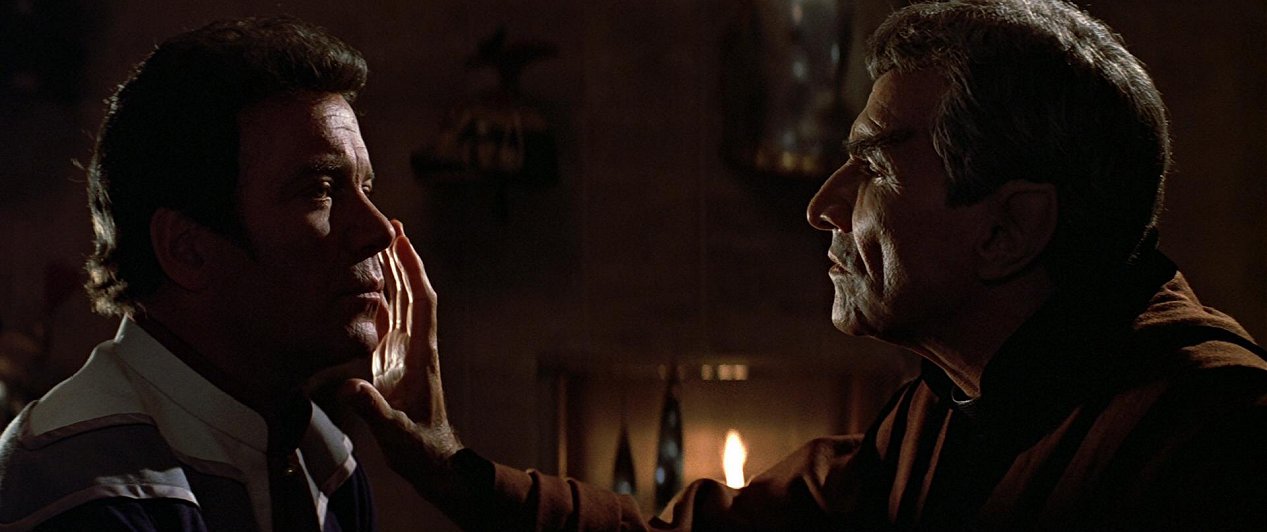
 Vulcan neuropressure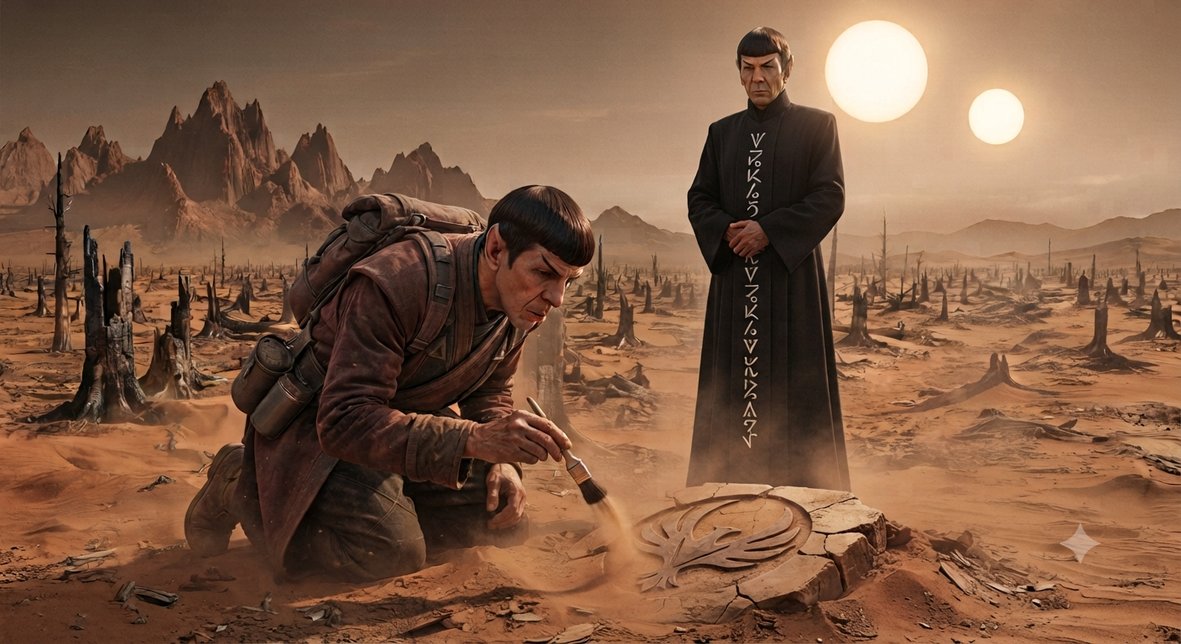
 Vulcan politics
 Notable Vulcans:
 Author's Notes: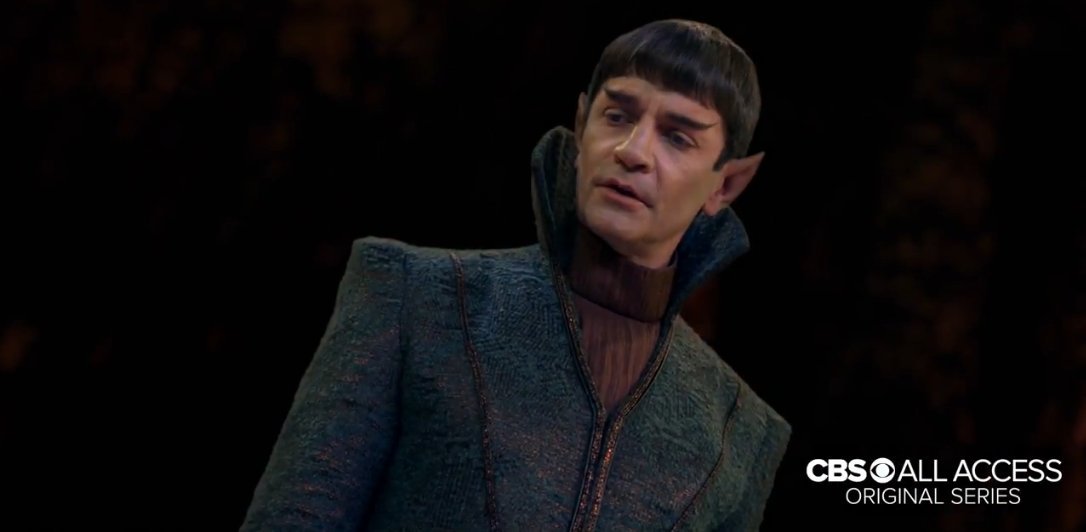
 I always thought that I would not have as much of Vulcan, feeling like the climate wouldn't be my favourite personally. In light of having now had four holidays in Egypt, I think I might fare a little better than at first thought. Like the Klingons, we actualy know less about the Vulcans than we think. Some of the best Star Trek episodes and movies, including Star Trek III, Star Trek (2009), Amok Time, Unification, The Forge, The Awakening and Kir'shara amongst them. The Interim Years will explore more about this logical race.
 The JJ Abrams and Star Trek: Discovery productions have moved forwards with the look of the Vulcan wardrobe, moving away from the flowing cloaks of the classic Star Trek series and movies to a more practical look for the 23rd and 24th Centuries. The asymmetrical suit designed for Spock Prime in the 2009 Star Trek movie (see right) is an example of this. As with each new Star Trek series and movie, so the Vulcan race has become more detailed and shown to have a wider culture than was first shown in the 1960s.